Six New Guides for University Teaching with a Gender Perspective
The collection “Guides for University Teaching with a Gender Perspective” expands its resources with six new publications offering concrete tools for reviewing courses and fostering inclusion in the classroom.
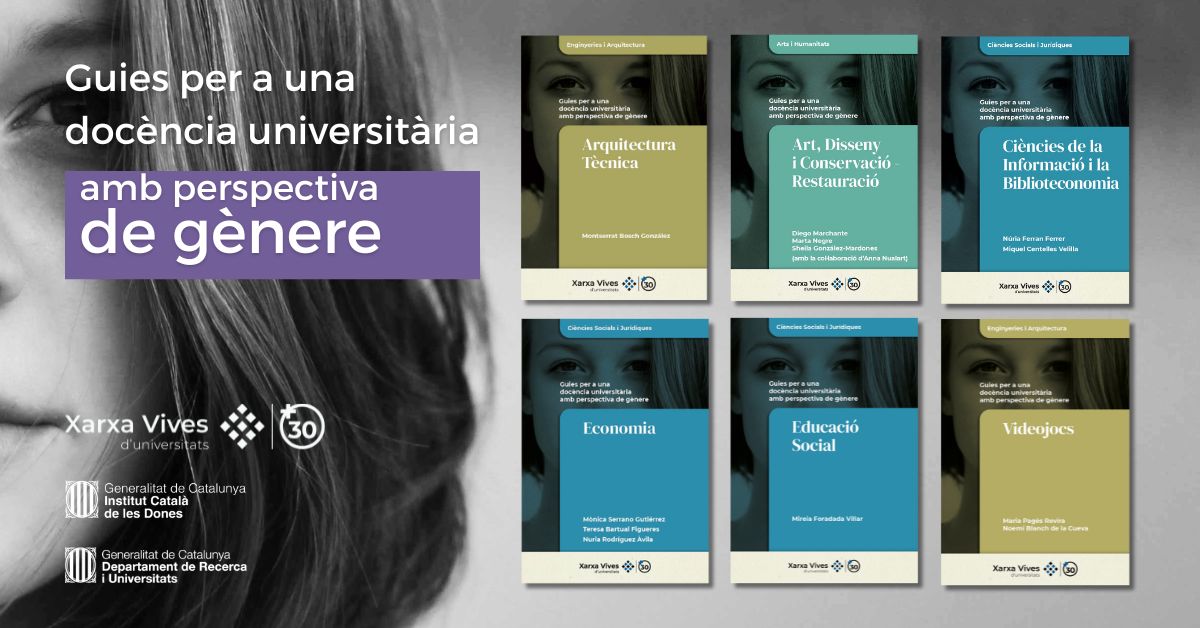
The Xarxa Vives presents six new guides corresponding to the 6th phase of its collection, which now includes 11 works covering various disciplines and fields of knowledge. These guides provide recommendations on incorporating the gender perspective into objectives and content, examples, language, sources, teaching and assessment methods, as well as the management of the learning environment and its outcomes. Their goal is to provide faculty with resources that enable them to identify and address gender dynamics in the classroom, andocentric biases, and to ensure the consideration of students’ diversity.
The six new guides published are:
-
Technical Architecture – Montserrat Bosch González (UPC).
-
Art, Design and Conservation-Restoration – Diego Marchante Hueso, Marta Negre Busó and Sheila González Mardones (UB).
-
Information Science and Library Studies – Núria Ferran Ferrer and Miquel Centelles Velilla (UB).
-
Social Education – Mireia Foradada Villar (UAB).
-
Economics– Mònica Serrano Gutiérrez, Teresa Bartual Figueres and Nuria Rodríguez Àvila (UB).
-
Video Games – Maria Pagès and Noemí Blanch (UPC).
The UAB contributes to this phase with the Social Education Guide, prepared by Professor Mireia Foradada Villar from the Department of Theories of Education and Social Pedagogy. The guide emphasizes that Social Education is a discipline grounded in the principles of social justice, inclusion, and equality, acknowledging that “it is a field permeated by androcentric biases, dominant epistemologies, and practices that may reproduce gender inequalities and other forms of oppression.”
This initiative, published with the support of the Catalan Institute for Women and the Department of Research and Universities of the Government of Catalonia, provides university faculty with a theoretical and practical framework for incorporating the gender perspective in an intersectional and decolonial way, offering tools for the critical review of curricula, teaching practices, and the pedagogical relationship.
Students will be able to benefit from these tools to recognize gender stereotypes and social roles, develop critical thinking, and acquire skills for their future professional practice. Faculty can find guides for incorporating the gender perspective in various disciplines, available in Catalan, Spanish, and English.
More information about the collection and available guides can be found here.