Xavier Roqué forewords the Catalan edition of The world as I see it, by Albert Einstein
Almost a century after its first edition in German, The world as I see it, by Albert Einstein is published in Catalan with a prologue by Xavier Roqué, a researcher at the iHC and one of the main experts on the figure of Einstein in Catalonia. The work, considered a reference, explores a wide thematic diversity and offers a humanist vision of scientific knowledge, inseparable from philosophy, history and politics.
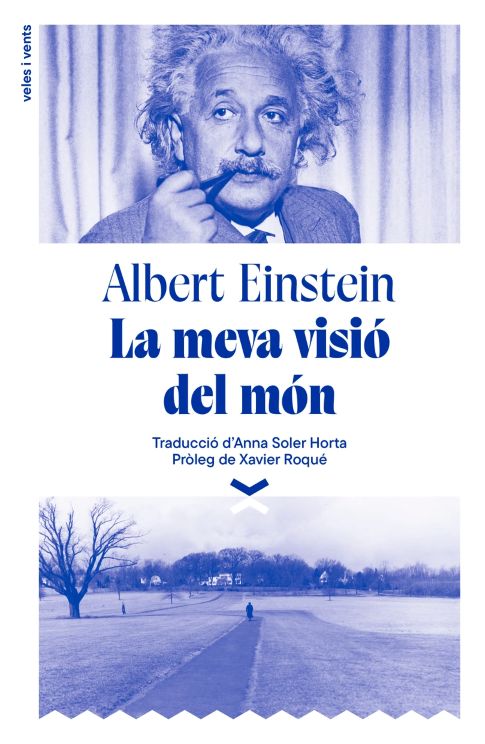
"If the contemporary scientist found the time and courage needed to examine calmly and critically the situation in which he finds himself and the work he is doing and to act accordingly, the prospects for a reasonable and satisfactory solution to the current dangerous international situation would improve significantly." With this reflection written by Albert Einstein in 1950 in his essay "On the degradation of scientific man", iHC researcher Xavier Roqué ends the prologue to the Catalan edition of The world as I see it, one of the most relevant works by the humanist scientist from Ulm and which the Veles i Vents publishing house has decided to incorporate into its collection "Mestres d'aixa" with the translation by Anna Soler Horta.
First published in German (Mein Weltbild) in 1934, and with a second, more extensive edition in 1954, The world as I see it is a collection of articles, letters and lectures by Einstein. Considered the canonical compilation of his thought, it has been translated into many languages. Through his texts, Einstein reflects on topics such as politics, philosophy and the Jewish question, showing at all times an open, pacifist attitude and totally opposed to the advent of Nazism, because of which he had to leave Europe.
The world as I see it has had a remarkable impact on the public understanding of Einstein's human, ethical, and philosophical figure, beyond his physical theories. It has shaped his image as a committed intellectual and as a thinker who reflects on peace, democracy, the role of religion and the moral responsibility of scientists. The book is, therefore, a direct window into Einstein's thought at a time when his worldwide fame made him an important reference point on both a scientific and social level.
The last section of the anthology should also be highlighted. Dedicated to the dissemination of Einstein's scientific findings and written in plain and understandable language, it has had a great influence on the popular reception of science.
And, returning to Einstein's initial reflection on the confidence in the capacity of scientists to deal with international problems, "we could say that it has been disappointed because these problems are not exclusively scientific. This is perhaps the most relevant lesson that Einstein's worldview offers today," concludes Roqué.
If you want to learn more about the relevance and validity of this work, don't miss Roqué's interviews:
Xavier Roqué talks with Alba Triadó in Radio Sant Cugat (09/03/2026)
Xavier Roqué talks with Marina Romero at the 3Cat tv show Mésnit (25/03/2026)
Xavier Roqué talks with Anna May at the book presentation that took place at the Science and Technology Library of the UAB (22/04/2026).