The Awards for the Best Bachelor's Degree Final Projects with a Gender Perspective reach their tenth edition with 32 awarded projects
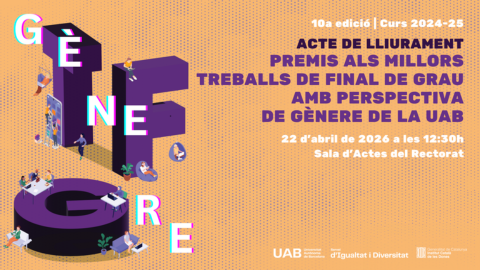
Last Wednesday, April 22nd, the Universitat Autònoma de Barcelona held the award ceremony for the Best Bachelor's Degree Final Projects (TFG) with a Gender Perspective for the 2024-2025 academic year, recognizing 32 academic projects from very diverse disciplines.
The call for entries originated from the agreement signed between the Catalan Institute of Women (ICD) and the UAB Faculty of Law for the 2014-2015 academic year, which established an award for the best final project in each of the Faculty's degree programs. From the following year onwards, the Equality and Diversity Service expanded the initiative to all UAB faculties, turning it into a transversal and institutional call. This year marks the tenth edition of the awards, a milestone that highlights the consolidation of this initiative as a benchmark for equality within the university community.
The awards pursue a dual objective: on one hand, to sensitize students to gender equality and non-discrimination by fostering their interest in critical and committed research; on the other, to promote the incorporation of a gender perspective in university teaching and consolidate gender as a legitimate and necessary object of academic and scientific interest across the UAB. Within this framework, the event was opened by the Secretary General of the UAB, Esther Zapater, and by Sònia Guerra, president of the Catalan Institute of Women, who framed the day based on their career paths and commitment to equality, and thanked the awarded students for their involvement in gender issues.
Following this, the awardees collected their diplomas and the set of feminist books prepared as a gift, and shared a brief presentation of their work. The students demonstrated remarkable research maturity and a reflective commitment to the gender perspective, with statements such as:
"Gender violence cannot be understood as an isolated phenomenon, but rather within a broader social, economic, and structural context."— Antonella Ruiz Salazar, from the Degree in Data Engineering with the TFG Data analysis on gender violence and risk classification in Barcelona neighborhoods using K-means.
"Obstacles include the fragmentation of the movement, reductionist notions of class, a hegemony of identity-based common sense, or self-referentialism. The question of how to articulate struggles within the same transformative and comprehensive political project is a very relevant issue not only in research but also from the perspective of social movements."— Estel Puigarnau Pino, from the Degree in Political Science and Public Management with the TFG Unity in diversity: the dialectic of class and identity. The case of the LGTBIA(Q)+ movement in Barcelona.
"The biomedical model is designed to exclude, punish, and normalize dissident corporalities."— Alex García Arranz, from the Degree in Medicine, with the TFG Bodies to hate: Biomedical vestige of the pathologization of the queer from Francoism to the present in Spain, 1970-2025.
The event concluded with words from the Secretary General, who positioned the gender perspective as the backbone of a university committed to equality. From the Equality and Diversity Service, we congratulate all the award winners for their contribution to the advancement of rigorous, inclusive, and socially situated university research. The presented works prove that the gender perspective is not an accessory methodological option, but an epistemological condition that enriches and deepens any field of knowledge. In this sense, the call not only recognizes academic excellence but also reaffirms the UAB's commitment to the production of critical knowledge and the training of a research community capable of questioning the structures that reproduce inequality.
You can consult all the awarded TFGs from this edition at this link.