Erika Giraldo Gallego wins the Hernández Morejón Prize for the History of Medicine
The Spanish Society for the History of Medicine has awarded Erika Giraldo Gallego, a doctoral student at the iHC, the prize for the best PhD thesis defended in 2025.
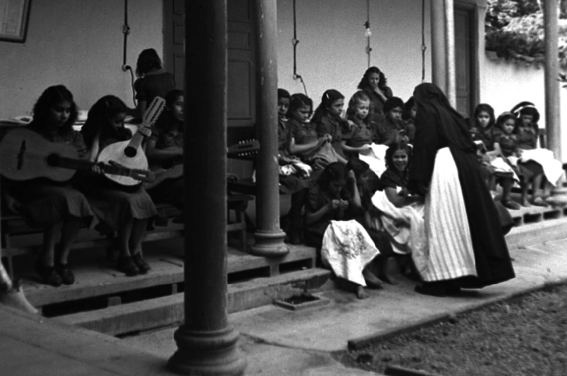
Since 1965, the Spanish Society for the History of Medicine (SEHM) has awarded the Hernández Morejón Prize for the best doctoral thesis, with the aim of encouraging research in the history of medical and health sciences. In its latest edition, the prize was awarded to Educar, medicalizar y corregir. Una aproximación desde las biopolíticas y el género a la construcción de las infancias anormales en Antioquia Colombia. 1920-1948 ("Educating, medicalizing, and correcting: An approach from biopolitics and gender to the construction of abnormal childhoods in Antioquia, Colombia, 1920-1948"), the thesis developed by Erika Giraldo Gallego within the PhD program at the iHC, supervised by Celia García Díaz (University of Málaga) and Carlos Tabernero Holgado (iHC-UAB).
This doctoral thesis provides a history of how the category of "abnormal childhoods" was constructed in a local context: the Antioquia region of Colombia between 1920 and 1948, examining its relationship with a global design of diverse practices and knowledge that developed around the world and were adapted according to the needs and interests of the territory. This refers to the theories and practices that were applied in the Antioquia context in relation to the processes of medicalisation and normalisation of abnormal childhoods, for example, with the inclusion of the problem within the Mental Hygiene Movement or the psycho-pedagogical trends of special schools. The proposed hypothesis suggests that the category of "abnormal childhoods" was a social construct in which the hegemonic power participated, as did children as generators of knowledge.
The approach is taken from the perspective of social control through the description of a biopolitical framework that crystallised into a network of institutions (the Rafael Uribe Uribe, Tomás Cadavid Restrepo, Baldomero Sanín Cano and Escuela Hogar special schools, the Casa de Menores y Escuela de Trabajo and the Antioquia Departmental Asylum). This analysis was carried out from a feminist epistemological perspective, applying an intersectional approach to the sources, taking into account categories such as gender, social class and race in the construction of the idea of "abnormal childhood".