Jesse Olszynko-Gryn: Oral history and audiovisual sources
Event details
- Start: 24 Feb 2026 12:00
- End: 24 Feb 2026 15:00
- iHC Seminar room
In recent decades, the history of science has become more capacious. No longer centred around the professional scientist, it now encompasses a much wider range of previously sidelined agents, from technicians and activists to patients and consumers.
This expansion has opened new historiographical vistas, revitalizing the field. At the same time, it has drawn scholars out of the library and archive and into less familiar spaces. Increasingly, we find ourselves learning about the past not only from manuscripts but also from oral history and audiovisual sources.
Thourgh a series of case studies, Jesse Olszynko-Gryn, head of the Laboratory for Multimodal History in the Department Knowledge Systems and Collective Life at the Max Planck Institute for the History of Science, explores how historians of science might deepen their engagement with more-than-textual forms of research and communication, and what this could mean for the politics and ethics of the discipline.
This event is part of the “Workshops on Historiographic Tools” (WHITS) series. Aimed primarily at doctoral students, it is also open to the entire academic community. (Given the activity schedule, lunch will be provided on site.)
Workshop instructions
Attendees are encouraged to prepare a brief summary (3-5 minutes) of their research and how it relates to the theme of this workshop (i.e., do you or would you like to engage with oral history and/or audiovisual sources and, if so, what sorts of benefits and/or difficulties have you encountered or do you anticipate?).
The prior reading of the following publications is also recommended (you can request the texts from Laia.Torres.Casas@uab.cat):
Case study 1: Steve Sango’s family portraits
- Jesse Olszynko-Gryn, “These are my family portraits”: Learning to see people in stock images (of postwar mixed marriage) as whole people’, Ten.8, forthcoming.
Primary sources (optional)
- Stuart Hall, «Reconstruction work: Images of postwar black settlement», Ten.8 16 (1984), 2-9.
- Trevor Philpott, ‘Would you let your daughter marry a negro?’ Picture Post, Vol. 64, nº. 18, 30 October 1954, 21-23.
- Kenneth Little, ‘Mixed marriages’, Getting Married (BMA, 1959), 74-77.
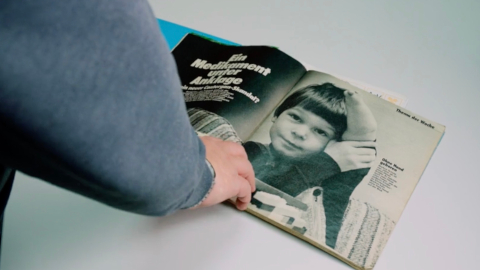
Case study 2: The Duogynon Affair
- Jesse Olszynko-Gryn et al., ‘Learning with patient campaigners about a German drug scandal’, Berichte zur Wissenschaftsgeschichte, forthcoming 2026.
Caste study 3: My grandmother’s oral history interview
- Noah Shenker, ‘Through the lens of the Shoah: The Holocaust as a paradigm for documenting genocide testimonies’, History and Memory 28 (2016), 141-175; (pp. 146-161 recomanat pel context).
- Anna Sheftel, ‘Talking and not talking about violence: challenges in interviewing survivors of atrocity as whole people’, Oral History Review 45 (2018), 288-303.
- Anna Sheftel, ‘Kaddish for unasked questions: On interviewing my father’, Holocaust Studies 30 (2024), 650-662.
Optional general readings:
- Peter Galison, ‘Visual STS’, in Annamaria Carusi et al., Visualisation in the Age of Computerization (Routledge, 2014), 197-225.
- Anna Sheftel and Stacey Zembrzycki, ‘Who’s afraid of oral history? Fifty years of debates and anxiety about ethics’, Oral History Review 43 (2016), 338-366.
- Courtney E. Thompson and Kylie M. Smith, ‘Introduction: A field guide to doing less harm’, and Richard A. McKay, ‘Becoming an ethical historian’, in Thomson and Smith, eds., Do Less Harm: Ethical Questions for Health Historians (JHUP, 2025), 1-13, 17-27.
- Dmitriy Myelnikov, ‘Where do we fit? Some reflections on practice, project design, and interpretation’, Berichte zur Wissenschaftsgeschichte, forthcoming, 2026.