The iHC presents its research at the most important international congress on the history of science in 2026
A group of twenty members from the iHC participated in the first joint meeting of the European Society for the History of Science and the Society for the History of Science, a congress that has brought together nearly 2000 historians of science, technology and medicine in Edinburgh.
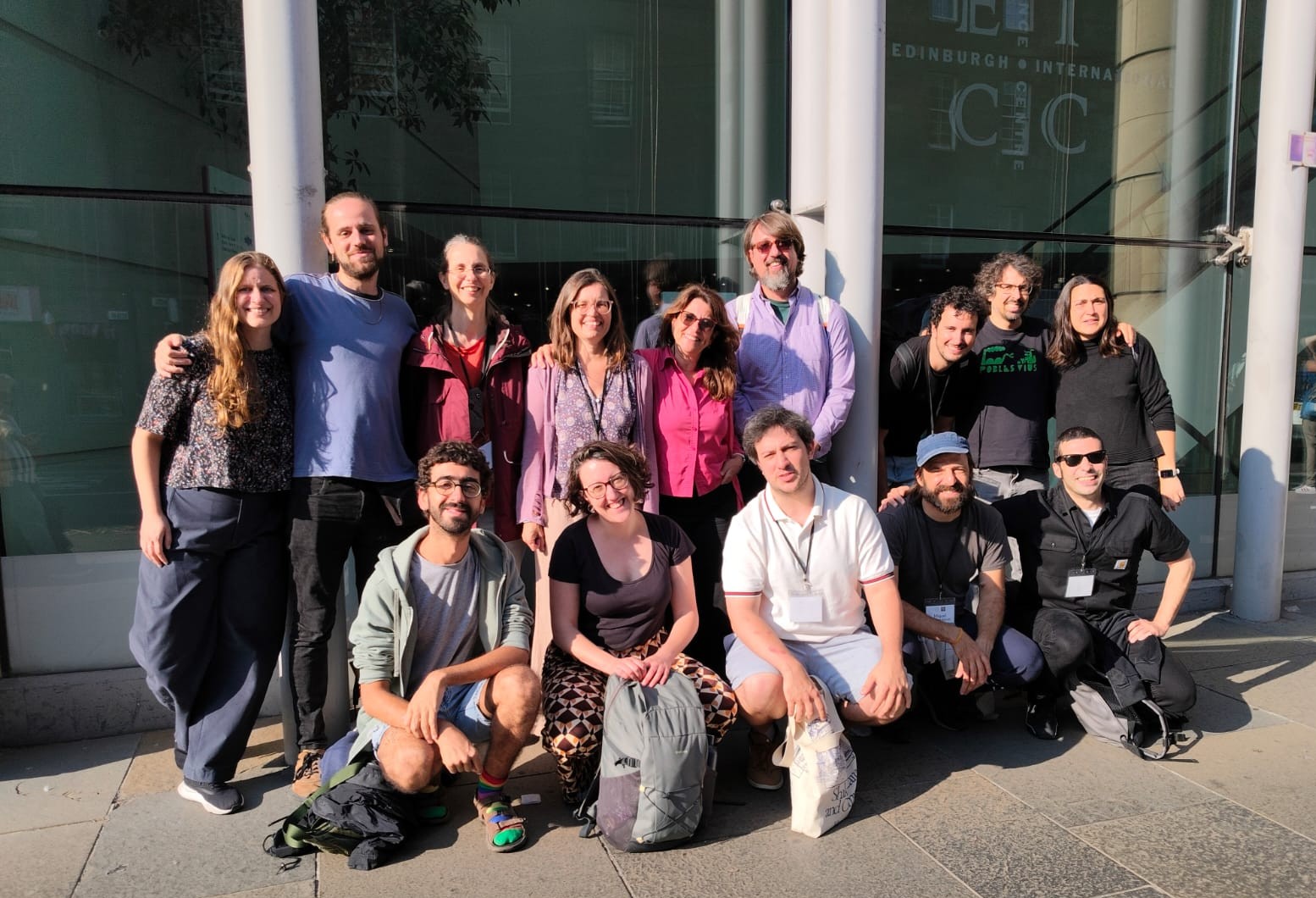
From July 12 to 16, the first joint meeting of the European Society for the History of Science (ESHS) and the History of Science Society (HSS) was held in the Scottish city of Edinburgh, with the support of the British Society for the History of Science and the collaboration of the National Museum of Scotland and the University of Edinburgh.
Under the theme "Shifting perspectives: Plural worlds, contested sciences", the meeting offered a space for transnational dialogue among nearly 2,000 researchers from more than 30 countries, and was articulated through an extensive programme of activities with more than 500 proposals (workshops, conferences, symposia and exhibitions, among others). The iHC presented much of its current research through the contributions of a group of 20 researchers.
Carolina Granado, Laia Iturrizaga and Jaume Valentines participated in the symposium "Activist epistemics and artefacts: Facing science while making science" (sessions 1 and 2), focussed on the intersection of science, activism, and sociotechnical innovation throughout the long twentieth century. The symposium highlighted how activists, social movements and local communities have become epistemic actors while resisting science through local and transnational networks, thus becoming a driving force of sociotechnical innovation. Granado spoke about the interaction between environmental defense organizations and international climate assessment bodies such as the IPCC, and Valentines addressed the debates surrounding the social, environmental, and economic impact of biogas production.
In the session "Science, technology and politics in the 20th Century" Jaume Sastre presented an article which looks at Portuguese colonialism in Mozambique through the lens of the technoscientific practices associated with the materiality of infrastructures such as the road network. And in the session dedicated to "Museums of 'Modern' Science" Roger Fernàndez presented his work on the history and exhibition practices of the Catalan Cement Museum.
The panel “Shifting narratives in space science and technology” (sessions 1 and 2) encouraged historical accounts of space science and technology that move beyond explanations centred on superpower rivalry during the Cold War. Contributions that trace multiple and diverse trajectories, sites, actors, materialities, discourses and institutions that have been eclipsed by hegemonic space age historiography. From artificial satellites to data centres, telescopes, launching sites and orbits; from scientists to miners, amateur networks, journalists and international organisations; from environmental to life, physical or astronomical sciences; from design and manufacture to launch, sharing and use –there exist a myriad of yet-to-be-explored historical accounts of space science and technology. Grigorios Panoutsopoulos, Nicole Mikly, Hèctor Isern, Sebastián Díaz, Anna Drou, Andrea Alvarez Laorden and Gemma Cirac, who also moderated the session on "Science, politics and the nation", presented their work.
Through case studies on countries such as Finland, France, Greece, and Spain, the session dedicated to "The Palomares nuclear accident (Spain 1966) and its international impact" examined how the nuclear accident was received internationally and in different countries, and to what extent Franco’s dictatorship and the U.S. nuclear programme shaped dissemination of information through various channels and the construction of "nuclear cultures". Miquel Carandell presented a paper analyzing the role of the Palomares accident in shaping nuclear risk perception in the Spanish public sphere and in the raise of the anti-nuclear movement.
Across the past two centuries, the physical sciences underwent profound social, cultural, and epistemic transformations. The symposium "Shifting perspectives: Diversity, geographies, and possibilities in the physical sciences" examined these shifts through diverse lenses: emotions, representation and visibility, scientific communities, and the role of communication. The presented papers, including Xavier Roqué's on "small science," argued for a more inclusive, critically reflective history of the physical sciences: one attentive to diversity, invisible labor, and the social conditions that structure knowledge production.
Monica Balltondre, Elena Serrano and Agustí Nieto-Galan participated in «Possessed, “crippled”, uncombustible: Bodies at the limit of technologies and genders», a session that explored the epistemic, political, and cultural construction of embodied experiences that appear to break boundaries, which helps us understand the role of bodily experience in the construction of science.
Balltondre spoke about female mediums in their role as go-betweens who moved between two or more different cultures; Serrano about an "Incombustible Man"'s abilities and their relationship to material culture and ideas about life and heat; and Nieto-Galan brought to the fore still-unknown aspects of Guttmann’s spinal cord injury treatments. Nieto-Galan also moderated the session dedicated to "Citizen science in a global perspective," and Serrano moderated the one entitled "Beauty matters: Contested Arts, contested sciences in the premodern world".
The articles presented in the symposium "The making of psychotherapeutic knowledge: Research practices, epistemic cultures, and disciplinary negotiations" (sessions 1 and 2), such as Catriel Fierro's on the interwar period, examined how psychotherapeutic knowledge has been produced, circulated, negotiated, transformed, and contested across different disciplinary, institutional, and cultural contexts.
The session “Raising exceptional children: Psychology, education, and motherhood” examined how scientific, pedagogical, and cultural discourses and practices in Europe and Argentina shaped ideas of childhood, motherhood, talent, and exceptionality between the late nineteenth and early twentieth centuries. Victoria Molinari participated with her work on the writer and feminist Concepción Gimeno de Flaquer (1850–1919), who theorized the relationship between motherhood and genius within debates on degeneration and national regeneration.
And, going even further back in time, the panel “Contested conceptions of Atlantic animals I” explored Iberian cultural conceptions of both land and sea animals in the Atlantic Ocean and on Atlantic islands in medicinal practice, naming, religious, and social attributes in the early modern period. Tasio Rodrigo presented his research on the treatise published in 1759 by the music theorist Caetano Melo de Jesús and its influence on European interpretations of the behavior of American species.