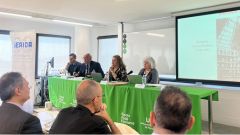
APTITUDE-PROXI promotes an innovative model in Catalonia to prevent dependency in the elderly
The Health and Ageing Foundation promotes the APTITUDE-PROXI project in Catalonia, a cross-border initiative that focuses on early detection and social prescription to prevent dependency in people over 60, in collaboration with primary care and community resources in Badalona and Maresme.
16/12/2025
The APTITUDE-PROXI project, launched by the Fundation for Health and Ageing of the Universitat Autònoma de Barcelona (FSiE), is rolling out an innovative model aimed at reducing the risk of dependency in people over 60, based on early detection and comprehensive care, in line with the World Health Organisation's (WHO) strategy for integrated care for older people (ICOPE).
APTITUDE-PROXI is a cross-border initiative being carried out in Andorra, France and Spain, led by the Centre Hospitalier Universitaire de Toulouse (CHUT) and co-financed at 65% by the European Union through its Interreg POCTEFA programme. The project includes the participation of partners such as Navarrabiomed, the FSiE and the Servei d’Atenció Sanitària d’Andorra (SAAS).
The main objective of the project is to identify early alterations in the intrinsic capacity of older people, a concept defined by the WHO as the combination of all physical and mental capacities of a person, including locomotor, cognitive, psychological, visual, auditory and metabolic capacities.
Five pilot centres in Badalona and Maresme
In Catalonia, the FSiE has coordinated the implementation of the project in five pilot centres in Badalona and Maresme, in collaboration with the Primary Care Management and in the Barcelonès Nord and Maresme Community of the Catalan Institute of Health (ICS), and with Badalona Serveis Assistencials (BSA).
Professionals from the Primary Care Teams (EAP) of Ocata-Teià and El Gorg (ICS), as well as the EAPs of Nova Lloreda, Morera-Pomar and Montgat – Dr. Jardí (BSA), have participated in the pilot programme by forming specific teams dedicated to the prevention of dependency. To date, the project has allowed assessing the intrinsic capacity of more than 200 older people.
The intervention is structured in four key steps—screening, in-depth assessment, personalised intervention plan, and follow-up or referral—to which is added a fifth cross-cutting step of social prescription. This component integrates sports, cultural, and social activities within an individualised plan, with the aim of strengthening the bond with the community and promoting active ageing.
Art and movement as a health resource
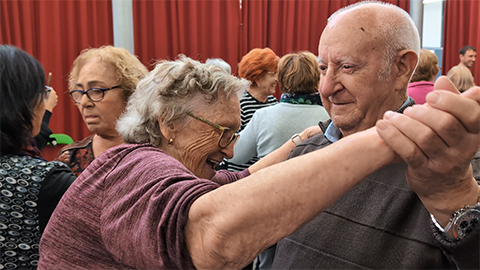
Among the activities carried out within the framework of the project is the “Dit-Dit” artistic activity offered by the CondeGalí collective in collaboration with Nilak in Badalona and Ocata. The activity brought together more than 60 people, including EAP professionals, pilot participants and key agents of the region's healthcare system.
Guided by four dancers and with live piano music, the proposal generated a space for meeting and shared expression, fostering enjoyment, nostalgia and emotional connection. Aimar Pérez, dancer, choreographer and co-director of CondeGalí, explains that “Dit-Dit is a practice designed so that participants can enjoy the movement of the body in a safe and judgment-free space”. According to Pérez, “touch is the point of support and anchorage from which we begin the practice to explore the freedom of movement”.
The initiative also has a direct impact on health. Júlia Ferrés, occupational therapist, researcher at the FSiE and head of the APTITUDE-PROXI project, points out that “music and movement stimulate attention and memory, improve balance and strengthen social connection when practiced in a group”. Ferrés stresses that carrying out these activities in community spaces “is an effective way to promote active and healthy ageing outside of the strictly healthcare environment”.
A model with international projection
APTITUDE-PROXI contributes to preventing dependency and improving the quality of life of older people and their families, while highlighting international collaboration and innovation in integrated care. Its adaptable and cross-border nature opens the door to replicating the model in other regions, bringing health and community care closer to the people who need it most.