The Faculty of Law participates in the CCW GGE sessions in Geneva
The UAB Faculty of Law, through the Manuel Ballbé Chair, has participated in the sessions of the Group of Governmental Experts of the Convention on Certain Conventional Weapons held in Geneva from 2 to 6 March 2026. The aim is to contribute to the international debate on the regulation of autonomous weapons systems based on artificial intelligence.
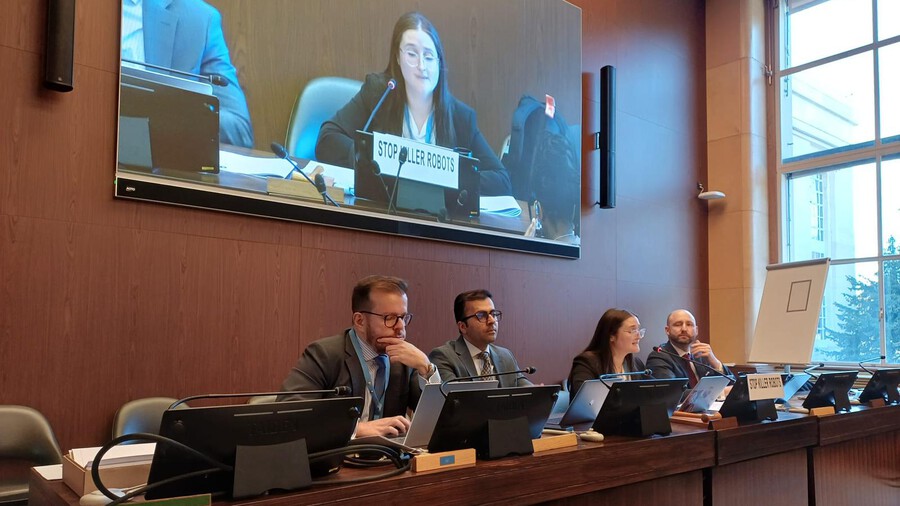
The first 2026 sessions of the Group of Governmental Experts (GGE) of the Convention on Certain Conventional Weapons (CCW) have once again positioned Geneva as a global meeting point for discussions on the regulation of autonomous weapons. From 2 to 6 March, delegations from 128 states, international organizations and independent experts resumed negotiations considered crucial for advancing towards a future international instrument on AI-based weapons systems.
In this context, the Manuel Ballbé Chair in Human Security and Global Law, linked to the UAB Faculty of Law, was present through the participation of ICRAC (International Committee for Robot Arms Control), one of the most prominent expert voices worldwide advocating for strong regulation focused on the protection of people. Professor Joaquín Rodríguez, a member of ICRAC and accredited academic observer, actively participated, together with Abdulkarim Baybah, a doctoral candidate in the PhD Programme in Human Security and Global Law, who also contributed to monitoring and support activities.
A key year for the governance of autonomous weapons
The chair of the GGE, Ambassador Robert in den Bosch, stressed the urgency of advancing towards a binding international framework. Although there is broad consensus that International Humanitarian Law applies to autonomous weapons systems, “specific standards remain virtually non-existent,” which increases the risks associated with rapid technological development.
This lack of standards has prompted the active involvement of civil society and expert communities such as ICRAC, which call, at a minimum, for:
- the establishment of positive obligations ensuring meaningful human judgement;
- the prohibition of systems that cannot guarantee adequate human control;
- requirements for transparency, oversight and accountability.
Contributions from Professor Joaquín Rodríguez and ICRAC
During the March session, Professor Rodríguez contributed to the preparation and advocacy of ICRAC’s proposals, structured around three main areas:
1. The structural risks of lethal autonomy
ICRAC emphasizes that autonomous weapons systems entail not only technical challenges but also systemic risks for international stability, conflict escalation and the dehumanization of warfare.
2. The need to guarantee meaningful human control
In line with the current Rolling Text, ICRAC advocates the creation of a clear legal standard ensuring that decisions on the use of force and target selection remain human responsibilities in all circumstances. This is one of the central issues under discussion within the GGE.
3. The ethical and democratic dimension
Professor Rodríguez highlighted that the governance of military AI is also a matter of democratic values. The introduction of automated systems in critical functions may alter the balance between institutions, citizens and the armed forces, making a transparent, participatory and auditable framework necessary.
Abdulkarim Baybah, a doctoral candidate from our Faculty, also attended the sessions, supporting research tasks, document preparation and monitoring of the discussions as part of the ICRAC team’s work.
The role of the Manuel Ballbé Chair in the global debate
The participation of the Manuel Ballbé Chair reflects its mission: to promote critical, interdisciplinary and public-interest-oriented analysis of emerging technologies and human security. Presence in Geneva makes it possible to:
- introduce academic perspectives into spaces where international norms are shaped;
- strengthen alliances with global actors such as ICRAC and Stop Killer Robots;
- ensure that the voices of civil society and academic research are represented.
The pace of work during 2026 will be intense and, despite consensus on the need to move forward, it appears difficult to meet the United Nations timetable for adopting a binding instrument before the end of the year.
Looking ahead
From the Faculty of Law and the Manuel Ballbé Chair we will continue working to ensure that future regulation guarantees:
- the protection of human rights,
- the prevention of uncontrolled technological risks,
- and an international order based on responsibility, ethics and human dignity.
The participation of Professor Joaquín Rodríguez and doctoral candidate Abdulkarim Baybah in Geneva reaffirms our Faculty’s commitment to the global governance of artificial intelligence and to the promotion of a human-centred approach to security.