The UAB participates in a project to strengthen the link between journalism and media literacy
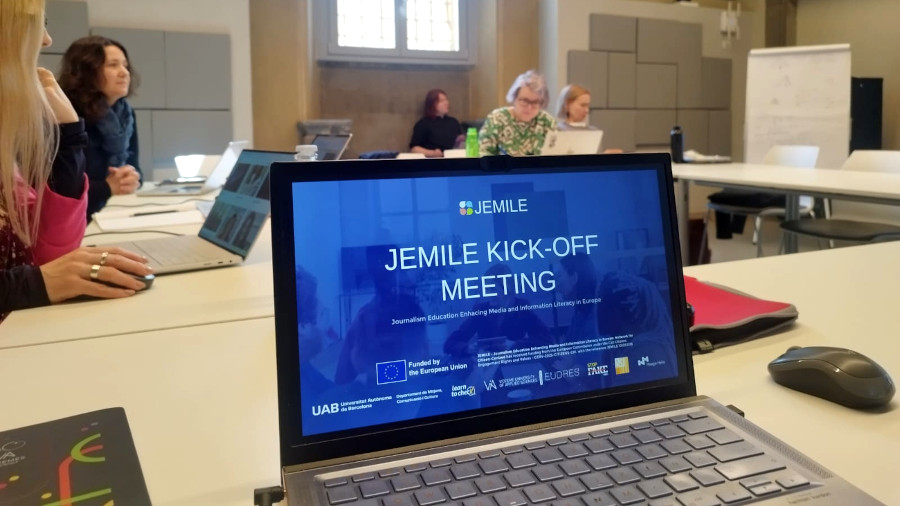
Four universities, including the UAB, and two NGOs from Finland, Latvia, Romania, Spain and Ukraine launch the JEMILE project, funded by the EU, with the aim of placing information literacy at the heart of journalism training and practice. The kick-off meeting took place this week in Florence.
The project Journalism Education Enhancing Media and Information Literacy in Europe: Network for Citizen-Centred Engagement (JEMILE) aims to tie journalism and media and information literacy better together. The professor of the Media, Communication and Culture department, Nereida Carrillo, is the IP of the project at the UAB. Disinformation has been identified as a major global risk and a threat for democracies and human rights. While efforts are being made to monitor disinformation through various observatories and the work of fact-checkers around the world, little has been done so far to innovate and improve the quality of European journalism practice and training to counter disinformation.
This project aims to improve the quality of journalism by adapting it from the ground up to new challenges, training journalism teachers and students in universities, and making them accountable for bringing media and information literacy (MIL) to society. These are indispensable methods in rebuilding trust in news that can help democratic participation and promote civic engagement. The focus of the project is placed on the participation of regional and local civil society organisations.
Four universities and two NGOs from Finland, Latvia, Romania, Spain and Ukraine launch this project, funded by the European Union under the call Citizens, Engagement, Rights and Values (CERV). Haaga-Helia University of Applied Sciences (HHUAS, Finland) is the leading partner of a consortium also formed by the Universitat Autònoma de Barcelona (UAB, Spain), Babeș-Bolyai University (BBU, Romania), Vidzeme University of Applied Sciences (ViA, Latvia), Learn to Check (LTC, Spain), and Media Reforms Centre (MRC, Ukraine). The project will last two years and began with a kick-off meeting on 10 March in Florence, at the European University Institute. The Voices Festival concentrating on information literacy and journalism will bring up the same topics this week in Florence.
A network of journalism teachers and students for MIL
JEMILE will focus on strengthening MIL among diverse audiences as a key component of the professional journalistic expertise in strengthening trust in journalism via building knowledge, skills, and attitudes. Partners will explore how these competencies can be integrated into journalism education curricula and how it can be brought to pedagogic practices. The project employs a multifaceted approach centred around the “Train to Trainers” model, which aims to train journalism educators to develop and implement innovative media literacy training methods. A core aspect of the methodology is fostering collaboration between university-based experts and external journalism professionals, stakeholders and media NGOs creating an enriching synergy. Initially, face-to-face training sessions will be conducted with a core group of trainers who will then continue the dissemination of knowledge and skills through participation in different events, hence beginning with the formation of a Media Literacy Task Force. The project will actively involve stakeholders, researchers, professional journalists and NGOs.
A second component involves training journalism students, utilising an approach that integrates journalistic practice with media literacy education. The goal is to reform journalism itself, making it more effective at reaching young audiences across diverse digital platforms, and fostering informal, collaborative learning environments where journalists and audiences can learn from each other.
The third element is research, which will provide a solid evidence base for the project’s activities. JEMILE aims to counter disinformation, information manipulation, and interference in democratic discourse along with rebuilding trust in news and journalism.
Collaboration with key European Journalism Associations
The project will count on the collaboration of the most influential European Journalism Associations such as the International Press Institute (IPI) and the European Journalism Training Association (EJTA), grouping more than 80 journalism centers, schools and universities from about 30 countries across Europe, and the Forum for European Journalism Students (FEJS), an international organisation dedicated to the exchange of information between European Journalism students, young professionals, and even citizens interested in the journalism field. Other institutions and associations collaborating are Mohyla School of Journalism (Ukraine), the Latvian Platform for Development Cooperation (LAPAS), News Media Finland, and the Finnish Arts and Culture Agency.