MEMEnginy brings together 80 companies and 1,500 participants
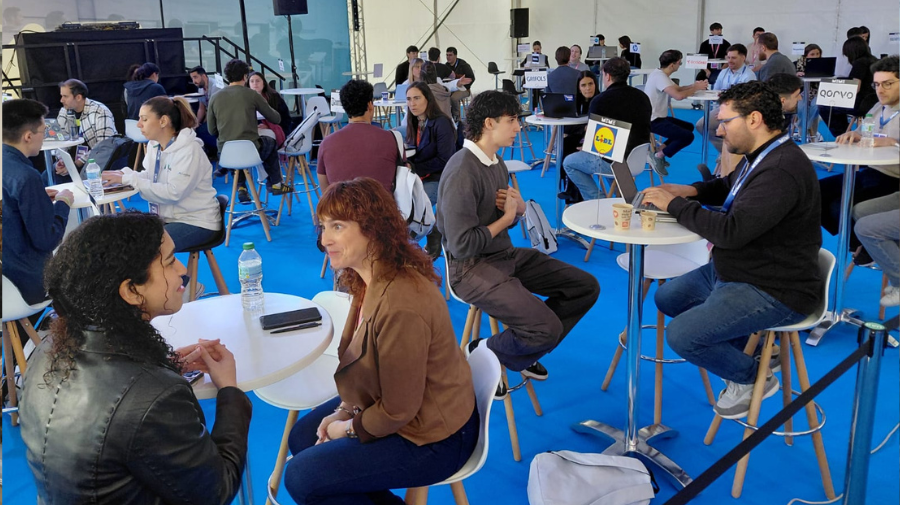
On 26 March the UAB School of Engineering held the 12th edition of MEMEnginy, a technology and engineering fair that connects students with companies during one whole day. This year included a new element, the MEMEnginy HUB, which matched the interests of students and businesses and set up brief interviews. Over 1,000 interviews were held in a day in which Roche, SEAT, HP, Deloitte, Accenture and JetBrains were some of the most sought-after companies.
A report from the Observatory of the School of Engineering analyses the aspirations and motivations of engineering students when entering the labour market.
The 12th edition of MEMEnginy, the UAB technology and engineering fair organised by the Engineering Student Council with the support of the management of the School of Engineering, took place on 26 March by Javier Lafuente, rector of the UAB; Ian Blanes, director of the School of Engineering; and Gerard Garcia and Aimé Moral, coordinators of MEMEnginy 2026.
It once again became the meeting point between companies and young talent in the Vallès region. In this edition, more than 1,500 participants registered and were able to interact with nearly 80 companies, attend specialised conferences, and take part in 1,000 short job interviews scheduled throughout the day. With the growing participation of students and companies, MEMEnginy has consolidated itself as one of the main spaces for connecting universities, young talent and technology companies in Catalonia and Spain.
A business-student match app
One of the innovative elements of this edition was the new MEMEnginy HUB application, which allowed students' interests to be matched with the profiles requested by companies. In this app, the student profile contains six sections (basic data, PDF resume, technical skills, languages, privacy settings, and professional preferences). The tool automatically creates a professional biography in Catalan, Spanish and English based on the data entered. In the companies section, students can consult the profile of each of the participating companies, discover the profiles they are looking for, and mark the companies with which they would like to have an interview.
Among the companies that aroused the most interest among future engineers were Roche, SEAT and HP, followed by technology and consulting companies such as Deloitte, Accenture and JetBrains.
Programme to foster work inclusion
For the second year in a row, MEMEnginy reinforced its commitment to inclusion through the HP Inclusion – MEME Impulses, a programme developed jointly with the company HP. This initiative accompanied neurodivergent students in accessing the labour market and consisted of holding preliminary sessions in small groups in which aspects such as preparing a resume, developing a personal presentation, and simulating real job interviews were worked on. At the fair, students received additional support during interviews with companies and adaptations were implemented, such as scheduling interviews in time slots with less participants and less noise.
Aspirations and motivations of future engineers
A report by the Observatory of the UAB School of Engineering was also presented under the framework of MEMEnginy. The report anslyses the aspirations and motivations of engineering students when entering the labour market. The study, based on a survey conducted in March with over 300 students, reveals that future engineers have very clear objectives and focus on professional growth and continuous learning.
One of the most striking findings is that students prioritise career challenge over salary. Two-thirds (66%) value responsibility and the opportunity to learn more than money when choosing their first job, while only 18% consider salary to be a key factor. At the same time, 69% highlight the importance of the work environment and relationships with bosses and colleagues, revealing that company culture is also an important aspect for young people of Generation Z.
In addition, six out of ten students already have defined their professional path, all the while showing remarkable flexibility. A total of 72% are willing to accept a job outside their initial vocation, demonstrating their ability to adapt to companies in the sector. And 77% attach great importance to continuous training, underlining their commitment to professional development.
Future engineers also show great motivation to entering the labour market quickly. More than half (57%) expect to find their first job in less than a year, and 18% are already working, demonstrating high employability. Regarding possible job changes, the decisive factor for accepting new opportunities is professional growth, while aspects such as teleworking or responsibility have less influence.
Student profile is characterised by adaptability, as they perceive themselves as professionals capable of adapting to different roles, rather than as specialised technicians. In terms of the type of company, half prefer to work in a multinational, although a third has not yet decided. In terms of job search channels, LinkedIn clearly leads, followed by professional fairs and events.
The UAB, with Sustainable Development Goals
 Quality education