Viviane Reding: “Citizens believe in democracy, but they no longer believe in political parties”
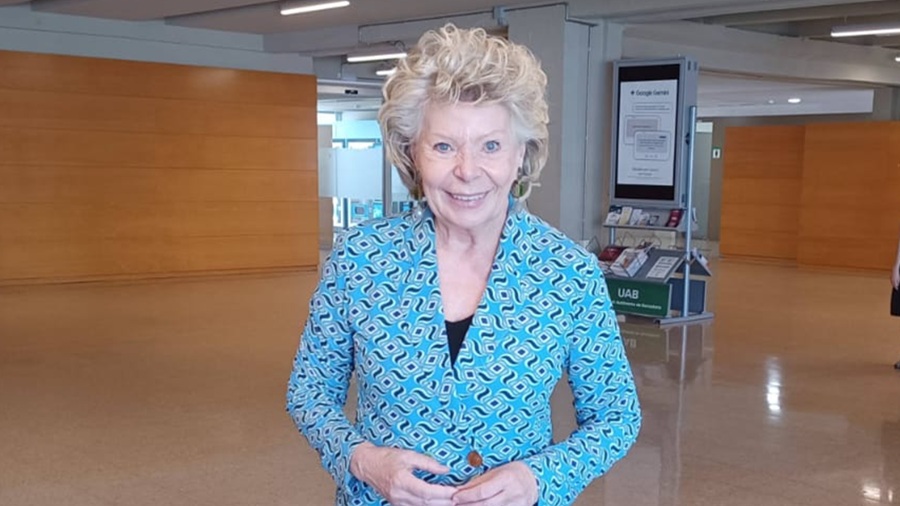
Former European Commissioner Viviane Reding took part in the closing session of the 2025/26 University Master's Degree in European Integration (MUIE) of the UAB. The event took place on 30 June at the Faculty of Law and included the attendance of Javier Lafuente, rector of the UAB; Esther Zapater, secretary general; and Ricardo Esteban, dean of the Faculty of Law. We took the opportunity to interview Reding about the current state of the European Union, the rise of populism and the far right, the United Kingdom, and the challenges facing the European project in a rapidly transforming global context.
After nearly four decades of close involvement with European institutions, how would you describe the current state of the European project?
It is important to recognise that the European project is never truly finished. The founding fathers of Europe determined that the European model would be built step by step, with each generation contributing further to its development. While there may be occasional setbacks, they tend to be minor. Conversely, there have been major strides—such as the EU’s largest enlargement or our efforts to protect our citizens during the coronavirus crisis—alongside smaller ones. Today, significant new steps are required because the overall landscape has changed. The first priority is security. For a long time, we did not invest in defence, believing that the enlargement process and the integration of former Soviet states would ensure lasting peace. We have since learned that this is not the case. It has become abundantly clear that Europe must build its own security. We need to increase our investment in defence and rely on ourselves rather than on unreliable partners. Europe must be sovereign in matters of security.
What other steps need to be made?
The second step we must take relates to technology. There has been significant technological development in recent years, but we have seen nothing yet—this is just the beginning. Making policy decisions regarding technology in a democracy is a slow process, and therein lies one of our problems, as technological development moves very quickly. We must therefore push ourselves to move faster in securing funding for technology. We have the money—currently sitting idle in banks—but we need to channel those resources into investments that support talent, industry, and sovereignty. If we do not want to fall behind in the technology sector, we must pick up the pace, invest, and take risks.
And while our European project is being built, what is currently the largest threat to European democracy?
I believe that the main threat to Europe today is populism. We are witnessing a significant rise in movements that have forgotten the past and history—movements that once led us into wars and are now beginning to grow again.
We see a growing increase in support for these populist and Euro-sceptic movements across Europe. Is the EU doing enough to explain to its citizens the danger of these movements?
I believe the way we communicate has changed significantly due to digital platforms. In these spaces, there is no room for explanations—only the three or four words that make up populist slogans—which makes it difficult for democracies to articulate their positions effectively. Yet, we must remember that this is the only way forward: we need to explain, explain, and explain again—using not the language of lawyers, but simple language that all citizens can understand. We also need to share more history, as I believe young people do not learn enough in school about modern history—about how Europe was repeatedly dragged into wars in the past and just how dangerous populism is. When I look at the polls, I realise that while citizens still believe in democracy, they no longer believe in political parties. Therefore, perhaps the task of communicating shouldn't fall solely on parties, but also NGOs, engaged citizens, and associations. We must restore a sense of security to the people and explain to them that democracy is built not only by political parties but also by citizens themselves.
Far-right parties using these populist slogans continue to gain support in the EU. In some cases, they are already in government. How should democratic institutions respond to this situation?
In some countries, they have already experienced what happens when these populist movements come to power, and they have quickly seen that their slogans are very different from reality.
Once they reach power reality has shown us that they no longer keep their promises?
I believe that when they come to power then you can see what they fail to do. It is crucial to keep in mind what was said and then look at the reality. The same applies to fake news: what is being said versus the actual reality? It is a very difficult task because the message must be repeated across all channels to reach the entire population. For instance, this happened in the United Kingdom when the public realised that everything promised by Brexit supporters was a lie. The result is that the UK now finds itself in a dire social and economic situation. It is also interesting to note that among young people—those who did not decide on Brexit—70% believe it is time to return to Europe. They do not believe what previous generations told them, because they have seen that it was false.
Is it realistic to think the United Kingdom could one day become part of the EU again?
Rejoining the EU would take time—just as it takes time for countries wishing to join—and would also require lengthy negotiations and legislative changes. However, I believe that, little by little, this younger generation—fed up with the mistakes of their parents and grandparents—will come to power, and negotiations between the EU and the United Kingdom will then move forward again.
So you are optimistic?
Yes.
Broadening the focus on the international landscape, the war in Ukraine, growing competition with the United States and China, and the situation in the Middle East have reshaped the global stage. Is the EU prepared to act as a geopolitical leader in this changing global context?
Europe is a geopolitical power. It is the world's largest organised market. It is also a very strong continent. Yet, if we look at the policies pursued by governments, we very often see that they are local, regional, and national in scope. Politicians must understand that when they act based on nationalism, they are very small and very much alone. In contrast, they are stronger when they integrate their regions and national policies into European solidarity. Even large nations are small when compared to the geopolitical challenges we must face. When we are united, we have a real opportunity.
In your speech at the closing ceremony of the UAB's University Master's Degree in European Integration, you spoke of the importance of alliances and joint collaboration. Is this the EU's strong point?
This is the only way to survive. If we want to be independent and possess European sovereignty, we must realise that we are stronger together. We are a true global power. Working together is the only answer, while always respecting diversity.
During your years at the EU, you have done a great deal to increase the presence of women in politics and the economy. However, despite the progress made, women remain underrepresented in certain positions of power. Do you believe the EU is making sufficient progress in gender equality?
We have been making rapid progress. Let us not forget that the President of the Commission is a woman, the President of the European Parliament is a woman, and the President of the European Central Bank is a woman. They are role models—very strong women who are doing an excellent job. We have also seen an increase in the number of women in parliaments and governments, as well as in leadership roles within the economic sector. However, I am deeply concerned about the technology sector. There, we see that the number of women is very low—between 8% and 9%. This is a problem because technology will play an increasingly decisive role in our lives. I would like to see more young women fascinated by learning about technology, applying it, and building the future, because the future will be technological.
How can we change this trend?
This change must be driven by national policies. Education systems need to manage to have more girls interested in technology. We see that girls are excellent students with great potential in primary school, but from the age of seven or eight, many begin to lose confidence. I believe we need to steer them away from dolls and encourage them to reach their full potential by sparking their interest in STEAM disciplines. We need these girls if we want to win the technology war.