Study reveals the genetic history of a medieval Jewish community in Catalonia
A pioneering study promoted by the Catalan Ministry for Culture and carried out by the UAB on victims of the Tàrrega pogrom of 1348 has for the first time traced the genetic history of a medieval Jewish community in the Iberian Peninsula.
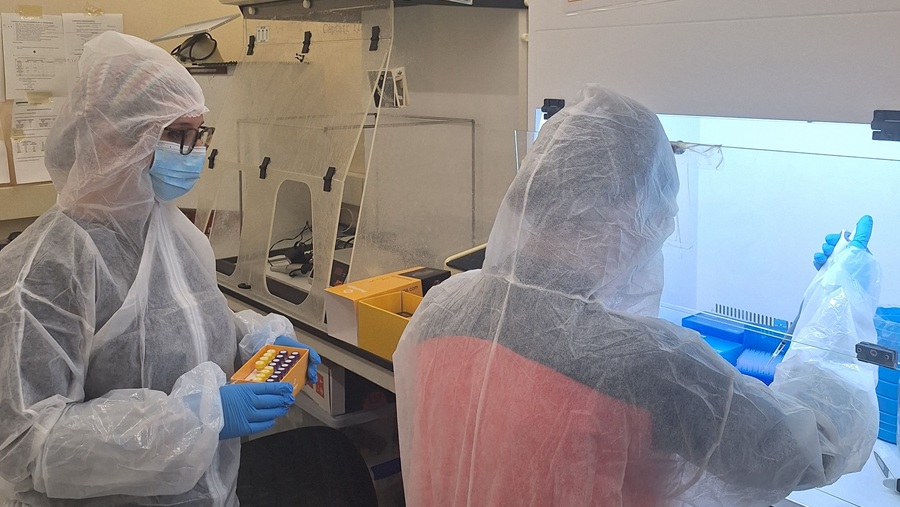
The research was promoted by the Directorate General of Cultural Heritage, and was carried out by a research team from the UAB's Biological Anthropology Unit, led by Cristina Santos. The work was published in a special edition of the journal Genes dedicated to new trends in population genetics and molecular anthropology.
The study was carried out on the skeletal remains of sixteen medieval individuals recovered in 2007 from mass graves in the necropolis of Roquetes de Tàrrega, Lleida, a funerary space related to the violent attack (pogrom) suffered by the city's Jewish community in 1348.
The results provide a detailed picture of the origin and composition of the analysed group, formed by both men and women. The main analyses indicate that they had a majority proportion of ancestry linked to populations of the Eastern Mediterranean, particularly to individuals from Canaan of the Bronze Age, the historical origin of the Jewish communities. The rest of the ancestry is explained by genetic contributions compatible with populations of medieval Iberian origin, the result of interactions inherent to the long history of coexistence in the Crown of Aragon.
The study also identified a high diversity of mitochondrial DNA, which is inherited only through the maternal line, with a dozen lineages historically documented in Jewish populations, and three paternal branches common in Jewish populations of the diaspora and with roots in the Middle East. "This diversity indicates that, despite its integration into medieval Catalan society, the community maintained its own biological identity and a strong continuity with the genetic flows of the Jewish diaspora", says Cristina Santos, lecturer at the Department of Animal Biology, Plant Biology and Ecology of the UAB.
The analysis of sections of the genome in which the two copies of DNA—that of the father and that of the mother—are identical “shows patterns compatible with a socially cohesive but not highly endogamous community, contrary to what has been seen in other studies carried out in the medieval Jewish communities of Erfurt, Germany, and Norwich, England, with a high rate of endogamy”, explains Cristina Santos. “These data enrich the knowledge of the demographic dynamics of Catalan Jews in the late Middle Ages”, she highlights.
The absence of kinship confirms the catastrophic nature of the graves
Previous archaeological and anthropological studies had indicated that the mass graves of Tàrrega showed clear evidence of violent death and a simultaneous mass burial, consistent with historical sources describing the deaths of approximately 300 members of the Jewish community of Tàrrega. Kinship analyses now reveal the absence of direct family ties between the individuals analysed, which, together with the simultaneity of the burials, confirms the catastrophic nature of the graves.
The study was carried out entirely in the UAB's Ancient and Modern DNA laboratory, equipped with specialised technology for the processing and analysis of highly degraded archaeological remains, applying state-of-the-art protocols and procedures. This has allowed the genetic profile of the analysed community to be reconstructed with unprecedented resolution in the Iberian context.
With this research, Catalonia is at the forefront of palaeogenomic research on medieval Jewish communities and positions itself as a leader in Europe in the study of ancient Jewish communities. The project consolidates the commitment of the Catalan government's Ministry for Culture to integrate the most advanced scientific methodologies in the study of archaeological heritage, and allows for a deeper understanding of a fundamental episode in the history of Catalan Judaism and for the collective memory of the country.
Reference article: Laura Pallarés-Viña, Daniel R. Cuesta-Aguirre, M. Rosa Campoy-Caballero, Núria Armentano, Anna Colet, Assumpció Malgosa and Cristina Santos. Uncovering a Medieval Pogrom: Genetic History of a Jewish Community in Catalonia (Spain). Genes 2026, 17, 358. https://doi.org/10.3390/genes17030358