Sant Pau de Riu-sec, new research and work experiences site
05/06/2009
This past 5 June, Manuel Bustos, Mayor of Sabadell, Ana Ripoll, Rector at UAB, and Isabel Rodà, Director of the Catalan Institute of Classical Archaeology (ICAC), signed an agreement whose main objective is to convert the archaeological site at Sant Pau de Riu-sec into an area for research and academic work experiences.
The main objectives of the agreement are first to establish a work framework and second to study and set down the collaboration methods which will allow the institutions to carry out the actions proposed in the Directory Plan. The accord aims as well to consolidate the site, and disseminate and share information on the site with society. The Directory Plan also aspires to develop the stages of archaeological intervention at the site in order to document the different structures, as well as to create actions in the research and treatment of recovered archaeological materials in accordance with the terms of the Directory Plan and the developments in archaeological interventions.
Work Experience for students of the new EHEA degree in Archaeology
The Sabadell City Council's line of action includes the promotion of its architectural and archaeological Heritage. This line of action is precisely what makes the city council eager to promote scientific research and the dissemination of the archaeological richness found in Sabadell and its surroundings, and in the archaeological site of Sant Pau de Riu-sec in particular.
One of the goals which Universitat Autònoma de Barcelona has set through the Area of Archaeology at its Department of Antiquity and Middle Age Studies is the development of teaching and research activities in the field of archaeology. For this reason it is the ideal institution to collaborate in the proposed project which will take place at the archaeological site of Sant Pau de Riu-sec, located near the Bellaterra campus.
Its participation will on the one hand guarantee scientific quality in the archaeological research carried out and on the other hand set the bases for the work experiences available to both history students and those beginning the new EHEA degree in Archaeology, in which practical experience in the field and in the lab make up a fundamental part of their training. The Area of Archaeology at the Department of Antiquity has already participated in previous digs at the site and over the years has signed several agreements with Sabadell City Council and with different cultural institutions of the area.
The Catalan Institute of Classical Archaeology is a public research centre set up by the Catalan Government and the Rovira i Virgili University, with the participation of the Catalan Interuniversity Council. Its objectives are research, advanced teaching and dissemination in the field of classical culture and civilisations.
Therefore all three institutions have a common interest in the research, documentation and dissemination of archaeology and heritage.
Archaeological discoveries
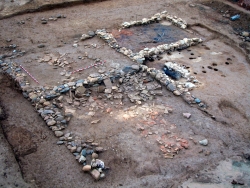
The results of the two stages of Preventive Archaeological Intervention have demonstrated the great scientific interest and the possibilities in social dissemination presented by the archaeological site found at Sant Pau de Riu-sec. The different stages of the intervention have recorded structures corresponding to a villa dating from the Roman Republic Era and combined with structures from more modern times. Prior interventions documented the identified structures as those corresponding to a palaeo-Christian church which incorporated the structures of the imperial villa. The scientific importance of the site, which could one day be converted into a park to preserve and display the remains to the public, has encouraged those taking part in the dig to continue and disseminate the discoveries at the site. It is a unique opportunity to add to the scientific knowledge of the Romanisation of this area of Catalonia and of the villages existing during the late Middle Ages and Early Modern era. It will also contribute to an improved dissemination of this element of the Archaeological Heritage of Catalonia.
At this moment the site is affected by a Partial Urban Plan which aims to transform the 1,564,857 m2 into a new business park with new roads and public spaces located near the river Riu-sec and between the church of Sant Pau and the manor house of Can Borrell de Riu-sec (where the archaeological site is found).