Ian Shapiro: “When people are afraid of losing their jobs, they are more vulnerable to messages of exclusion”
Yale University professor Ian Shapiro addressed the causes of the rise of contemporary populism on Wednesday 25 March in a lecture at the UAB Faculty of Political Science and Sociology in front of a packed auditorium. Entitled “Angry populist politics: Why is it happening and what to do about it,” Shapiro’s talk reviewed recent transformations in international politics and the current challenges facing Western democracies, and concluded by recalling Roosevelt’s words: “extreme necessity makes people less free.”
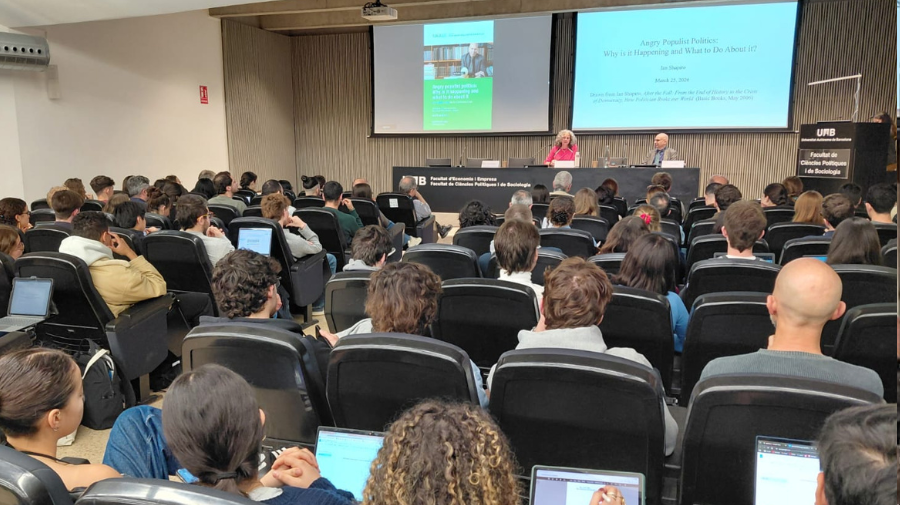
Professor Shapiro warned that it is not enough to wait for populism to run its course.
Ian Shapiro is Sterling Professor of Political Science and Global Affairs at Yale University. He was born in South Africa, but migrated to England at the age of 16. After graduating from university, he went to the United States, where he received his doctorate from Yale, and where he has developed a brilliant academic career that has led him to receive various awards and become a renowned researcher in political science. He has written several books and will soon publish After the fall, in which he analyses the rightward turn in global politics since the end of the Cold War. In the conference he gave at the UAB, presented by Eva Anduiza, lecturer of Political Science at the UAB, Shapiro presented a large part of the thesis he analyses in this book.
Shapiro went over what really happened after 1989, the year in which the fall of the Berlin Wall fueled hope for a safer and more cooperative world. According to Shapiro, that optimism was no fantasy, but wrong political decisions were made that generated instability both internationally and within Western countries. For this reason, he argued that understanding those mistakes is key to facing the present and the future more successfully.
In the conference, Shapiro also explained how these processes have contributed to the rise of current populism. He noted that many people are disillusioned with political elites, distrust traditional parties, and see immigration as a threat. This unease makes some citizens feel attracted to leaders who promise easy solutions to complex problems, and also reinforces trends such as protectionism and nationalism. According to him, all of this has deep roots in economic insecurity and the disappearance of a growth that benefited everyone.
Shapiro devoted a significant portion of the talk to recalling a key moment in international politics: the invasion of Kuwait in 1990 and the response of the international community led by the United States. He explained that that episode followed very strict criteria—the well-known “Powell doctrine”—and managed to gather broad international support. Years later, however, this model changed radically with the Bush doctrine after the 9/11 attacks, which justified intervening around the world even with poorly defined threats and broke with the multilateralism that had characterised previous actions.
Finally, Shapiro warned that it is not enough to wait for populism to run its course. He insisted that when people live in fear of losing their jobs or without prospects for improvement, it is easier for exclusionary messages to take root. Recalling an idea from Roosevelt, he pointed out that “extreme necessity makes people less free” and noted that guaranteeing decent living conditions is essential to maintaining democratic and stable societies.
The conference was followed by a Q&A session in which many people from the audience participated.