Formation of the new UAB Senate and approval of the rector's annual report
The new UAB Senate was established today with the incorporation of the members chosen in the past elections. The ordinary session also served to approve the annual report presented by Rector Javier Lafuente, which details the actions carried out during 2025 and the Governing Team's plan to "continue moving towards a more modern, inclusive, sustainable and globally leading university" during the next year. The document obtained 90 votes in favor, 36 against, 15 blank, and one null. The Senate also debated the regulatory development of the new UAB Statutes.
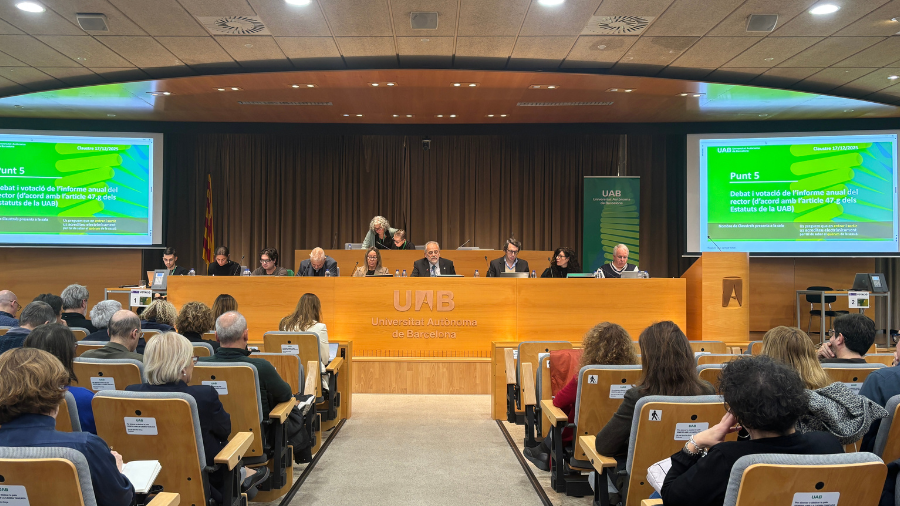
Once again, the rector focused his report on the economic aspects affecting the University. Next week, he explained, a meeting of the rectors of Catalan universities with the Catalan Minister for Research and Universities is scheduled to discuss the new university finance model. The rector stated that, "I am confident that in 2027 we will have a model based on a programme contract with objectives agreed on with the government. This new framework should guarantee us multi-annual financing for university investments." Looking ahead to next year, the University hopes to have a budget of 450 million euros approved. Rector Lafuente praised the "financial strength" of the UAB and explained that, if the Catalan Government approves its budget, "for the first time in the history of the UAB there will be a specific item for city expenses". In addition, he referred to the renewal of the executive administrator, which starting on 1 January will be Samuel Reyes, and thanked Jaume Tintoré for his work as executive administrator over the past nine years.
The report also dealt with the new infrastructures and planned reforms to the campus facilities. The work on the Artextil in Sabadell, as explained, is underway and will be completed by the end of 2027. The Faculty of Medicine now also incorporates the Hospital of Mataró as a university hospital of the UAB and is analysing a possible increase in student places starting in the 2027/28 academic year. Moreover, two new buildings are planned to house facilities of the Faculty of Psychology and Speech Therapy, and the Institute of Neurosciences, and plans are also underway for the updating of spaces in building B and the rehabilitation of the Plaça Cívica.
Regarding staff, the rector explained that 140 people have been hired this 2025, including lecturers, tenured professors and associate professors, in addition to four distinguished researchers with ERC projects or large-scale international projects. In addition, over the course of this government team's term, the UAB plans to incorporate more than 380 new people. This year there has also been an increase of 25 administrative staff positions and, according to the rector, "if we manage to have a programme contract that gives us sufficient autonomy to establish our objectives, the first objective that I will put on the table will be the increase in administrative and service staff positions". The approved report also explains that "the deadlines set" in the review of the structures of the administrative staff are planned to be met.
The report's information on the university community also referred to issues related to students, such as the creation of the Student Forum, a space for participation to present proposals and deliberate on issues of interest to this group, and the recent establishment of the UAB Alumni Advisory Council. The rector also referred to the community's commitment to the values of the institution, referring, on the one hand, to the solidarity actions with the Palestinian people: as he explained, the members of the working group in charge of monitoring the actions proposed by the members advocating for solidarity with Palestine will soon be elected. And, regarding the current African swine fever crisis and the security measures that are being applied on the UAB campus, Lafuente wanted to "acknowledge and thank the responsible behaviour" of the community.
The UAB, with Sustainable Development Goals
 Peace, justice and strong institutions
 Quality education
 Sustainable cities and communities