Europe Day concludes that "judicial independence is the basis of the entire European system" in an international context of change
As part of the celebration of Europe Day, on 8 May at 12 noon, the Institute of European Studies and the Faculty of Law of the UAB organised the conference “The role of the EU Court of Justice in a changing international context”, delivered by José Martín, judge and advocate general of the Court of Justice of the European Union. Ricardo Esteban, dean of the Faculty of Law of the UAB, and Esther Zapater, secretary general of the UAB, also spoke at the event.
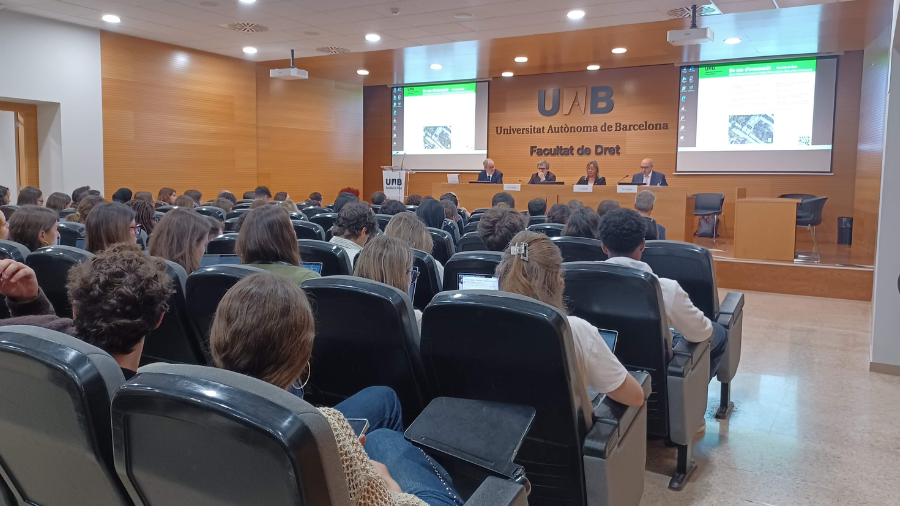
Dean Esteban opened the event, in the main hall of the faculty, highlighting the importance of students being able to learn first-hand about the experiences and knowledge of the participants: “It is a privilege that you dedicate your valuable time to us at a time when the role of international courts is more questioned than ever.” The dean encouraged attendees to maintain a space for European reflection in a complex international context, vindicating the international prestige of the CJEU.
He was followed by José Martín, who warned about the weakening of the international system and global legal mechanisms, and confessed that "we find ourselves in a particularly problematic and delicate moment, to the point that we could speak of a process of dismantling the international legal system as we know it". He also defended the need to strengthen the European project and the community institutions, given that "public international law is being subject to a very intense and progressive process of erosion".
Referring to the role of the EU's Court of Justice, Martín recalled that it “has contributed to the development of the European integration process”. According to Martín, “it is the largest court in existence”, given that there are 2,302 civil servants and agents, a budget of 537 million euros, 24 official languages, 552 possible language combinations, nearly 50,000 accumulated court rulings, and around 2,300 appeals resolved annually. He also covered the concepts of the rule of law and judicial independence through Article 2 of the EU Treaty. The judge stressed that the CJEU assumes a central role in the defence of European democratic values, where “these are not only a requirement for entry, but are also essential for belonging”, in a context where liberal democracies are under threat, such as in Poland and Hungary.
Martín also highlighted the great importance of the current power of big technologies; "we are experiencing a process of concentration of large economic operators that is unparalleled". Companies such as Google, Amazon, Apple, Meta or Microsoft "generate concern and dependence on the economic and political capacity of Big Tech". In addition, he also highlighted the threat to the territorial integrity of the EU, where "flagrant and daily violations of international law are a reality". Martín exemplified this with the war in Ukraine, the common foreign and security policy, and the European sanctions against Russia. He also addressed the issue of asylum and immigration through an area of freedom, security and justice, as well as the need to include recognition and good judicial cooperation.
Finally, Esther Zapater closed the event by asserting the role of the Court of Justice of the European Union as a legal and democratic benchmark within the European integration process. Zapater highlighted that having a judge from the CJEU “is a true luxury”, and stressed that, despite its complexity and size, the court “has managed to consolidate itself as that international court that very few took seriously”. She also defended that speaking of the CJEU “is talking about rights, values and a benchmark that has changed our legal system”, highlighting its high level of compliance with rulings and the international respect that its resolutions generate. Finally, she recalled that “thanks to the rulings of this court we have evolved” and highlighted the role of UAB teaching staff in consolidating European studies at the university. The UAB also invested the president of the CJEU, Koen Lenaerts, with an honorary doctorate last year.
The UAB, with Sustainable Development Goals
 Peace, justice and strong institutions
 Quality education