Centre for Research in Agricultural Genomics inaugurated
09/06/2011
Authorities coincided in highlighting the collaborative dimension of a public consortium such as CRAG, in which four leading institutions in the field of research participate: CSIC, IRTA, UAB and UB. The centre also receives financial support from the Department of Economy and Knowledge of the Government of Catalonia.
Ana Ripoll praised the fact that the two Catalan universities for the first time worked together on such an important project and put emphasis on the centre's research potential as part of the UAB Research Park. ?Its presence on the university campus, together with the rest of research centres, make this one of the most important poles of Southern Europe?, she stated.
Minister Garmendia mentioned that under the new Law of Science, CRAG is a model example of how research activities should be organised, with the ability to concentrate resources, compete with the best researchers in the world and attract international talent.
CRAG carries out pioneering research activities in the fields of genomics, molecular plant biology, farm animal genetics, development of molecular applications for the culture and breeding of agricultural and livestock species. The centre is directed by Pere Puigdomènech, research professor at CSIC and expert in molecular plant genetics.
The centre's researchers have years of experience and come from various institutes which progressively have joined the consortium. Institutes such as the CSIC Departments of Molecular Genetics, the IRTA Department of Plant Genetics, the UAB Department of Animal and Food Science, and the UB Departments of Biochemistry and Molecular Biology (Biology and Pharmacy), Genetics, and Natural Products, Plant Biology and Edaphology. A total of 51 researchers, 20 from CSIC, 12 from IRTA, 6 from UAB, 6 from UB, 4 from ICREA and 3 under the direction of CRAG. Taking into account administration and services staff and post-doctoral and doctoral students, 239 people currently work at CRAG.
Pioneering molecular genetic research in Spain, some of the centre's research groups have participated in emblematic international projects such as the first plant gene sequence published in Spain, the complete sequencing of Arabidopsis thaliana - a model plant in molecular biology - and the study of genes involved in plant development, their defence against pathogens, and the biosynthesis of pigments or aromas. The centre includes groups which have been the first to use molecular approximations for the improvement of plants and farm animals, and which work closely in collaboration with businesses from the agro-food sector.
In 2010, CRAG was carrying out over 50 projects valued at approximately five million euros. Six were European projects, one under the European Young Investigator (EURYI) programme and one ERC Starting Grant. Another outstanding project is that of Cucurbit Genomics led by CRAG and funded by Genoma España, five Autonomous Communities and five private enterprises. This is the first genome sequencing project of a higher species to be carried out in Spain.
The new building occupies 9,000 square metres, divided into four floors, and represents a giant step forwards by uniting the centre in one single site and giving it the infrastructure it needs to become a centre of excellence in research and training.
The new building has cost approximately 20 million euros, paid in equal amounts by CSIC and the General Direction of Research of the Government of Catalonia. In both cases approximately half of the funding comes from European funds. The building has been constructed on land yielded by UAB. The building's most outstanding elements include:
? Greenhouses with 600 m devoted to the study of plant growth under controlled conditions.
? Genomics and Capillary and Massive Sequencing Laboratory
? Confocal Microscope and Proteomics laboratories
Its on campus location at the UAB Research Park provides the centre with a greater projection of its teaching activities the Laboratory's undergraduate and postgraduate courses.
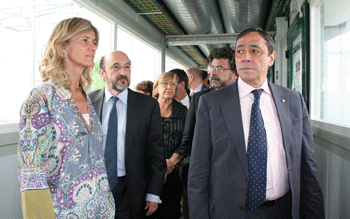
Image: Cristina Garmendia, Pere Puigdomènech, Ana Ripoll, Antoni Castellà and Rafael Rodrigo, during the visit to CRAG laboratories.