Boosting research and knowledge transfer in global health with the creation of the CORE in One Health
The UAB launches the new CORE in One Health to connect disciplines, knowledge, capabilities, and stakeholders in the fields of human, animal, and environmental health—both within the University and in its surrounding environment—and to foster knowledge transfer and collaboration in these areas. The initiative is being announced to coincide with World One Health Day.
Zoonoses, antimicrobial resistance, food safety, and the health impacts of climate change are examples of challenges that can hardly be addressed from a single field. The "One Health" approach is based precisely on the interdependence between the health of humans, animals, and ecosystems, and on the need to mobilise disciplines, sectors, and communities to provide a collective response.
In this context, the UAB has created the new CORE in One Health, which aims to strengthen the connections between the capabilities already existing at the University and to facilitate their relationship with other stakeholders. The activity of the new research community is initially structured around seven priority areas: infectious diseases and zoonoses, antimicrobial resistance, food safety, health and climate change, biodiversity and ecosystem health, epidemiological surveillance, and public policy and governance. The aim is thus to create synergies between research groups and disciplines at the University, to forge alliances with external stakeholders such as hospitals, companies, public administrations and social organisations, and to strengthen UAB's position in the field of One Health at a local and international level.
A conference on interconnected health challenges
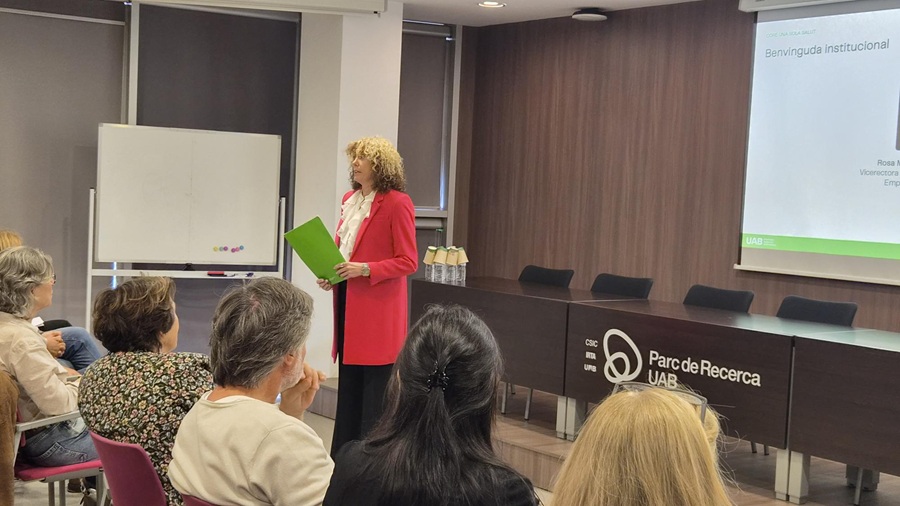
The CORE in One Health was presented at an event that brought together around thirty experts and representatives of institutions involved in the One Health field at the UAB Research Park, where issues such as the importance of addressing prevention, the control and management of biological risks and threats of infectious diseases in a global context were highlighted.
Rosa Maria Sebastián, vice-rector for Innovation, Transfer and Entrepreneurship, emphasised in her welcome address the active role the university must play in connecting and mobilising the capacities of the various departments and disciplines. "We need to create spaces for meeting and collaboration that allow us to pool knowledge and address today's health challenges from a cross-cutting, interdisciplinary perspective," she noted.
Chiara Seminati, coordinator of the CORE in One Health, then presented the new community, its objectives, and the areas in which work will begin, as well as the CORE’s role in connecting the UAB’s capabilities with other stakeholders.
The event also featured the lecture "One Health: from global challenges to local action", delivered by Katinka de Balogh, veterinarian specialising in veterinary public health with extensive professional experience at the FAO and who is currently advising universities, institutions and international organisations in the field of One Health.
De Balogh emphasised that current threats transcend the boundaries between different domains. In this regard, she argued that simply bringing disciplines together is not enough; rather, this cooperation must translate into changes in decision-making and practices. Among the examples discussed, De Balogh highlighted the case of the West Nile virus in Europe, where joint surveillance across humans, birds, and equids provides complementary information to improve prevention and response efforts.
The global perspective was rounded off by the round-table discussion "One Health from Different Perspectives", featuring three distinguished specialists: Laila Darwich, professor in the Department of Veterinary and Animal Anatomy at the UAB and coordinator of the University Master's Degree in Zoonoses and One Health; Israel Molina, physician and head of the Tropical Medicine and International Health Unit at the Vall d'Hebron Hospital, and Rafa Mateo, environmental toxicology researcher at the Institute for Environmental Diagnosis and Water Studies (IDAEA-CSIC). All three agreed on the need to adopt a more holistic and cross-cutting view of health, which allows disciplines, fields of knowledge, and institutions to connect. In this regard, the need to improve institutional and administrative coordination was also highlighted, as policies and funding streams often remain fragmented by sector—health, agriculture, industry, etc.—despite many of today's challenges requiring integrated responses.
With the new CORE in One Health, the UAB strengthens its role as a leading institution in the One Health approach—a field in which it stands out for its excellence in veterinary and biomedical research, its ties to specialised centres such as IRTA-CReSA, and its participation in international networks.
The initiative joins the University's three other active communities: Cultural Heritage, Smart and Sustainable Cities, and Education and Employability. With this addition, the UAB now has four CORE centres, each focusing on different areas but united by a shared aim of connecting knowledge and capabilities around strategic challenges.
More information: CORE in One Health website
Contact: core.unasolasalut@uab.cat