The UAB organises the 2nd University Social Responsibility Conference
On Wednesday 14 October, the UAB held its Second Conference on University Social Responsibility. The aim was to share good practices developed by various universities regarding university social responsibility, particularly in the areas of the value chain, suppliers, and responsible purchasing and procurement.
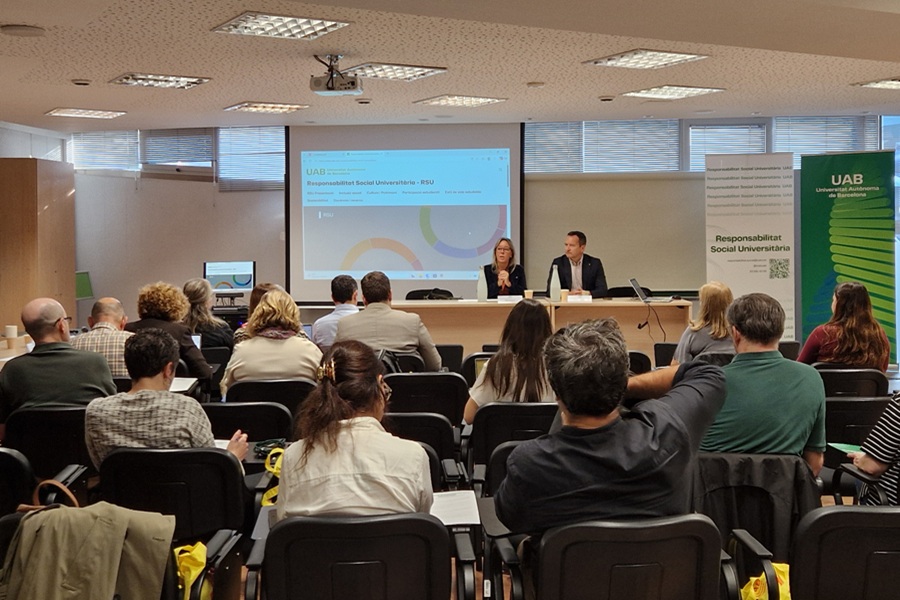
The event began with an institutional welcome by Esther Zapater, secretary general of the Universitat Autònoma de Barcelona (UAB), who emphasised the importance of this issue for public institutions such as the UAB. "Sometimes we are not sufficiently aware of the responsibility we have as an institution", Zapater said, citing as an example the 6,800 suppliers the UAB has, which "make our responsibility when hiring abundantly clear". Zapater pointed out the importance of the meeting in "highlighting our perspective on social responsibility and giving it a content more geared towards today's challenges".
Joan Martí, director of the Business Strategy Unit at ACCIÓ—the Government of Catalonia’s agency for business competitiveness—then delivered the opening lecture, titled "El valor compartit al centre de l’estratègia empresarial" [Shared Value at the Heart of Business Strategy]. Martí explained that at ACCIÓ—which defines itself as an "agency for growth"—they often ask themselves "whether it makes sense to grow on a planet in risk of collapsing". For him, the answer was clear: "Growth is compatible, provided it generates a positive social and environmental impact; however, this requires a new, more conscious form of capitalism", he stated. This highlights the importance of placing not only economic strategy but also social and environmental impact at the core of a company.
"Toxic" companies and "activist" companies
ACCIÓ, he explained, has the "Shared Value" programme, which specifically helps companies place this triple impact at the core of their operations. According to Martí, "We live in a polarised world, and capitalism will be polarised too: we will see both 'toxic' companies and 'activist' companies. We want to see an increasing number of Catalan companies become activists". However, he noted that this does not mean abandoning the goal of making a profit, and he cited examples of foreign companies—such as Patagonia and Ben & Jerry’s—that are known for their social activism.
Finally, Martí posed a key question: What kind of companies do we want in Catalonia? As he himself answered, "we want those that put economic results, the social dimension and environmental impact at the centre". "Because when you do good, you do well", he added, emphasising that the world's largest companies that treat their employees well, according to the Best Work Places ranking, "achieve much higher profits than companies that do not treat their staff well".
Responsible purchasing at the UAB and other practical examples
The event continued with three talks on various responsible procurement strategies at the UAB, delivered by Roger Casanova, head of the Administrative Contracting and Procurement Office; Patrícia Giménez, head of the Sustainability Office; and Sílvia Altafaja, head of the Engagement and Community Office.
These were followed by a conference on institutional strategies for more sustainable procurement and travel at the University of Barcelona, followed by a talk on three cases of fair trade collaborations and certifications. The event concluded with a presentation on the collaboration between the Universitat Politècnica de Catalunya and the company Electronics Watch.