BrainMapp, a new spinoff dedicated to improving brain mapping during tumour surgery
The new company originating from the Universitat Autònoma de Barcelona (UAB) and the Centre for Computer Vision (CVC) has developed a digital tool that helps neurosurgery teams identify the areas of the brain that need to be preserved during tumour removal. The project has been developed in collaboration with the Neurosurgery Department at Bellvitge University Hospital and the Cognition and Brain Plasticity research group at IDIBELL, and has been used to date in 31 neurosurgical procedures, 19 of which took place at Bellvitge University Hospital.
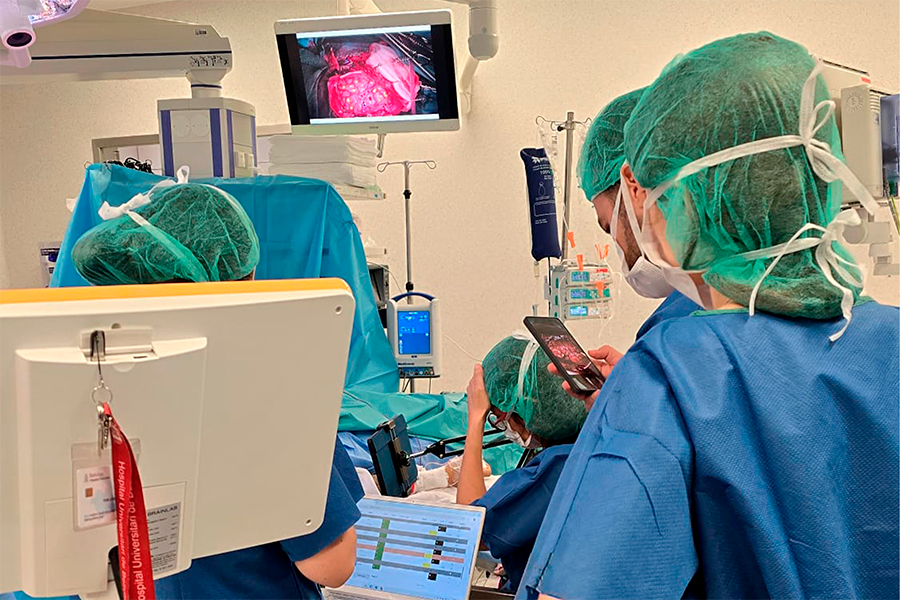
BrainMapp Software Solutions has established itself as a new spin-off company of the Universitat Autònoma de Barcelona and the Computer Vision Centre, with the aim of bringing to market a digital technology to support medical teams during brain tumour operations, and to facilitate the identification of areas of the brain associated with essential functions such as speech, movement or cognition.
The technology was developed by researchers from the UAB, the University of Barcelona (UB), the CERCA Computer Vision Centre (CVC), and the Catalan Institution for Research and Advanced Studies (ICREA), in collaboration with the Neurosurgery Department at the Bellvitge University Hospital—led by Dr Andreu Gabarrós, with the participation of Dr Alejandro Fernández Coello—and the Cognition and Brain Plasticity research group at the Bellvitge Biomedical Research Institute (IDIBELL), led by Dr Antoni Rodríguez Fornells. Neuropsychologists Anna Gasa Roqué and Dr. Joanna Sierpowska were also involved in the development of the technology.
This collaboration between clinical and research teams has made it possible to tailor the technology to the specific needs that arise in the operating theatre during brain tumour interventions.
Preserving essential functions during surgery
In certain neurosurgical procedures, specialists need to identify with great precision which areas and brain connections are involved in essential functions such as language, movement and certain cognitive abilities.
To do this, during the procedure different areas of the brain can be stimulated and the patient's response observed. This procedure, known as intraoperative brain mapping, allows the structures that need to be preserved to be identified while the tumour is being removed.
"In brain tumour surgery, one of the major challenges is removing as much of the tumour as possible while preserving functions essential to the patient. Intraoperative brain mapping allows us to identify during the procedure the areas and connections involved in these functions and to decide which structures must be preserved", explains Dr Andreu Gabarrós, Head of the Neurosurgery Department at Bellvitge University Hospital.
BrainMapp facilitates this process through a digital platform that allows for the recording, organising, and real-time visualisation of information generated during the intervention. The system operates via a workstation installed in the operating theatre and enables the capture of stimulations performed by the neurosurgery team, patient responses, and the results of various tests conducted during the operation.
The platform also allows these data to be integrated with previous brain images, such as MRI scans and other neuroimaging tests, and to preserve records of the intervention, such as audio, video and medical images.
"During an intervention, a great deal of information is generated in a very short space of time. With BrainMapp, we want to help neurosurgery teams keep it organised and accessible in a single environment, to facilitate tracking of brain mapping and help make more informed decisions during surgery", explains Víctor Cepero, co-founder of BrainMapp.
Out of thirty-one interventions, nineteen took place in Bellvitge
BrainMapp is used as a supplementary support tool, under the direct supervision of the responsible medical team at all times. To date, it has been used in 31 neurosurgical procedures, 19 of which were at Bellvitge University Hospital.
The technology incorporates computer vision and artificial intelligence tools to facilitate the recording and organisation of the information generated during brain mapping. "The first version of BrainMapp focuses on mapping the superficial areas of the brain. We are now working to extend its functionalities to mapping deeper brain regions and to incorporate new data analysis and decision-support tools", explains Joaquim Cerdà, lecturer in the Department of Computer Science at the UAB, researcher at the CVC and co-founder of the company.
The structured recording of data generated during interventions can also facilitate their subsequent use for research purposes and contribute to advancing the understanding of brain functions.
The project has also collaborated with other hospitals, such as Hospital del Mar, Josep Trueta University Hospital in Girona, and the 12 de Octubre University Hospital and La Paz University Hospital, both in Madrid.
From university research and clinical innovation to knowledge tranfer
Before becoming a spinoff, BrainMapp participated in various initiatives supporting entrepreneurship and knowledge transfer through Emprèn UAB—most notably the AI4ALL and Polaris programmes, as well as the Barcelona Deep Tech Node’s Mentoring in Residence. It also took part in the RDI-IA Network’s AI Accelerator, an initiative linked to the Government of Catalonia’s Catalonia AI 2030 Strategy, which helped accelerate the technology's maturation and transfer.
With the establishment of the spinoff company, BrainMapp now embarks on a new phase focused on continuing to develop and validate its technology and moving towards commercialisation and wider adoption in the clinical setting.