The UAB successfully hosts the 8th Ibero-American Congress of Egyptology, a leading international event
The event, organised by the Institute for Ancient Near Eastern Studies (IEPOA), was notable for its broad thematic scope, the participation of researchers from ten countries, the inclusion—for the first time—of dedicated sessions on philology and astronomy, and the presentation of significant archaeological findings made by a UAB team at Saqqara.
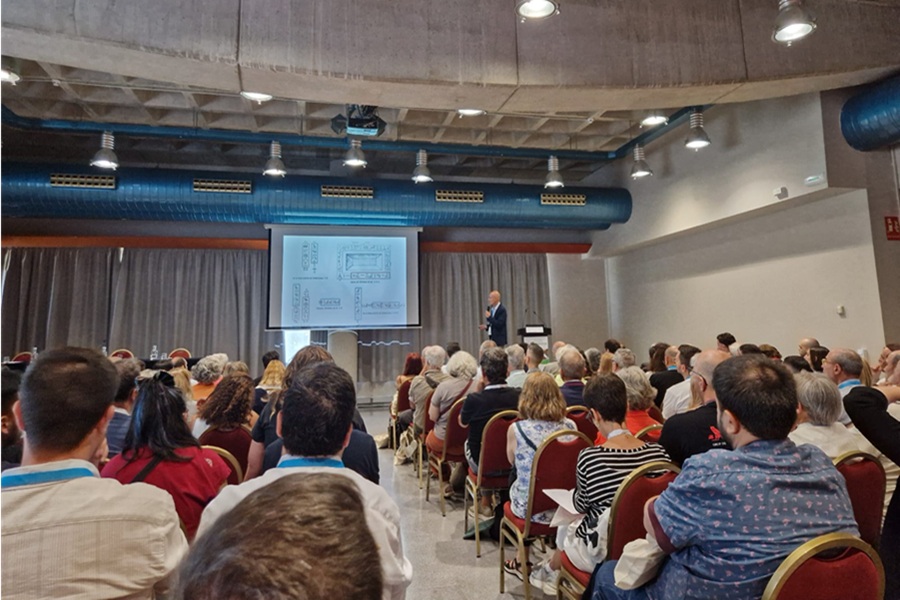
From 7 to 9 september 2026, the Universitat Autònoma de Barcelona (UAB) hosted the eighth edition of the Ibero-American Congress of Egyptology. This important academic gathering has brought together a large community of researchers from across the Ibero-American sphere to debate and share the latest advances in the discipline.
The congress stood out for its broad thematic scope, addressing virtually all current lines of research regarding ancient Egypt. For the first time, sessions were scheduled that were dedicated exclusively to philological and linguistic aspects, as well as to astronomy and cosmology. Furthermore, there was a particularly significant number of presentations focusing on Greco-Roman Egypt, highlighting the growing academic interest in this historical period.
Recent discoveries at North Saqqara
The opening lecture was delivered by Egyptology Professor Josep Cervelló, director of the IEPOA, who presented the latest findings of the Spanish-Egyptian Archaeological Mission at Saqqara. Cervelló presented the work carried out in the area known as Mariette's cemetery, in North Saqqara, where the 2026 campaign has enabled the near-complete excavation of the double mastaba of Iunmin, an official in the state's central administration, and of his father, Iti, dated to the late 5th Dynasty and decorated with various reliefs and scenes.
Notable contributions of the Ibero-American research
Among the numerous lines of research presented, those of great relevance stand out, such as the work of Daniel González León, who presented a comprehensive study of the hieroglyphic sign for tree in the tomb of Mereruka at Saqqara from a palaeographic, philological and lexical perspective. His aim is to determine, through this specific case, whether variation in the level of detail of the hieroglyphs can contain semantic information that indicates different linguistic functions.
Jaume Vilaró Fabregat presented a previously unpublished ostracon from the Metropolitan Museum of Art in New York; written in cursive hieroglyphs and likely originating from Deir el-Medina, it features a structure resembling that of Theban sarcophagi from the 19th Dynasty. Furthermore, Vilaró participated in the presentation of the Medjehu project, which focuses on the economic and social history of timber along the Nile.
In the field of linguistics and philology, Christian Olalla-Soler and Alejandro García Martín examined how different grammatical theories concerning the verbal form sDm=f condition the translations of one of the most important literary works of ancient Egypt, The Eloquent Peasant.
Francisco L. Borrego Gallardo's paper delved into the funerary texts of the TP 516 enchantment, analysing some infrequent elements that are of notable interest for understanding certain largely overlooked aspects of the religion and royalty of the Old Kingdom. Finally, the iconographic and religious dimension was addressed by Marc Orriols-Llonch, who analysed the representation of corporealities and gender identities in the Turin Papyrus 55.001, a truly exceptional piece featuring various sexual scenes. Guilherme Borges Pires presented a study on the meaning of light in the laudatory texts of the New Kingdom in order to more precisely assess the weight and function of this concept in the texts.
Consolidating the UAB's leadership
The success of this edition and of all the sessions held reinforces the role of the UAB, and specifically of the IEPOA, as a centre of reference in Egyptology teaching and research in the Ibero-American sphere, driven by the track record of its master's degree programme in Egyptology and its international archaeological missions.