Simulating real-life situations improves training in dementia care
The Foundation for Health and Ageing of the Universitat Autònoma de Barcelona (FSiE-UAB), in collaboration with the geriatric services entity Pere Mata Social, has launched an innovative training programme based on role-playing to improve the skills of professionals who care for people with dementia and the psychological and behavioral symptoms of dementia (BPSD). Through the simulation of real-life cases enacted by actors, the initiative helps professionals detect and manage these symptoms.
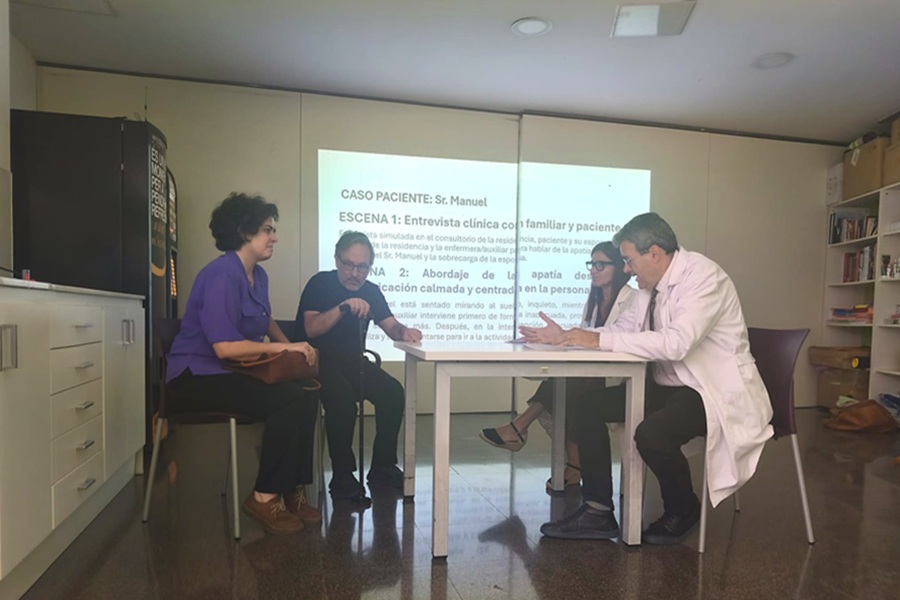
The proposal combines theoretical sessions with practical experiences that allow participants to practise key skills such as communication, empathy, emotional validation, and the management of complex situations commonly encountered in residential centres.
According to Sara Domènech, researcher at the FSiE-UAB and course coordinator, the Behavioural and Psychological Symptoms of Dementia (BPSDs) affect 60% to 90% of people with dementia, a fact that highlights the need to equip professionals with specific tools to address them. "It is essential that professionals know how to identify them and intervene appropriately to improve the well-being and quality of life of all those involved", she highlights.
The experiential methodology also fosters deeper reflection on clinical practice. "We learn better when knowledge is linked to an emotional experience. Simulation transforms theoretical content into experiences that leave a lasting impression and facilitate learning", says Dr Ramón Miralles, director of the FSiE-UAB.
Role-playing allows professionals to practice key verbal and non-verbal communication skills for interacting with people with dementia by acting out real-life situations. According to Susana Martínez, actress and stage director at the FSiE-UAB, this methodology offers an experiential learning process that helps professionals better understand the person behind the symptoms and fosters care that is more empathetic and person-centered.
The perspective of professionals: from theory to healthcare reality
The participants highlight the innovative and deeply human nature of this simulation-based training course and the direct experience of situations that form part of their clinical reality.
For FSiE-UAB, addressing brain health means going beyond disease. It entails promoting people's cognitive, emotional, and social well-being, while also providing the necessary tools to professionals who face complex situations arising from cognitive decline and dementia on a daily basis.