Irene Psifidou: "The social value given to vocational training in Spain must change"
As part of the fourth edition of the CRiEDO Conference (Centre for Research and Studies of Organisational Development) at the UAB, Irene Psifidou, expert in European educational policies, visited the Faculty of Education on 19 November and gave a lecture on vocational education and training and early school leaving.
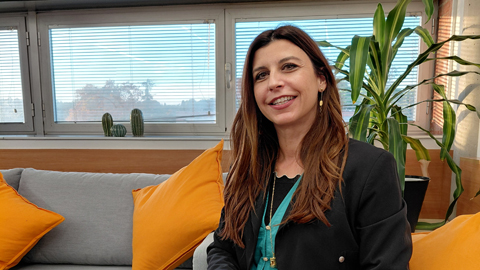
"There is currently a trend in Europe to return to vocational training after graduating from university."
"Early school leaving rates have lowered among vocational training students, but they are still above the European average."
Irene Psifidou is an expert in educational policies at the European Centre for the Development of Vocational Education and Training (CEDEFOP), one of the first decentralised agencies of the European Union. The centre is based in Thessaloniki, Greece, the city where she is originally from and where she now resides. Irene Psifidou also holds a PhD from the UAB.
What do you do in the European entity you work for?
It is the leading vocational education and training (VET) research centre in all of Europe. This year actully marks its 50th anniversary. We use our research and studies to create policies at European level that can give support to all the educational proposals available in this area. We set goals (new policies) and then we work jointly with the ministries for education and labour markets, and with social agents.
With regard to Europe, where does Spain currently stand in vocational training dropout rates?
Spain is following the European trend of reducing early school leaving from both VET and general education, although at a slower pace than some of its European counterparts. In 2024, 3.1 million young people aged 18-24 in the European Union (9.4%) did not complete either upper secondary education or mid-level VET. This phenomenon of early school leaving was highest in Spain.
In Spain, the dropout rate was 20% in 2015. They did a great job in the past 10 years and it has gone down to 13% in 2024. This is a historic low for the country, although it is still higher than the European average. Spain is a model country because it started with very high rates and they are falling incredibly, although they are still above the European average.
What about Catalonia?
Well, it turns out that in Catalonia the rate is one point higher than the Spanish average, 14%! Last year, more than 97,000 young people between 18 and 24 years old had left school early without earning any qualifications beyond the compulsory education diploma, a figure that is equivalent to the capacity of the Camp Nou football stadium, or 3,200 full classrooms.
What about other autonomous communities in Spain?
Catalonia is in the average of the communities. Right now the highest dropout rates are in the Canary Islands, Madrid and Asturias, and the lowest in the Basque Country, Galicia, Navarra and Extremadura. Great efforts have been made with the latest VET law in Spain and the demand for VET is growing. If I am not mistaken, this same year an article in El País spoke of a record level of enrolment in VET in Catalonia, with more and more students and fewer dropout rates.
Could it not be that even though there are more and more vocational training courses, there is also an increase in early school leaving?
Yes, that may be so. But what I mean is that now in Spain VET is much more attractive than years ago. A total of 39% of the Spanish population accessed higher education through higher-level vocational training cycles, compared to 16% in OECD countries, and 10% in the EU. And we have data at a European level that shows that insertion into the labour market is faster than those with the same level of education. I am referring to intermediate VET courses and baccalaureate.
In recent years, many political measures have been implemented that have resulted in a more flexible, more attractive and higher quality VET system. This has also happened in other Mediterranean countries, like my own, Greece, for example, where VET had a lower social value and was not attractive to students.
At European level, should we be focusing on any specific countries? One always hears that the German system is the one to follow.
Well, the truth is that you do not need to look to the Nordic countries or Germany to see who is doing it well. Right here, in Spain, there is a clear example of very low dropout rates. I'm referring to the Basque Country. We can take inspiration from them, they are doing things very well and have been for a long time. Their low dropout rate stands out compared to the rest of the communities, which are much higher.
What must be done to prevent youth from dropping out of vocational training courses?
Early school leaving is a very complex phenomenon and depends on many factors. It is a social phenomenon and must be addressed in a very interdisciplinary way. But evidence shows that when there is a very attractive, high-level VET, students are retained more, especially those who are not interested in going to university.
It used to be said that “if you’re not a good student, go to VET”, but all that has changed. Now, in Europe, we are talking about VET of excellence, which promotes the socio-economic development of Europe. It is a new movement. At European level, centres of vocational excellence (CoVE) are being promoted with European funds, which create ecosystems of skills in strategic sectors and foster excellence in VET with a flexible training offer adapted to the labour market. In addition, they promote collaboration between training centres, universities, companies and other key agents at local and international level.
What measures should be taken to deal with early school leaving?
Structural changes need to be made, very flexible systems need to be built with models that allow students to continue on to a university education if they so choose. And the social value given to vocational training needs to change. Society needs to understand that it has a lot of value.
Specifically, in Spain we have evidence that VET offers faster job placement. And even more so now, with dual VET, which is more up-to-date and more linked to the job market. In fact, there is currently a trend in Europe that consists of the fact that many students who finish university later return to VET, because they want a specialisation, more practical training and closer linked to the job market.
In the conference you spoke of the importance of educational guidance.
Guidance is key, but it is not the only measure. It is not a cure-all, of course. When we analyse the factors that lead to dropping out of vocational training, a lack of guidance often comes up, because many students choose vocational training without realising what this path consists of, and then realise they are choosing paths that are not related to their interests or abilities.
Furthermore, in Spain, many young people are not finding the itineraries they want and are enrolling in something that was not their first choice. According to our data, there is a lack of public funded vocational training in Spain.
Good guidance should start in primary school, because it is not only professional guidance but also personal, and it should be integrated into the educational system and very well linked to the labour market, updated and also online, so that it can be accessed by vulnerable students.
To reduce early school leaving, psychosocial support for students is needed. Teachers also need to be trained so that they can identify the signs that some students are at risk of dropping out. In addition, data is needed to be able to follow the itineraries of students. There are, for example, early warning systems that monitor absenteeism and other signs.
All this must be taken into account in order to intervene before it is too late. And then it would be necessary to follow up on those who have dropped out in order to be able to give them support and offer alternatives. For example, it is very different to help someone who dropped out after primary school than someone who dropped out of higher education because they failed their final exam.
The UAB, with Sustainable Development Goals
 Quality education