Exhibition "Viruses and Kusudamas. Representing Viral Capsids with Modular Origami" at the Science and Technology Library
The Library opens 2026 with an artistic twist: an exhibition by Lucas Bartolomé, a Microbiology graduate from the UAB, reminding us that art and science share far more common ground than we often realize.
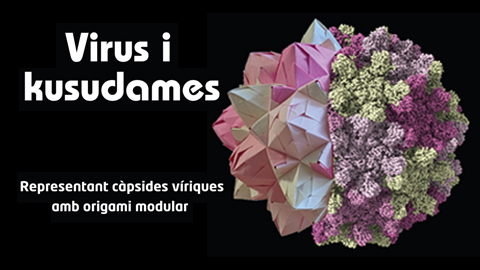
Origami is a relatively little-known discipline compared with other art forms, yet it frequently intersects with science. Many modern origami designers are also physicists or mathematicians, applying scientific principles to their creations.
Biology, too, has long been a source of inspiration. But usually, the resemblance between a paper figure and the organism it evokes is only superficial.
One day, during a virology class, as the professor explained how protein shells—capsids—protect the genetic material of viruses, and how these shells are built from the same protein repeated many times, one student, Lucas Bartolomé, immediately thought of modular origami, which allows countless paper units to be joined together.
Kusudamas are decorative modular origami figures made from identical paper units, used to create polyhedral forms that are hollow, decorative and, like viruses, often exhibit icosahedral symmetry. With a bit of experimentation, they managed to represent viral capsids as kusudamas.
These models are now on display at the Science and Technology Library until February 5.
We invite you to visit and discover the fascinating worlds of viral capsids and modular origami—two realms united by the geometric beauty that emerges when identical units are assembled in the same way, or almost.
We look forward to seeing you!