UAB publishing house releases a volume that reviews six million years of human evolution with a critical eye
Published by Edicions UAB, Evolución o involución humana. Un viaje de seis millones de años, by science communicator and lecturer David Rabadà i Vives, analyses how how prejudices and interests have influenced the interpretation of our origins and advocates for critical revision as a driver of scientific progress.
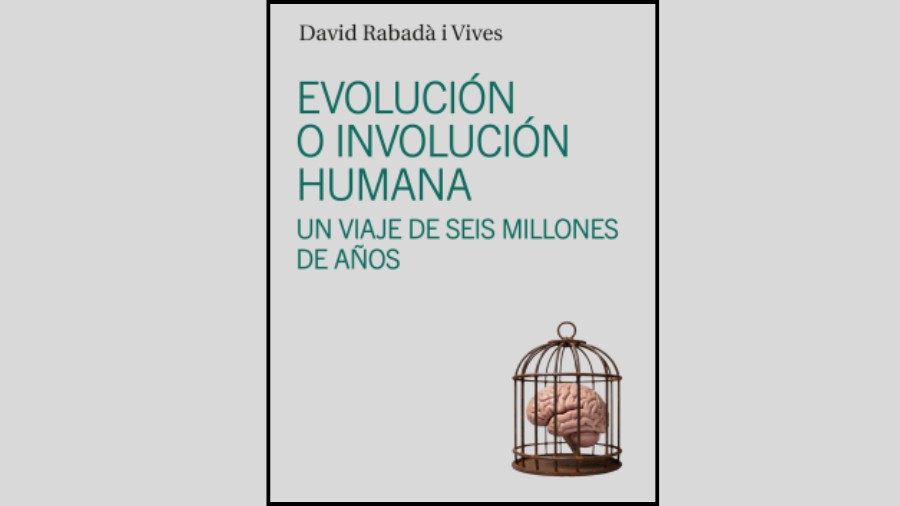
"This book invites the reader to distinguish between the facts and the prejudices that, all too often, have shaped the narrative of our origins", explains the author.
The history of human evolution has been constructed based not only on the fossils themselves but also on how they have been interpreted over the course of more than a century. With this premise, David Rabadà i Vives publishes Evolución o involución humana. Un viaje de seis millones de años (Edicions UAB), a work that invites readers to discover a critical review of some of the most established narratives regarding our origins and encourages reflection on the role that prejudices, vested interests, and anthropocentrism have played in the development of paleoanthropology.
The work reviews the key episodes of human evolution, from the first bipedal primates to the development of abstract thought. It does so by focusing on a topic rarely addressed: how scientific knowledge is constructed and how it evolves as new evidence emerges.
Revise hypotheses and rectify interpretations
Across five chapters, Rabadà reviews some of the discipline’s most important debates, such as the concept of species in paleoanthropology, the proliferation of new fossil human species, the interpretation of evolutionary trees, the myth of the "missing link," and the role of cladistics in reconstructing evolutionary relationships. Far from questioning the scientific method, the author argues that its greatest strength lies in the ability to revise hypotheses and correct interpretations when the evidence demands it.
"Human evolution has been shaped not only by fossils but also by the interpretations we have made of them. This book invites the reader to distinguish between the data and the biases that, all too often, have shaped the narrative of our origins," explains the author.
With an accessible style and a solid scientific foundation, the book is aimed at readers interested in human evolution, as well as students, educators, and anyone wishing to better understand how scientific knowledge is constructed. Forewords by Camilo José Cela Conde and Francisco Poyato Ariza reinforce the commitment to addressing ongoing debates in paleoanthropology with rigour and critical thinking.
David Rabadà i Vives is a writer, science communicator, and educator. Throughout his career, he has published numerous popular science works and has been actively engaged in the fields of science, education, and science communication.
The public presentation of the book will take place on 8 October at 7:00 p.m. at the Documenta bookstore in Barcelona, featuring the author David Rabadà, the head of the UAB Publications Service Joan Carles Marset, and the actor and comedian Toni Albà; they will discuss the major questions raised by the work in a dialogue combining science, popularisation, and humour.
Book specifications: https://publicacions.uab.cat/llibres/evolucion-o-involucion-humana-viaje-seis-millones-anos
Access to the first pages: https://lectura.unebook.es/viewer/9788412954142/1