The Veus de Palau project is developing the first oral history and local heritage trails
The UAB is collaborating with the Town Council of Palau-solità i Plegamans, the Alzina Library, and the Casal de la Gent Gran to create Veus de Palau, an initiative dedicated to preserving the oral history and local heritage of this municipality. This initiative is part of the Social and Educational Innovation Campus, which is promoted by the Council and the UAB. It is also funded by the CoCrea BiblioLab call for proposals from the Barcelona Provincial Council.
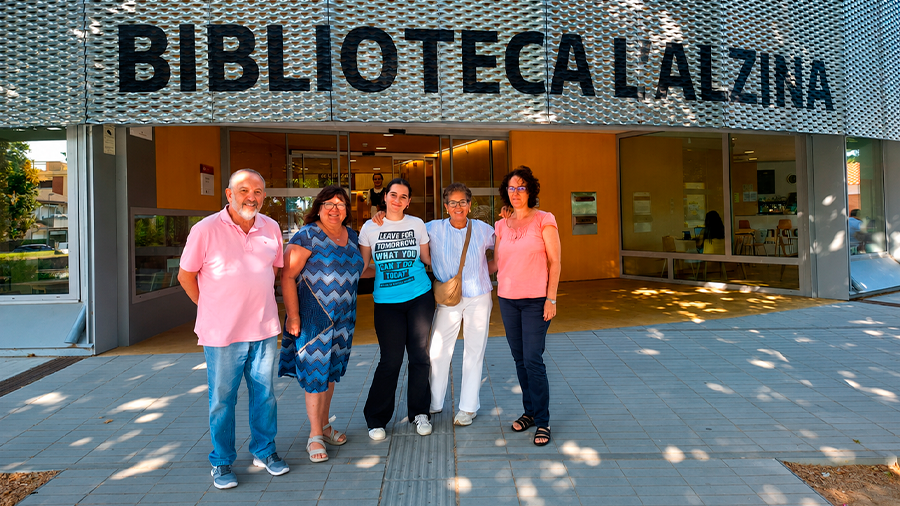
The project was born from a request from the Casal de la Gent Gran and responds to the need to put together and highlight a set of resources linked to oral memory and local heritage that until now were scattered in different formats, experiences and spaces. Through Veus de Palau, these materials are being organised to facilitate their consultation, preservation and educational, cultural and community reuse.
One of the main objectives of the initiative is to strengthen the role of public libraries as a space of connection between citizens, entities, local knowledge, and educational resources. The L'Alzina Library thus becomes a meeting point between stories, documents, audios, videos, games, educational materials, community experiences, and local knowledge.
The participation of the people of the Casal de la Gent Gran is one of the central values of the project. Their contributions have allowed the incorporation of memories, local knowledge and experiences related to the history of the town, so that the local heritage can be transmitted not only as historical information, but also as a shared and a location-specific memory. As Jaume Ventura, president of the Casal de la Gent Gran, highlights, “it is incredible what can be done as a team and what all of us together can do for our heritage”.
The UAB takes part in this project through its Social and Education Innovation Campus, a framework of collaboration aimed at connecting the university, surrounding region, community and local administration, promoted by the Department of Educational Theories and Social Pedagogy and the CORE in Education and Employability. From this space, the University provides a methodological perspective linked to social and educational innovation, co-creation, service learning, and the design of playful pedagogical experiences. University students have contributed to the development and adaptation of the documentary collection to educational and heritage materials.
The project also incorporates digital resources and immersive technologies. Through the UAB Open Labs, ways of combining physical and digital materials have been explored to enrich heritage routes and facilitate new ways of accessing, exploring and interpreting the memory of the town.
Currently, Veus de Palau is in a key validation phase. Three educational and entertaining packs are being reviewed, designed as reusable resources to boost knowledge of local heritage. These packs bring together printed materials produced by UAB students, along with previous resources from the L'Alzina Library, associations and entities of the town.
The packs will serve to facilitate recreational heritage routes and generate, from the library, meeting spaces where schools, citizens, new residents, and participants in language revitalisation processes can approach local history from a shared experience. The selected materials function as a connection point between oral memory, heritage, education, digital technologies, and community participation.
In parallel, the project is making progress in the preservation and open access of the educational resources generated. To date, 80% of the digital materials have already been incorporated into the UAB digital repository, and it is expected that the set of multimedia resources, including videos, audios and documents, will also be integrated into the library's consultation channels.
The first pilot test of the recreational heritage routes is planned for September, under the leadership of the Casal de la Gent Gran. This phase will allow the materials to be compared with participants, collect input for improvement, and assess their educational, community and cultural usefulness before consolidating them as a stable resource linked to the L'Alzina Library.