The University to welcome future UABers from 4 to 6 February
This year the UAB will be holding its annual Open Days on campus on 4 and 5 February, and online on 6 February. Almost 400 different information sessions will be taking place all over campus. Thoise interested in participating must sign up previously. The 2026/27 academic year will bring with it a new double degree in Psychology and Criminology, a new specialisation in Korean in the East Asian Studies degree, and two bachelor's degrees in the field of humanities have also undergone important changes: Humanities and Cultural Management, and History.
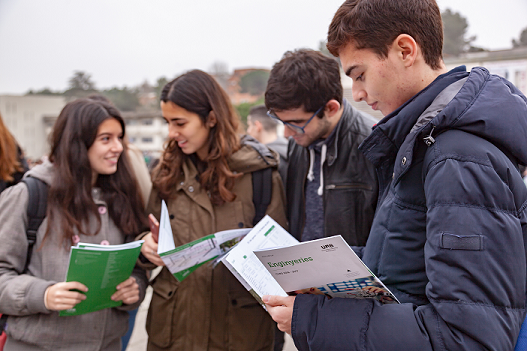
Lecturers from all degrees will explain the characteristics of each academic programme and show prospective students the different teaching centres. In addition, visitors will also be able to make contact with students from the UAB bachelor's degrees, who will share their experiences. Moreover, the open days offer the opportunity to visit the Vila Universitària residence halls to those interested in living on campus. There will also be sessions aimed at secondary school teachers. Regarding the online information sessions held on Friday 6 February, they are organised to facilitate the participation of future UABers who cannot travel to the campus. The UAB Open Days kick off the campaign to promote the university and its academic programmes for the 2026/27 academic year, which will continue at the Education Fair next March, among many other activities that can be consulted in the Visit the UAB section of the website.
New and restructured degrees
Starting next academic year, the UAB will offer for the first time the bachelor's degree in Psychology + bachelor's degree in Criminology, a pioneering double degree that will train professionals specialised in intervention in cases of violence and risk, especially in the areas of violence against children, sexual violence, intervention in families at risk, gender violence and harassment, and others. Students will be trained in a comprehensive vision of the criminological field and in the understanding of human behaviour to understand the phenomena of violent behavior and intervention with offenders and victims. This double degree will consist of 366 ECTS credits (six academic years) and will offer twenty new admission places, with part of the lectures being offered in English. This is an eminently interdisciplinary training that will be taught at the Faculty of Psychology and Speech Therapy and the Faculty of Law.
The bachelor's degree in East Asian Studies, which has been taught for years at the UAB with the possibility of specialising in the language and culture of China and Japan, will expand its places and offer a new specialisation in Korean that aims to respond to the growing importance of relations with South Korea. Ninety new places will be offered, thirty for each of the specialisations (Japanese, Chinese and Korean). Thus, starting in the 2026/27 academic year, the UAB will train the first class of thirty specialists in intermediation in commercial, political, cultural and linguistic relations with Korea, who will find professional opportunities in consulting and analysis for transnational corporations, the tourism sector, or the diplomatic world. The degree offers student mobility possibilities and benefits from the collaboration the UAB's Faculty of Translation and Interpreting has maintained for years with official institutions in China (Confucius Institute of Barcelona), Japan (Fundación Japón), and South Korea (Sejong Institute of Barcelona).
In addition, two degrees in the humanities will undergo a profound renovation. The bahcelor's degree in Humanities and Cultural Management will prepare students to manage sustainable and inclusive cultural projects and events, and to promote the democratisation of culture. It is focused on the professional sectors of the management of public and private cultural entities, cultural services, the creation of virtual spaces or tourism, etc. The bachelor's degree in History, at a time when there is more need than ever for professionals with critical capacity and a deep knowledge of historical processes, will expand its range of optional subjects and possible specialisations to strengthen professional opportunities in areas such as the design of social responsibility policies, the management and conservation of heritage, archival science and documentation, and the world of education. Both degrees will be taught at the Faculty of Arts & Humanities.
The UAB, with Sustainable Development Goals
 Quality education