The UAB receives the Montserrat Sebastià Award for its open science strategy
The Universitat Autònoma de Barcelona received recognition in the first edition of the Open Science Awards of Catalonia with the Montserrat Sebastià Award, a modality addressed to institutions and entities. Catalan President Salvador Illa was in charge of handing the award to UAB Rector Javier Lafuente in an institutional event which took place yesterday in Barcelona.
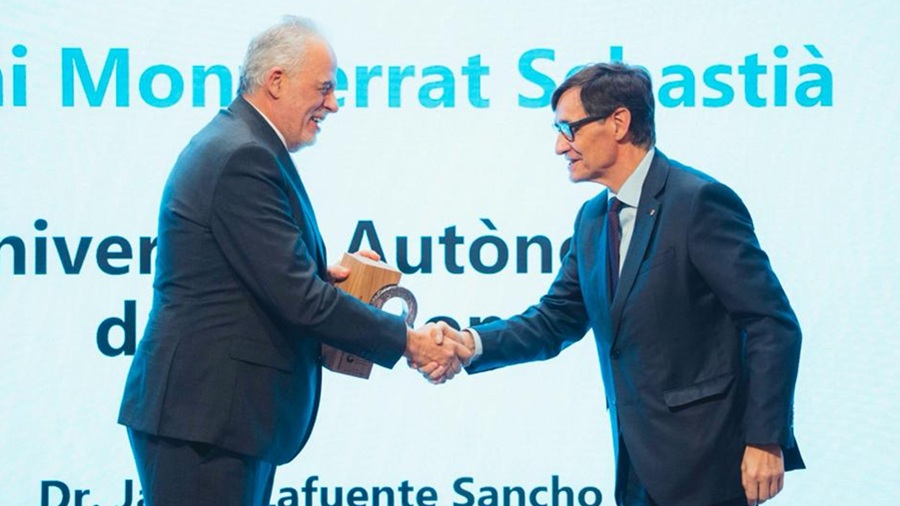
Rector Lafuente congratulated the government for the initiative of creating these awards, which will contribute to “working to make research more connected to society every day.” According to the rector, the goal of open science is “to bring laboratories closer to citizens,” “to generate more transparent knowledge with a tangible impact,” and “for society to benefit from the results of our research”. And directly regarding the award for the UAB, he stated that “it goes far beyond specific policies: it is a recognition of the collective commitment of the university community” to the open science strategy.
President Illa declared that with these awards, “we are making a declaration of principles on how we understand science, what role we want for science, and what significance we give to science.” Secretary of Research and Universities Núria Montserrat expressed her hope that open science will contribute to “consolidating Catalonia as a leading international hub, positioned among the best in Europe”.
A leader in integrating open science
The award, with a cash prize of 75,000 euros, recognises the UAB's role as a leading public university in integrating open science into its institutional strategy. The award also acknowledges the University for implementing open access policies and promoting the reuse of data and resources in accordance with the FAIR principles (Findable, Accessible, Interoperable, and Reusable).
The Open Science Awards of Catalonia are organised by the Ministry for Research and Universities of the Government of Catalonia, the Consortium of University Services of Catalonia (CSUC), and the Catalan Foundation for Research and Innovation (FCRI). The goal is to recognise researchers and institutions that have contributed to making research results more accessible to the academic community and to society as a whole.
As for the category for entities, the Montserrat Sebastià Award, a category that includes universities, research centres, and hospitals, a total of twelve nominations were submitted. The jury noted the high quality of the nominations received in this first edition and the difficulty this presented in determining the awardees.
In addition to the UAB, Josep Perelló, lecturer of Condensed Matter Physics at the UB, was awarded the Mercè Durfort Award, and Blanca Arias, lecturer in the Department of Translation and Language Sciences at the UPF, and Jordi Gené, researcher in proximal remote sensing and artificial intelligence at the Institute for Agricultural and Food Research and Technology (IRTA), both received a Joan Modolell Award.
The names of the three award categories pay tribute to three late Catalan researchers of notable prestige within the scientific community: cell biologist Mercè Durfort (1943–2022), biochemist and molecular geneticist Joan Modolell (1927–2023), and researcher in information ecology and digital content management Montserrat Sebastià (1957–2014).
The UAB, with Sustainable Development Goals
 Industry, innovation and infrastructure
 Quality education