The UAB kicks off the university academic year with Catalan culture as the star
American-born translator and cultural diplomat Mary Ann Newman gave the inaugural lecture at the opening of the university system's new 2026/27 academic year, and highlighted the contribution of Catalans to the USA: "understanding immigration as a vehicle for transmitting cultural heritage is the richest contribution I can make as a translator." This academic year, the UAB is dedicating its thematic year to Catalan culture.
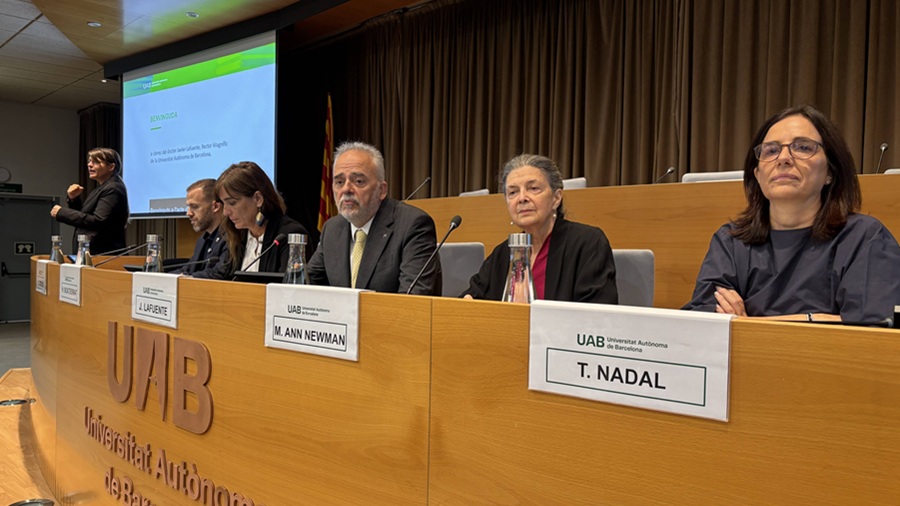
The UAB hosted the opening ceremony for the 2026/27 academic year of the Catalan university system this Friday 2 October. The ceremony, held in the conference hall of the Rectorat building, began with a performance by the UAB Escuradents bastoners group. The inauguration brought together representatives from the university sector and was centred on the lecture “Veure l’elefant sencer: la cultura catalana a Nord-Amèrica” [Seeing the Whole Elephant: Catalan Culture in North America], delivered by translator Mary Ann Newman.
The event, which was presided over by UAB Rector Javier Lafuente and Catalan Minister for Research and Universities Núria Montserrat, began with a welcome from Elisabet Carnicé, presenter and UAB alumna, who led a minute of silence in tribute to former rectors Carles Solà and Antoni Serra Ramoneda, who passed away in 2026.
Preserving the legacy of Carles Solà and Antoni Serra Ramoneda
Justament la intervenció de Javier Lafuente s'ha iniciat amb unes paraules sobre Carles Solà i Antoni Serra Ramoneda: «la millor manera d’honorar la memòria de tots dos és preservar el seu llegat i continuar treballant per una universitat acadèmicament exigent, oberta al món, compromesa amb el país i al servei de la societat». Així mateix, ha assegurat «que l’exemple i el compromís d’aquests estimats professors continuaran inspirant-nos en la tasca col·lectiva que avui reprenem».
El rector de la UAB ha reivindicat el valor del coneixement com a pilar fonamental de progrés i com a element cabdal per avançar «cap a una societat més justa i democràtica» i ha assenyalat que «els canvis socials i demogràfics, les desigualtats persistents, les tensions geopolítiques, la crisi climàtica i la irrupció de noves tecnologies són desafiaments per a les universitats perquè, més enllà de la nostra funció fonamental de crear, transmetre i transferir coneixement, les universitats hem de contribuir activament a donar resposta als grans reptes col·lectius del nostre temps».
El rector ha recordat que la universitat, com a servei públic, contribueix a fer «una societat més justa que garanteixi que el talent, l’esforç i la vocació siguin els factors que determinen les oportunitats de cada persona», però que és imprescindible «disposar d’un model de finançament que garanteixi prou recursos per planificar amb visió de futur». I ha anunciat que treballen amb el Departament de Recerca i Universitats en un model de finançament basat en un contracte programa entre les universitats i l’Administració: «un model amb una clara rendició de comptes que incorpori, alhora, les singularitats de cada universitat». En aquest sentit, «Govern i universitats compartim l’objectiu d’enfortir el sistema universitari català per afrontar amb garanties els reptes presents i futurs de país», ha finalitzat Lafuente.
"Un model de finançament sostenible"
Per la seva banda, la consellera de Recerca i Universitats, Núria Montserrat, ha afirmat que el Govern acompanyarà les universitats, davant dels reptes de futur, "garantint recursos i dotant-les d'un model de finançament sostenible", i ha afegit que “el gran repte de les universitats serà canviar per no perdre la seva essència i incorporar la tecnologia sense renunciar a l'humanisme".
També hi ha hagut parlaments de la presidenta del Consell Social de la UAB, Tania Nadal, que ha agraït el compromís expressat per la consellera amb el finançament del sistema universitari català: "Ens cal un model de finançament que respongui a les necessitats reals de les universitats i del país". Tania Nadal també ha fet esment dels reptes que suposa la IA: "La digitalització i la IA estan canviant la manera com adquirim coneixement. L'aula ha de ser el lloc on s’aprèn a interpretar-lo. La universitat ha de formar persones per comprendre la IA i qüestionar-la”.
Per la seva banda, l’alcalde de Cerdanyola, Carlos Cordón, ha assenyalat, en el seu parlament que "infraestructures científiques com el Parc de l'Alba situen Catalunya en el mapa mundial de la innovació, i la UAB és el cor bategant d'aquest ecosistema".
Lecture by Mary Ann Newman
Abans dels parlaments, la traductora Mary Ann Newman ha pronunciat la lliçó inaugural, en què ha fet un repàs a l'empremta catalana a Nova York al llarg de la història. Ha destacat que convé pensar d’una altra manera la projecció cultural: «explicar als americans què en tenen, de catalans, i explicar als catalans què han deixat a Amèrica».
Per a aquesta diplomàtica cultural, «en un moment de tanta hostilitat cap a la immigració, això pot ser un bàlsam. Però sobretot és una visibilització. Al cap dels anys, ajudar a fer visible allò amagat, estudiar l’amplitud i la complexitat de l’empremta catalana a l’Amèrica del Nord i entendre la immigració com a transmissora de patrimoni cultural potser és, al capdavall, la contribució més rica que puc fer com a traductora i mitjancera de la cultura catalana».
Annual report and presentation of the Jaume Vicens Vives awards
During the ceremony, UAB Secretary General Esther Zapater presented a video with the highlights of the 2025/6 academic year.
The Jaume Vicens Vives awards—presented by the Government of Catalonia to lecturers and projects at Catalan universities in recognition of teaching quality—and the M. Encarna Sanahuja mentions for excellence in incorporating the gender perspective into university teaching practice, were also awarded. Among the recognised initiatives is the Antígona research group from the UAB.
The Jaume Vicens Vives awards were given to three lecturers and three collaborative projects from Catalan universities. The individual awards went to Amalia Creus Quinteros (UOC), Cristina Petreñas Caballero (UdL), and Miquel Àngel Prats Fernández (URL). Regarding the collaborative projects, initiatives from the UOC, UIC Barcelona, and Rovira i Virgili University were honoured.
Music also played a role in the ceremony, with two performances by the group Tincatinc, which played several pieces of traditional Catalan music—notably the garrotins dedicated to the university and educational community.
The Gaudeamus igitur, performed by the UAB Choir, brought the ceremony to a close. To conclude, the Ganàpies, the UAB castellers troupe, gave a performance, and refreshments of typical Catalan products were offered to the attendees.