The ENIA UAB-Cruïlla Chair and the Computer Vision Centre present a science and innovation space at the Cruïlla Festival
From July 8 to 11, the Festival Cruïlla will become a space for exploring the role artificial intelligence can play in the arts and music, within the context of open science and innovation. Research entities, public authorities, and companies from the innovation ecosystem are collaborating in this initiative to test new technologies in a real-world setting, placing citizens at the heart of the activities. This initiative is driven by the ENIA UAB-Cruïlla Chair for AI Research in Music and the Arts—a joint venture between the UAB and Barcelona Events Musicals (organisers of the Cruïlla Festival)—led by Fernando Vilariño, lecturer in the UAB Department of Computer Science and Artificial Intelligence, with the collaboration of the Computer Vision Centre (CVC).
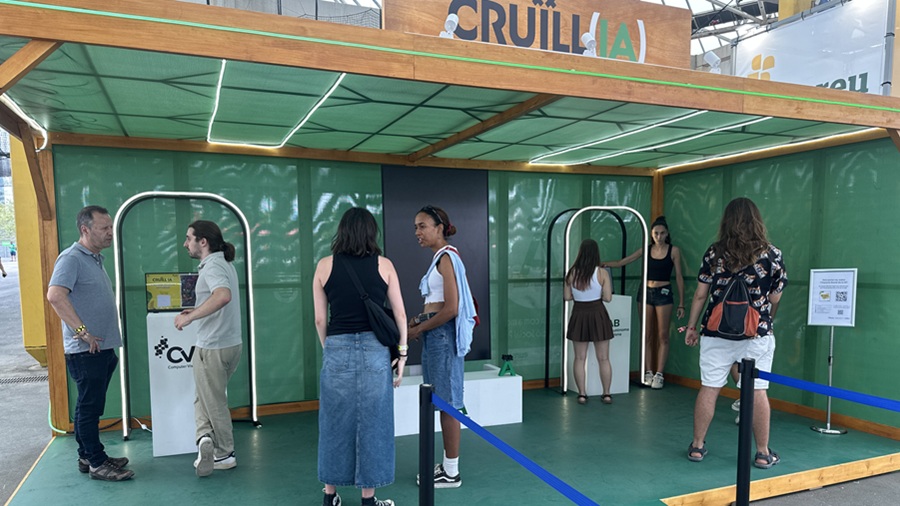
The initiative will transform the festival into a living laboratory where attendees are invited to explore socially acceptable uses of AI through business and academic prototypes. This year, under the theme "Cruïlla is Home: Your Identity and AI," practical, concrete examples will be presented regarding the potential consequences and impacts on digital identity—covering aspects such as human body representation and hyper-sexualisation, the interpretation of preferences, and the tensions between individual and collective identity.
Nonetheless, beyond the technological experience, the goal is to incorporate the citizens' perspective into the validation of new solutions prior to their implementation, fostering open, responsible innovation aligned with European values.
The festival, an ephemeral city for innovation
The initiative is part of the mission of the ENIA UAB-Cruïlla Chair to transform both the UAB campus and the Cruïlla Festival into living innovation laboratories, where artificial intelligence research is conducted while enabling the public to participate in the debate on what constitutes socially acceptable AI.
For four days, the Cruïlla Festival transforms into an ephemeral city where nearly 80,000 people share spaces, activities, and cultural experiences, and where AI plays a role in multiple dimensions—ranging from creative content generation to logistics, audience management, and planning. This ecosystem offers a unique environment to observe how new technologies interact with people in real-world situations and to incorporate this experience into the innovation process.
In this context, and in collaboration with the Catalan Data Protection Authority (APDCAT), the Chair is helping to develop a pioneering open experimentation space at the festival—a unique model serving as a regulatory learning sandbox—that will enable the validation of artificial intelligence prototypes while fully guaranteeing the protection of rights. Integrated into Barcelona City Council’s new ordinance on experimentation spaces, this model will also ensure that the demonstrators presented are ready to comply with new regulations on data protection and artificial intelligence, specifically the General Data Protection Regulation (GDPR) and the European AI Act—while involving citizens in defining socially acceptable uses.
To this end, the Chair has relied on the guidance of the APDCAT to mitigate the impact on fundamental rights arising from the design and use of AI systems. Specifically, the Catalan Data Protection Authority has provided support for regulatory compliance—promoting privacy by design and by default—and has made the Catalan FRIA model available to the project; this is a pioneering European methodology for designing and using trustworthy and responsible AI systems, developed by the APDCAT within the framework of the "DPD en xarxa" (Networked DPO) community.
Four AI initiatives to be validated in a real-world environment
The space will bring together four initiatives—two business-led and two academic—that will be validated with the direct participation of festival attendees. Among the business initiatives is Lainapp, which emerged from the AI4ALL programme (coordinated by the UAB Parc de Recerca) and develops artificial intelligence tools to personalise content and monitor mass events in real time, aiming to improve the attendee experience. Also participating is Tecous, a startup driven by the AI Accelerator programme (coordinated by the RDI-IA Network), which is developing a platform to make the terms and conditions of digital services easier to understand.
The space will also feature two demonstrators developed in an academic setting. The first, "Tal cara, tal beat," was created by students from the UAB’s Artificial Intelligence degree programme as part of a challenge-based learning project. Using a photograph and a brief questionnaire, the system generates a personalised musical composition, identifies musical affinities, and suggests connections with artists and other festival attendees. This demonstrator explores the potential of AI systems to interpret tastes and preferences based on various information sources while simultaneously inviting the public to reflect on the limits of such inferences and the responsible use of personal data.
The second academic demonstrator, CraftGraffiti—developed by the Computer Vision Centre—invites visitors to become the stars of Cruïlla Festival posters. Using a photograph as a starting point, a generative AI system creates a personalised visual narrative inspired by the festival's musical universe and graffiti aesthetics, one of its most distinctive artistic expressions. Beyond the creative experience, the demonstration prompts questions about how generative models represent identity and the human body, as well as the stereotypes they may perpetuate.
Citizens at the heart of developing responsible AI
The demonstrations will be accompanied by multimedia materials designed to foster reflection, developed in collaboration with the UAB-Cruïlla Chair’s Techno-Values Committee, which has helped analyse these technologies in terms of their ethical and regulatory dimensions, as well as their social impact. The goal is for attendees not only to experiment with artificial intelligence but also to engage in an open conversation about the risks, opportunities, and values that should guide its development.
For the UAB-Cruïlla Chair, public participation is essential to building an artificial intelligence that meets society's needs. The arts and cultural festivals provide an ideal setting for this dialogue, bringing research closer to the public and incorporating their perspectives into the innovation process.
A university, research and cultural alliance
The ENIA UAB-Cruïlla Chair is a public-private initiative involving the Universitat Autònoma de Barcelona and the Cruïlla Festival, with the Computer Vision Centre participating as a collaborating entity. Its activities are structured around three main lines of work: AI as a creative tool (AI-CREATE), AI as support for artistic creation processes (AI-SUPPORT), and AI as a tool to enrich the cultural experience (AI-EXPERIENCE).
The project brings together researchers from the UAB, the Computer Vision Centre, and the Artificial Intelligence Research Institute (IIIA-CSIC), working in collaboration with the Barcelona Music Lab, Eurecat, and the Fundación Épica La Fura dels Baus to drive open, responsible research aimed at generating a positive social impact. The project is partially funded by European Next Generation funds through the ENIA strategy (National Artificial Intelligence Strategy) of the Spanish Government's Ministry for Economic Affairs and Digital Transformation.
The UAB, with Sustainable Development Goals
 Sustainable cities and communities