Study confirms gender inequalities still faced by war correspondents
A research by UAB Journalism graduate Ada Solà Conesa and based on the direct testimony of seven active war correspondents—Mònica Bernabé, Laura de Chiclana, Txell Feixas, Maria Dolors Massana, Marcos Méndez, Gervasio Sánchez and Alfonso Bauluz—confirms that since the war in Ukraine there has been a notable female presence in conflict zones. However, in this Final Degree Project awarded by the FAS, the female reporters interviewed continue to point out and identify significant gender inequalities when carrying out their journalistic work.
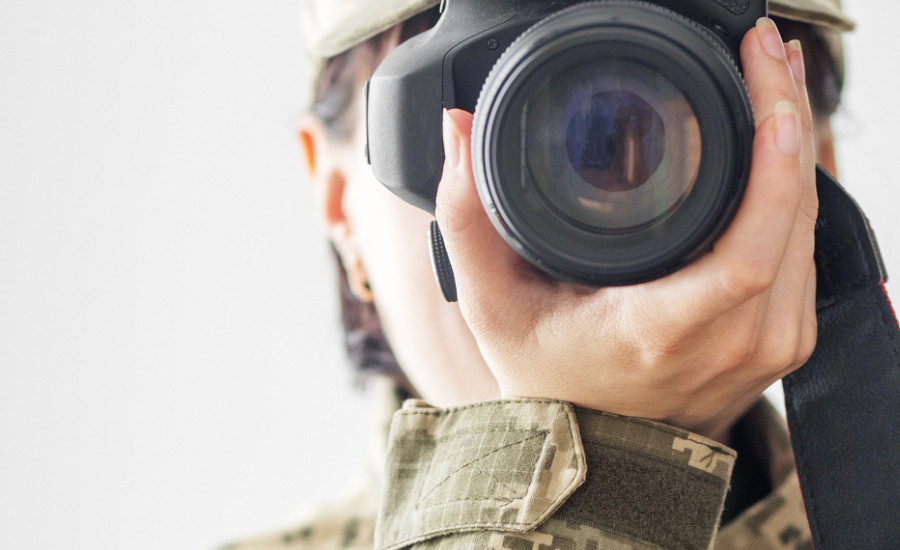
At a time when information about global conflicts plays a key role in shaping public opinion, the research advocates for making women correspondents more visible and incorporating diverse perspectives that allow for a better understanding of the human consequences of war.
Journalist Ada Solà Conesa, graduate of the Universitat Autònoma de Barcelona (UAB), focused her bachelor's thesis—supervised by UAB Journalism professor Beatriz Villarejo Carballido—on the gender inequalities that female war correspondents continue to face. The research, recently recognised with an Arcadi Oliveres Award from the Fundació Autònoma Solidària (FAS) for its contribution to human rights, equality, and global justice, analyses the obstacles that still persist for female war reporters in the practice of their profession.
The thesis, entitled Veus al front: La lluita de les corresponsals de guerra contra les desigualtats de gènere (freely accessible in the UAB Digital Document Repository), analyses how women journalists have had to overcome historical barriers in a traditionally male-dominated field, characterised by structural sexism, professional invisibility, work-life balance challenges, cyber-harassment, and specific risks of sexual violence in conflict zones.
"The discrimination they face is not an isolated incident but is structural, persistent, and multifaceted; it manifests in professional barriers, as well as cultural, symbolic, and social ones that perpetuate stereotypes and pre-established roles." In this context, the thesis notes that motherhood remains a "source of penalty." "A father covering a war is seen as a brave hero, whereas a mother doing the same is stigmatised as a bad mother who abandons her children," the researcher points out.
The study also highlights that many female professionals have had to keep quiet about experiences of harassment or assault for fear of having their professional competence questioned. Furthermore, several reporters have voiced the perception of female correspondents as "spoils of war," warning of the constant fear of sexual assault in conflict zones.
Paradoxically, being a woman has opened doors that were closed to men, allowing access to spaces and stories that—without the female perspective—would have remained invisible. This perspective offers a narrative that is "more empathetic, intimate, and diverse, breaking the heroic and masculinised narrative", the author notes in the conclusions of this recently awarded project.
The war in Ukraine represented a turning point
The research confirms that the war in Ukraine has marked a turning point, as a significant female presence—often young and adept at leveraging new technologies and direct communication channels—is being seen in conflict zones for the first time. This shift has brought a more diverse generation of correspondents into the spotlight. "This growing presence has broken silences and paved the way, making other ways of reporting on the war visible," states the study's author. However, she also highlights that "this progress risks being mistaken for an equality that has not yet been achieved. Visibility is not synonymous with equity."
This research is based on interviews with renowned active professionals who cover conflicts:
-Maria Doleres Massana, one of the pioneers of female war journalism in Spain. She was the first head of the international news desk at La Vanguardia and one of the first women to report from the Middle East and the Maghreb.
-Mònica Bernabé, freelance correspondent in Afghanistan (2006–2014) for El Mundo and currently associated with Diari Ara. Recognised for her social and journalistic work.
-Txell Feixas i Torras, former Beirut correspondent for TV3 and Catalunya Ràdio. With over 20 years of experience, she has reported from Syria, Iraq, Afghanistan, Gaza, and Turkey. She has received various awards.
-Laura de Chiclana, freelance journalist collaborating with Mediaset España. She has covered conflicts and humanitarian crises in Ukraine, Israel, Venezuela, and Colombia, as well as the migration crisis in Lesbos. She has received various awards.
-Gervasio Sánchez Fernández, photojournalist specialising in armed conflicts in Latin America, the Gulf War, the Bosnian War, Afghanistan, and Africa. He has worked for La Vanguardia, Cadena SER, the BBC, Heraldo de Aragón, and the Cover agency.
-Alfonso Bauluz de la Iglesia, journalist and current president of the Spanish section of Reporters Without Borders since 2022. International editor at the EFE news agency and special correspondent covering wars and natural disasters.
-Marcos Méndez Moreira, freelance broadcast journalist. He has covered international conflicts and disasters for media outlets such as Telecinco and El Progreso. He has received several awards.
Final Degree Project awarded the ARCADI OLIVERES 2026 Award
Veus al front: La lluita de les corresponsals de guerra contra les desigualtats de gènere
The UAB, with Sustainable Development Goals
 Reduced inequalities
 Gender equality