Documentary "Earth’s Greatest Enemy" screened at the UAB
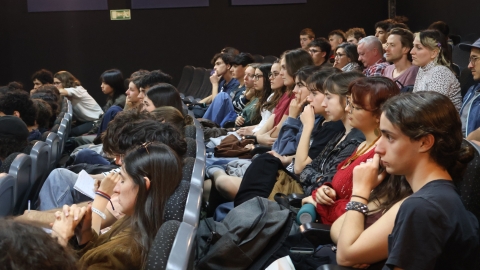
On 27 March over 115 people attended the screening of the documentary Earth’s Greatest Enemy at the UAB Cinema Hall, followed by a round table on the impact of the US military industry on the environment. Participating in the event were CREAF and ICTA-UAB researchers and Abby Martin, director of the documentary.
According to a study by Pennsylvania State University, the US army generated a total of 636 million metric tonnes of CO₂ from 2010 to 2019, proving to be being one of the world's largest institutional polluters.
Filmmaker Abby Martin captures this reality, often hidden by the media and international institutions, in her new documentary Earth’s Greatest Enemy. The audiovisual piece combines investigative journalism, shocking images and stories of affected communities and seeks to "awaken the critical awareness of citizens in the face of imperialism, a result of the current capitalist system", she highlights.
Over 115 people attended the screening, which took place on 27 March at the Cinema Hall of the Universitat Autònoma de Barcelona (UAB). Following the documentary, a round table was held with the participation of Sandra Saura, lecturer and researcher at CREAF, another researcher from ICTA-UAB, and the director of the documentary, Abby Martin.
The researchers contextualised the impact the military industry has on ecosystems and the environment. In the case of the Syrian conflict, almost 20% of the country's forests have been destroyed in these past nine years, a surface equal to the of the Barcelona Metropolitan Area. And the exploitation of rare earth mining, minerals necessary for the construction of military and war weapons, increased by more than 85% between 2017 and 2020.
The director defined the current situation as an era of “existential crisis” in which we observe all events as if they were part of a reality TV show. She highlighted that “the most powerful men in the world” carry out activities that have a devastating impact on the planet and people. This occurs in a global context where European leadership has a great responsibility, as they allow major global actors to act without limits.
The audience shared questions and concerns about the topic with the director, and were able to reflect on the environmental crisis caused by the military and arms industry.