The UAB develops an optical technology to predict the coagulation capacity of milk
MilkOpt has been selected to receive support from X_AgriTech to define its roadmap to market. The technology aims to facilitate the classification of milk according to its suitability for cheese making.
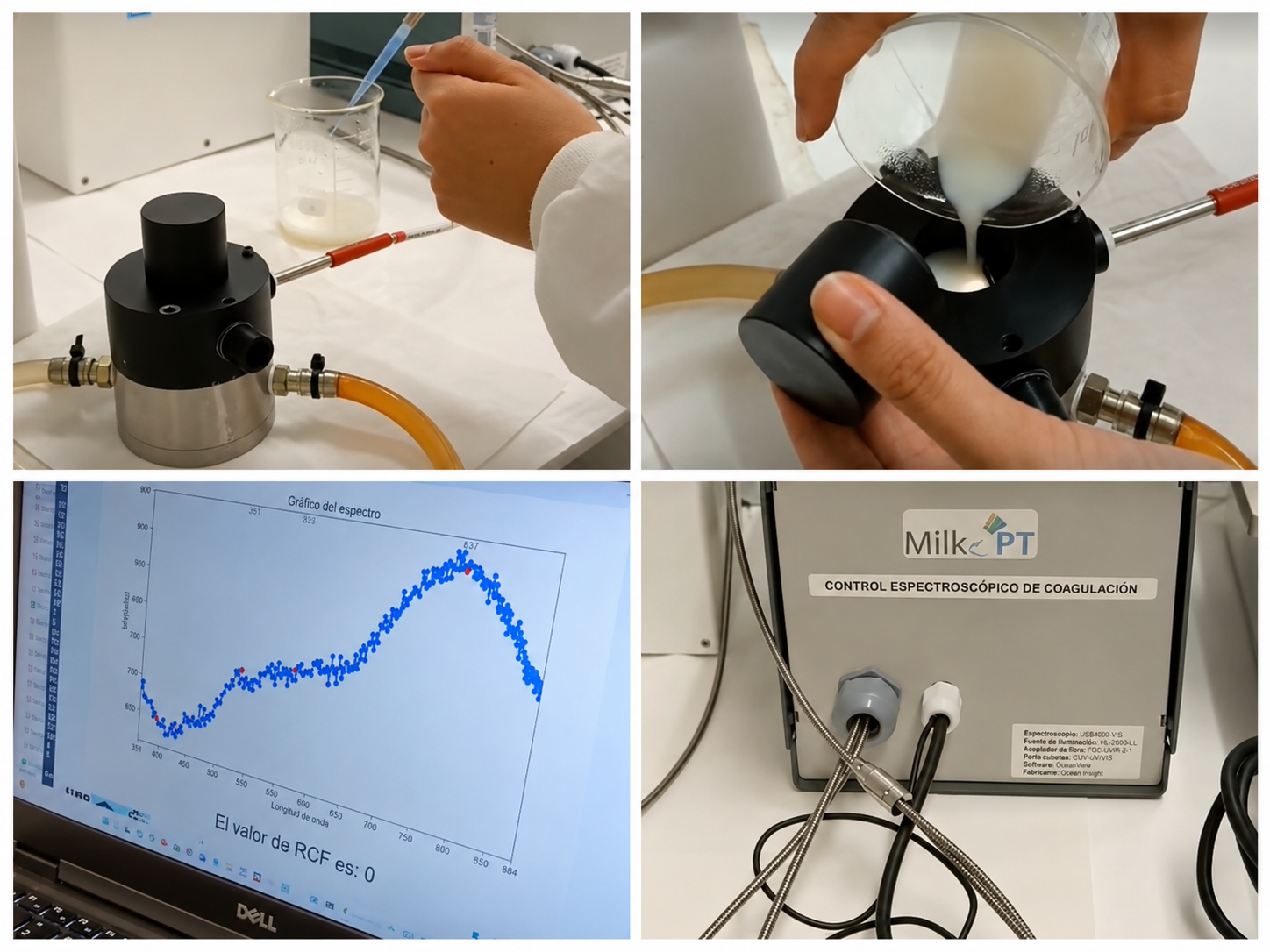
MilkOpt, a technology developed at the UAB to predict the coagulation capacity of milk before the addition of rennet, has been selected for the 2026 X_AgriTech grant call. This support falls under the "Technology Roadmap to Market" category, which focuses on defining the steps required to advance the transfer of research results to the productive sector.
The technology is the result of Lucía Verdugo González's doctoral thesis, supervised by Manuel Castillo Zambudio, Anna Zamora Viladomiu and Oscar Arango Bedoya at the Centre for Innovation, Research and Transfer in Food Technology (CIRTTA-UAB). The proposal combines optical measurements with predictive models to obtain information on the suitability of milk for cheese production.
Coagulation is a fundamental stage in this process: it enables the formation of the curd and influences both the yield and the characteristics of the product. Its behaviour varies depending on factors such as milk composition and processing conditions. Being able to anticipate this property could help producers and the dairy industry classify raw materials before processing, as well as predict critical parameters—including the timing for cutting the curd and the expected cheese yield.
"We want to help cheese producers and creameries determine the coagulation capacity of milk before processing it. The next step is to test how the models perform using samples from different farms," explains researcher Lucía Verdugo González.
Models calibrated with data from the UAB experimental farm
The team's work includes models that use information from the visible and near-infrared spectrum, as well as models that also incorporate fluorescence data. These techniques enable the collection of optical data on milk, which are used to generate the predictions.
The algorithms were calibrated using data from various animals at the UAB experimental farm: Murciano-Granadina goats, as well as Lacaune and Manchega sheep. To further this development, the team plans to expand data collection to include animals from different farms and to validate the models using independent milk samples. This expansion would allow for working with a greater diversity of samples and evaluating predictions using data distinct from that used to calibrate the algorithms.
The results have been protected by a European patent application filed in 2025, entitled "Methods and Systems for Predicting Milk Coagulation Properties", and an international application filed in 2026 claiming the priority of the former.
Support from X_AgriTech in the transfer process
The grant scheme in which MilkOpt was selected provides support to analyse the development status of a technology and to draw up a personalised roadmap. It includes identifying validation and maturation needs, defining a transfer strategy, offering recommendations on intellectual property, and seeking potential partners and funding opportunities.
Coordinated by IRTA and with the participation of the UAB, X_AgriTech promotes the transfer of knowledge and technology to the agri-food sector. The network is supported by the Ministry for Research and Universities of the Government of Catalonia.