Digital map created to track armed conflicts and peace processes around the world
The UAB's School for a Culture of Peace (ECP) has launched a "Map of Conflicts and Peace", a new interactive digital tool that analyses current conflicts, crises and peace negotiations and provides information on the causes, agents, intensity of the violence and evolution. This practical tool aims to be useful for the education community and the public in general and is available in Catalan and in Spanish at: ECP's Map of Conflicts and Peace.
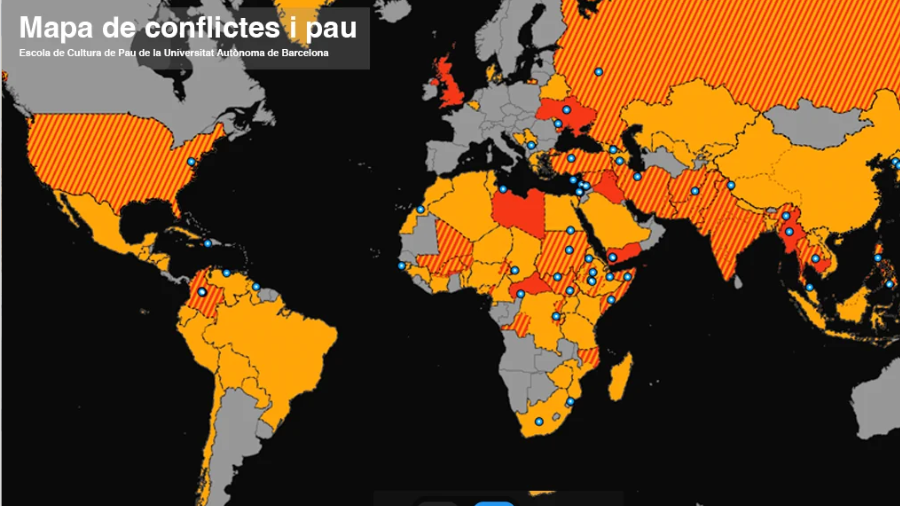
It profiles and analyses the 40 armed conflicts, 113 situations of political and social tension, and 53 peace processes and negotiations taking place around the world.
The map analyses the historical and current context, the causes, actors, dynamics and impacts of conflicts, tensions and peace processes, and incorporates a gender perspective. "It is aimed at various audiences, such as universities, secondary schools, the media and NGOs, among others, with the aim of contributing to critical thinking and the promotion of a culture of peace," says Josep Maria Royo, researcher at the ECP.
Specifically, it analyses the 40 armed conflicts, 113 situations of tension, and 53 peace processes in 2025, as well as the 37 armed conflicts, 116 situations of tension, and 52 peace processes and negotiations in 2024. The map focuses in particular on armed conflicts in Mali, the Western Sahel, the Democratic Republic of the Congo (eastern region), Somalia, Myanmar, Pakistan, the Philippines (Mindanao), Thailand (southern region), Russia-Ukraine, Turkey (PKK), and Yemen; this information will be expanded in the future to include other contexts.
Africa is the continent with the highest number of cases, with 17 armed conflicts, followed by Asia and the Pacific, with 12. Of the 40 conflicts analysed for 2025, 20 are classified as high-intensity—a category that assesses lethality and the impact on the population and territory, and which the map associates with confrontations resulting in more than 1,000 fatalities per year—including those in Sudan, Israel-Palestine, Russia-Ukraine, Myanmar, Syria, Somalia, Mali, Colombia, and Haiti. Regarding their trajectory, 18 conflicts are escalating compared to 2024, 13 remain unchanged, 8 are de-escalating, and the India-Pakistan conflict is listed as having concluded in 2025.
Furthermore, the majority of the conflicts analysed (24 out of 40) are internationalised internal conflicts, reflecting both the regional and international dimensions of these confrontations. As for the human impact, the map records more than 9 million internally displaced people due to conflict and violence in Sudan and, in the case of Syria, almost 6 million displaced people and 5.5 million refugees.
Depending on data availability, each profile includes indicators from key international sources—such as data on the refugee population (UNHCR) and displaced persons (IDMC), or human and gender development indices (UNDP)—which will be expanded upon in the future.
The map, which draws on the ECP’s more than 25 years of experience in analysing armed conflict and peacebuilding, aims to contribute to the understanding of conflicts and peace processes, and to promote a culture of peace within the educational community and among the general public.
The digital map has received positive feedback from many sectors, such as secondary school teachers in the EduglobalSTEM and Amix Crítix teacher working groups, and lecturers at Catalan universities. In this regard, "we presented a trial version of the map and exchanged impressions with various stakeholders, including members of the secondary school teacher working groups, who have highlighted the usefulness and potential of this resource for the educational field," says Ana Villellas, researcher at the ECP.
The ECP’s Map of Conflicts and Peace was designed by the company Lovelymaps, which was also responsible for its technological development. The development of the tool received to support of the Catalan Agency for Development Cooperation.
Link to the Map of Conflicts and Peace.