The conference for the 25 Years of "InfoK" held at the UAB highlights the importance of informing children in this digital world
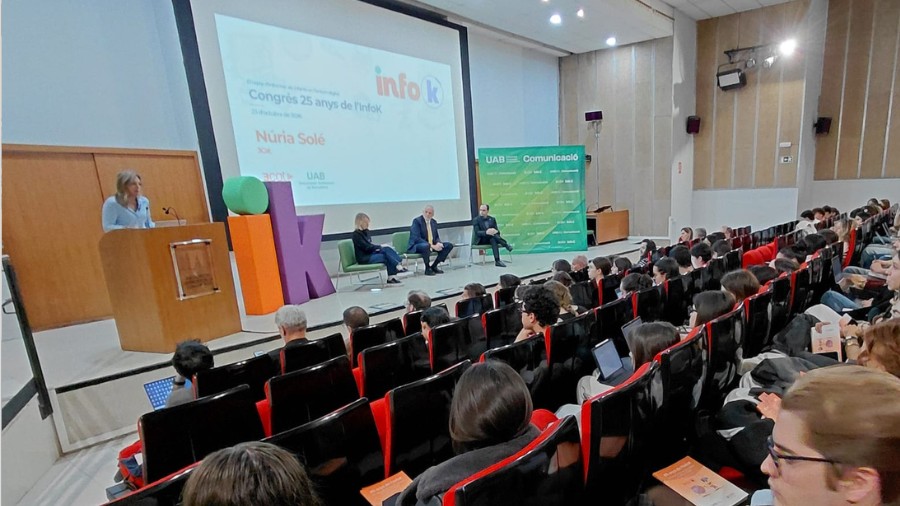
The Faculty of Communication Studies hosted the conference "El repte d'informar els infants en l'entorn digital" [Challenges in Informing Children in the Digital Environment] on Friday 23 October. The event was organised by the UAB and 3Cat, and was held in celebration of the 25th anniversary of the InfoK news programme for children. Academic experts and information professionals debated on the best ways to communicate current issues to children. Lewis James, editor of the BBC's children's news programme Newsround, a pioneering show in this field, delivered a conference in which he emphasised that now more than ever high-quality information is crucial for children.
Javier Lafuente: "It is a commitment to públic service that 3Cat television and the UAB share.”
Rosa Romà: "This faculty has been a training ground for many of the programme's professionals, which speaks to the prestige of this institution"
Lewis James: "I know that the programme's reputation for humanising the news and making it understandable for children is well deserved."
As part of the celebrations marking the programme’s 25th anniversary, the UAB and 3Cat organised a gathering to reflect on how information is handled when aimed at children, its educational dimension, and the challenge facing media outlets in a context where screens have become the primary medium for adolescent consumption. The Aula Magna of the Faculty of Communication Studies was filled with students and faculty from the Faculty’s degree programmes, as well as media professionals, all gathered to hear the views of the participants.
The first presenter of InfoK, journalist Núria Solé, gave way to the opening interventions. The rector of the UAB, Javier Lafuente, explained that “we live in an environment dominated by digital media, information circulates constantly and without control, and distinguishing facts from opinions is one of the fundamental challenges.” And in this context, Infok has an essential function, the rector said: “not only to inform children about current affairs but also to educate them as citizens capable of understanding reality”. For Rector Lafuente, “the programme has contributed to creating an information culture among children and to awakening their interest in what is happening. It is a commitment to public service that 3Cat television and the UAB share”.
Rosa Romà, president of the Catalan Corporation of Audiovisual Media, highlighted the issue of disinformation and the "noise" generated on social media, underscoring how important it is for children and adolescents to be well-informed. "The educational role played by a children’s news programme like InfoK is more crucial today than ever," she stated. She added that it also serves as "a tool to bring the Catalan language closer to children, to promote social cohesion, and to help shape identity during childhood—a key stage in a person's life". She also noted that the UAB Faculty of Communication Studies "has been a training ground for many of the programme's professionals, which speaks to the prestige of this institution. We are grateful for the education that makes the media landscape we have today possible," she said.
Following that, a plenary session was held, led by Lewis James—editor for the BBC’s children’s news programme Newsround, which began airing in 1972 and pioneered this genre in Europe. When InfoK was launched 25 years ago under the guidance of its first director, Joan Carreras, it took Newsround as its model. “I know that the programme’s reputation for humanising the news and making it understandable for children is well-deserved—and not just among children, but also among parents and teachers. I would like to congratulate the entire team on reaching this milestone,” said Lewis James.
Afterwards, three panel discussions were held with different moderators and participants who debated three main topics: the kind of news coverage aimed at children provided by 3Cat's children's programme, the educational role of audiovisual media, and the media consumption of children and adolescents. One of the constant concerns raised during the debates were how to deliver truthful, high-quality information to children in a society awash with information and digitalisation.
These debates featured contributions from professionals associated with InfoK, such as journalists Núria Solé, Manel Alías, Laia Servera and the current director, Núria Vilanova. The academic section included researchers from across Spain and experts in information and children, education, outreach, or psychology, such as David Bueno from the University of Barcelona; Mònica Figueras, from Pompeu Fabra University; Salvi Canadell, from the Digital Culture Area of the Ministry for Education and Vocational Training of the Government of Catalonia; José Alberto García Avilés, from Miguel Hernández University; Cristina Mercader and Santiago Giraldo, from the UAB; Sara Malo, from the University of Girona; and Miguel Ángel Casado from the University of the Basque Country.
In one of the debates, Núria Vilanova, the current director of the programme, explained that “an essential part of InfoK’s work is to inform young people about current events, providing them with the tools necessary to navigate the world with discernment,” and to help foster “critical, autonomous, and well-prepared citizens.” According to Vilanova, one of InfoK’s goals is for “children not to be mere spectators of the world they live in, but rather active participants.”
The congress was curated by lecturer Marta Narberhaus, from the Faculty of Communication Studies at the UAB, who won the fourth edition of the Montserrat Minobis Scholarship with the project “The gender perspective in children's news bulletins. A study on the representation of female journalists, gender-sensitive topics and the promotion of equality and women's rights in InfoK”. In addition, Narberhaus was the editor of the conference proceedings book, “25 anys de l’InfoK. El repte d’informar els infants en l’entorn digital” (UAB Publications Service), which was presented during the conference and given to all participants, and is available online at the UAB’s DDD website.
In the afternoon, a participatory debate involving around 200 children took place, moderated by the current director of InfoK, Núria Vilanova. During the session, children from various schools had the opportunity to share their views on how they stay informed, what interests them, and what they think about the whole process. Topics discussed included how to distinguish between an opinion and a fact, as well as the use of AI when seeking information.
The closing speeches were given by Virgínia Luzón, UAB vice-rector for Communication; Juanjosé Perona, dean of the UAB Faculty of Communication Studies; and Sigfrid Gras, director of TV3.