Convert any magnet into any field: the UAB and Chalmers University of Technology present the magnetic omniconversion
The new method, which is now being patented, could benefit biomedical tools such as magnetic resonance imaging or laboratory techniques such as mass spectrometry.
Physicists from the Universitat Autònoma de Barcelona and Chalmers University of Technology, Sweden, have found a way to transform the magnetic field of a source—such as a coil or a permanent magnet—into virtually any other predetermined field throughout a region of space, with mathematical precision.
The work, signed by Jaume Cunill-Subiranas, Natanael Bort-Soldevila, Fabian Resare, Núria Del-Valle, Witlef Wieczorek and Carles Navau, is to be published in the journal Science Advances, and the idea of this magnetic omniconversion is in the process of being patented.
Generating a magnetic field with a specific shape—uniform, dipolar, etc.—usually requires designing bulky, precisely tuned combinations of coils or magnets that, moreover, only approximate the desired field. The new method, magnetic omniconversion, surrounds the region of interest with layers of two materials arranged in a highly precise geometry: soft magnets (such as soft iron), which channel the field like a nearly perfect magnetic conductor, and superconductors, which tend to expel it. By calculating the exact geometry of these surfaces, the team has demonstrated that the internal field takes on the exact desired shape, regardless of the external source. This concept generalises magnetic shielding—which merely cancels out external fields—into a tool that transforms them into any target pattern.
Practical applications
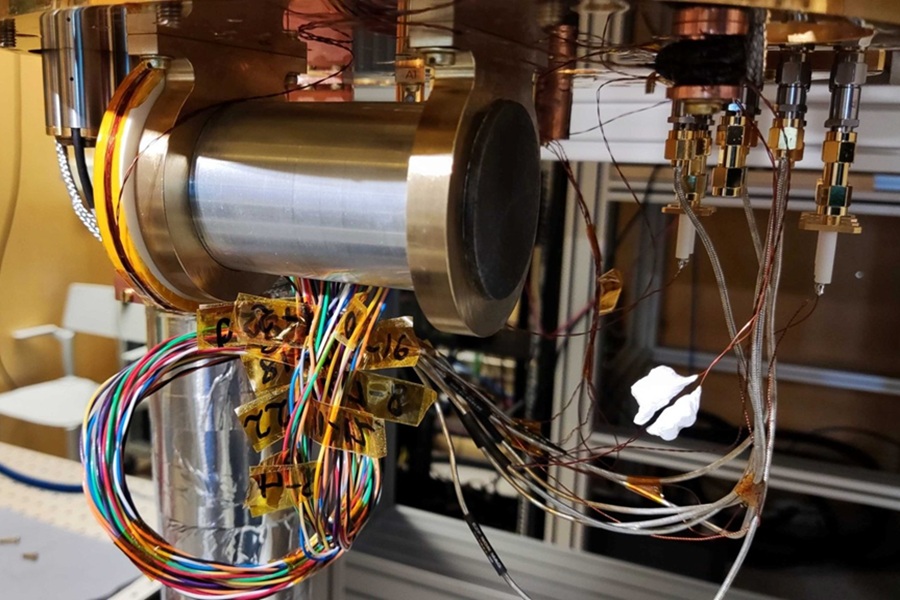
To demonstrate this, they built and tested a device that converts the non-uniform field of a simple flat coil into a highly uniform field within a small cylindrical chamber. Cooled to below one kelvin—and featuring soft-iron end caps and a superconducting aluminum tube—the measured field matched the simulations once the superconductor was activated.
As a universal recipe for shaping magnetic fields as desired, the technique could benefit particle physics, magnetic confinement fusion, atomic clocks, quantum technologies and biomedical tools such as magnetic resonance imaging and mass spectrometry.
The project was funded by Horizon Europe (EU, SuperMeQ project), the Spanish Ministry for Science, Innovation and Universities (PID2023-149054NB-I00), an AGAUR-FI Joan Oró fellowship (Government of Catalonia), the European Research Council (SuperQLev), and the Knut and Alice Wallenberg Foundation.
Original article: J. Cunill-Subiranas, N. Bort-Soldevila, F. Resare, N. Del-Valle, W. Wieczorek, C. Navau, Magnetic Omniconversion: Source-Independent Molding of Magnetostatic Fields, Science Advances. DOI: 10.1126/sciadv.aeh5747