Study reveals new insights into Europe's last major plague outbreak
A study by the UAB and the UOC, published in the scientific journal PNAS, examines the biological nature of one of the last major plagues in Western Europe in the 19th century – the plague outbreak in Majorca in 1820. The study helps to better understand how the disease circulated and was transmitted, the evolution of the outbreaks and the importance of quarantines.
In May 1820, a plague outbreak began in the eastern part of the island of Majorca, which had traditionally been classified as a late episode of bubonic plague. Now, the study “The 1820 Mallorca Plague Was Not a Classic Bubonic Outbreak”, published in the prestigious scientific journal PNAS and carried out by lecturers Pere Puig, of the Universitat Autònoma de Barcelona (UAB) and the Mathematical Research Centre (CRM), and Joana Pujadas-Mora, from the Universitat Oberta de Catalunya (UOC) and an ICREA academy researcher, analyses this outbreak and reviews how the plague was transmitted in a context prior to the development of bacteriology.
Research indicates that mortality reached 78% during that episode, and historical documents show that the condition of the sick deteriorated very rapidly. These characteristics suggest that the pneumonic and septicemic forms of the plague played a significant role in the outbreak—contrary to earlier interpretations that attributed it primarily to bubonic plague transmitted by flea bites associated with rodents. Historical data also rule out rats as a reservoir for the disease, pointing instead to human ectoparasites (such as fleas and lice) or direct person-to-person transmission as the most likely routes of spread during the 1820 episode.
According to the research, the 1820 outbreak in Majorca probably arrived from Tangier aboard a ship whose crew, already infected, landed clandestinely in the Son Servera area on the island's east coast. The village had no harbour and goods were unloaded by small rowing boats, making it unlikely that infected rats reached the shore. Most likely, according to the study, infected fleas from the ship bit residents of Son Servera, who subsequently fell ill. Another possibility is that the disease arrived through close contact with infected crew members. From this initial focus, the plague could have spread rapidly through human ectoparasites, such as fleas or lice, and also through direct person-to-person transmission of the septicemic and pneumonic forms.
The importance of quarantines
Despite this, the epidemic did not spread on a massive scale, thanks to the strict isolation measures implemented once the outbreak was confirmed. The towns of Artà, Son Servera, and Capdepera were cordoned off, as was Manacor shortly thereafter. These measures—which entailed a heavy military presence and curtailed trade and movement between towns—demonstrate the authorities' awareness that the disease was contagious.
In total, more than 2,400 of the area's 7,500 inhabitants died during this episode, which is known as the last major outbreak of the plague in 19th-century Europe.
This research challenges traditional interpretations of the disappearance of the plague in Western Europe and highlights the role of human behaviour, mobility and ectoparasites in the evolution of epidemics.
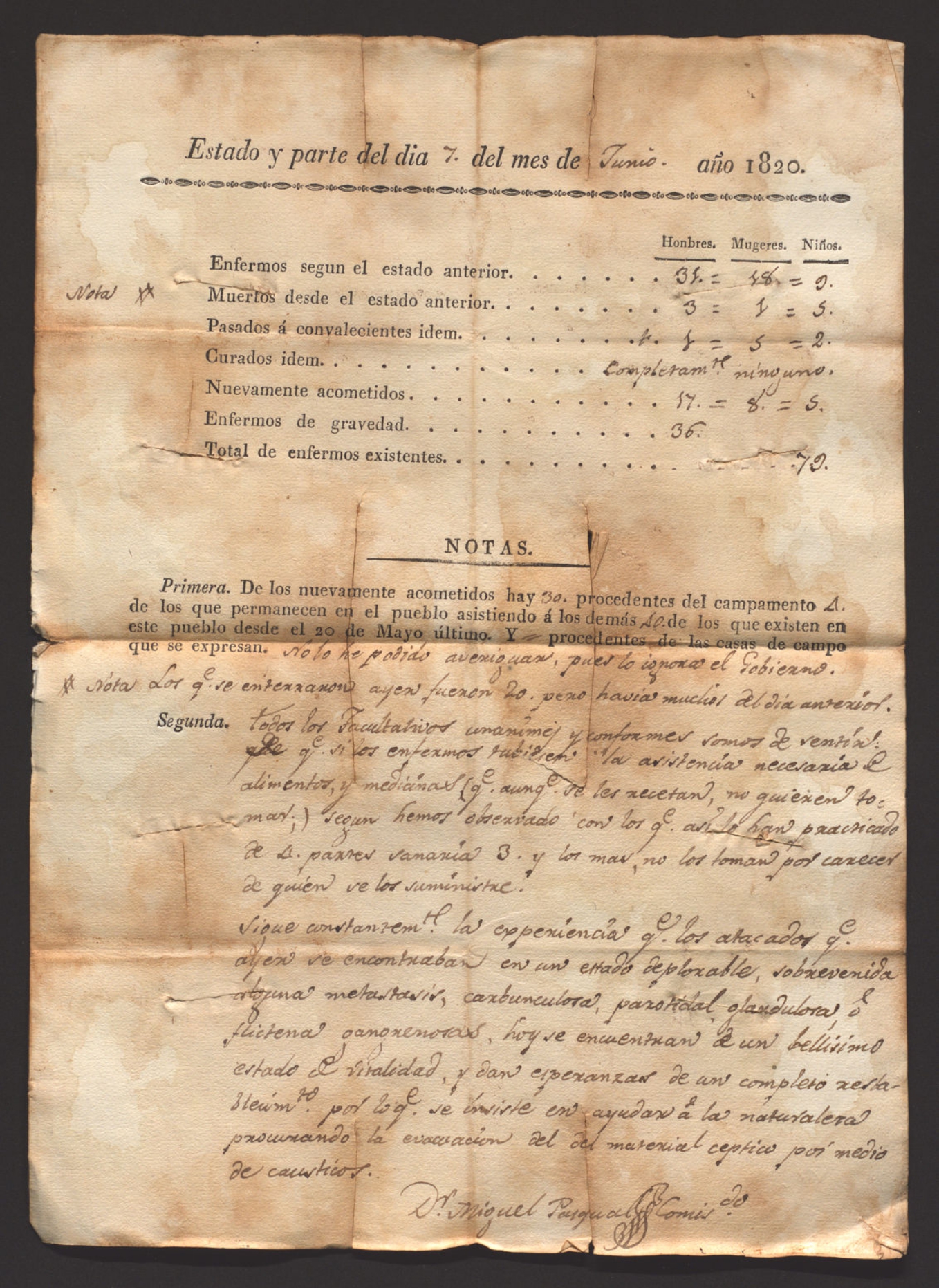
The study is based on a previously unexamined daily historical record that systematically tracked the number of sick, deceased, convalescent, and recovered patients throughout the outbreak. By combining this historical documentation with advanced quantitative methods, the research provides new insights into the nature of the outbreak and offers a better understanding of how plague epidemics unfolded before the causative bacteria were known. It thus helps link historical evidence with current knowledge regarding disease transmission.
It also demonstrates the value of combining mathematical and statistical modelling with archival sources to reconstruct the ecology of past diseases and improve the understanding of pathogen transmission in historical populations.
Original article: Puig, P., & Pujadas-Mora, J. M. (2026). The 1820 Mallorca plague was not a classic bubonic outbreak. Proceedings of the National Academy of Sciences https://doi.org/10.1073/pnas.2536892123