The UAB defends transfer in social sciences and humanities as a driver of social impact
On 16 April, the conference hall of the Rectorat building hosted the 2nd Conference on Knowledge Transfer in Social Sciences and Humanities, a meeting that served to share experiences, tools and collaboration models aimed at strengthening the social impact of research in this field.
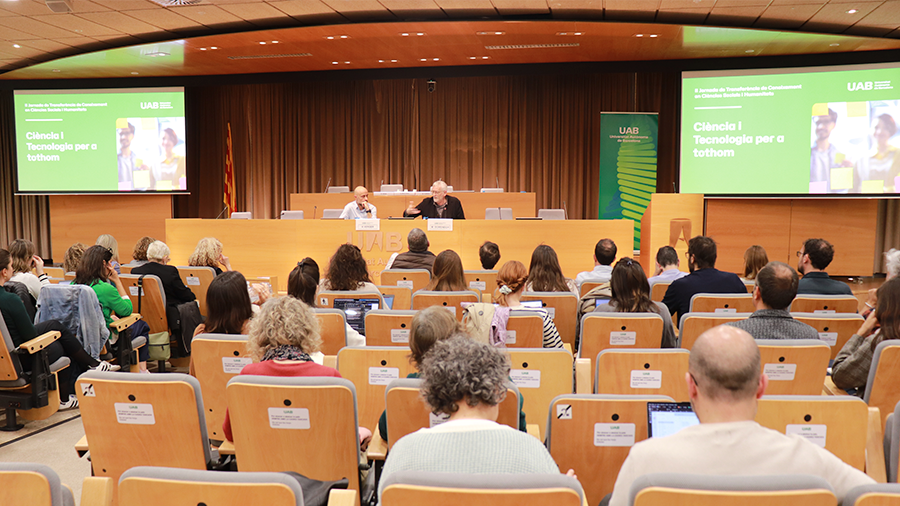
With the slogan "From research to impact: services, networks and transfer routes in social sciences and humanities" the conference demonstrated that transfer in these areas takes diverse and complementary forms: research networks, collaboration with the public sector and business, the development of applied tools, and influence in standardisation processes, to name a few.
The session was opened with the participation of Lourdes Puigbarraca, deputy general director of Knowledge Transfer and Society of the Department of Research and Universities of the Government of Catalonia, and Rosa María Sebastián, vice-rector for Innovation, Transfer and Entrepreneurship of the UAB, who placed the conference within the framework of the institutional commitment to strengthen the connection between research and society, and to make visible all forms of transfer that are generated from the social sciences and humanities.
In her speech, Lourdes Puigbarraca claimed the strategic role of this field in the knowledge system and emphasised that “transfer in social sciences and humanities is dialogue, co-creation, listening and transformation”. She also emphasised that transfer should not be understood as a final phase of research activity, but as a logic that runs through the entire process of knowledge generation: “Transfer is not the end of research; it is a way of doing research”.
Following that, Rosa María Sebastián highlighted the need to continue expanding the institutional recognition of transfer in social sciences and humanities, and to make visible everything that is already being done in this area. She insisted that the university must work in a bidirectional manner with its environment: "We must know how to listen and build together with society, because social challenges are outside".
The first part of the day was dedicated to presenting the UAB services and units that support transfer. The day thus showed the internal ecosystem that accompanies research groups on this path: the protection of research results and their valorisation, the COREs and the Open Innovation Laboratories (UAB Open Labs) to address social challenges from open innovation, and support for entrepreneurship, to help connect with companies or the public administration to generate projects, including legal and administrative support for these collaborations.
The conference then focused on the role of R&D&I networks as drivers of transfer. Nadal Bayà Fons, head of the Knowledge Transfer Area at AGAUR, opened this block by highlighting the strategic value of networks in the research and innovation ecosystem, especially when it comes to connecting the capabilities of research groups, bringing out opportunities and multiplying the impact of results.
In this sense, Anna Matamala, lecturer of the Department of Translation and Interpreting and East Asian Studies, presented AccessCat, the innovation network in accessibility of Catalonia which is coordinated by the UAB. In her speech she pointed out the consolidated experience of transfer in social sciences and humanities, articulated around the accessibility of information and communication. The network brings together 22 research groups and has developed a catalogue with 10 technologies, 22 services and 35 open educational resources, in addition to training, awareness-raising, internationalisation and work activities in the field of standardisation.
Also in this block, Maite Melero, from the Barcelona Supercomputing Center – National Supercomputing Center, presented CLARIAH-CAT, a recently created multidisciplinary Catalan network to promote the valorisation and transfer of research results in digital humanities to society as a whole. Melero emphasised the actions being prepared to connect research, cultural industry and technology, and the training they develop in areas such as digitisation, language processing, data visualisation, geospatial analysis, and access to European and supercomputing infrastructures. In the same session, Joan Anton Barceló, lecturer from the Department of Prehistory at the UAB, reinforced this idea and emphasised the opportunities offered by networked research to open up new interdisciplinary projects and new transfer routes in the field of digital humanities.
The second part of the day revolved around the relationship between the university and the public sector, with two experiences aimed at showing transfer as a process of collaboration and co-creation. Antoni Verger, professor of Sociology at the UAB and ICREA researcher, presented the ACCOUNTED project, focused on the field of collaboration in educational policies, a case that exemplifies how research can contribute to responding to public challenges from a logic of application and utility. Miquel Domènech, director of the Department of Social Psychology at the UAB, gave the presentation “Science and technology for everyone and with everyone”, in which he focused on accessibility, inclusion and the need for innovation to take into account the diversity of uses and recipients.
The block dedicated to transfer capabilities, methodologies and tools allowed these reflections to be grounded in two specific examples. Researcher Mireia Farrús presented SCRIBAL, a digital transcriber for teaching linked to the field of language technologies and accessibility, which was the tool used during the conference. Alexandra Bretones, researcher at the Department of Geography of the UAB, explained Urbametrics, an initiative that simplifies complex urban and regional data to facilitate decision-making. The two researchers explained the path leading to the transfer of these tools, and these contributions showed how the transfer also takes shape in products, methodologies and applied services that are born from research and are projected into real contexts.
The day continued with a block focused on collaboration between university and business. Beatriz Ferrús, director of the UAB School for Doctoral Studies, presented industrial doctorates as a consolidated transfer tool. The UAB has 69 PhD programmes, of which 37 correspond to the field of social and legal sciences, arts and humanities, and Ferrús highlighted the evolution in the number of theses within the industrial doctorate programme and agreements signed in recent years.
In this same block, lecturer of the Department of Public Law and Historical and Legal Sciences of the UAB Roser Martínez presented the case of an industrial doctorate between the UAB and TÜV Rheinland on preventive management of systemic risks, as an example of sustained collaboration between academic knowledge and the professional environment. Xavier Roda Gilabert, postdoctoral researcher in the Department of Prehistory of the UAB, presented PREHISTOPIRINEO, an initiative that proposes transferring heritage through immersive experiences. The project, linked to Roca dels Bous Immersive, proposes the use of virtual reality and serious games to make prehistoric heritage understandable to non-specialist audiences. The presentation also put on the table the learnings of this type of collaboration: access to new technologies, funding and contracting possibilities, but also the challenges derived from the alignment between tempos, languages and expectations of the university and the company.
The final special session, led by Anna Matamala, addressed standardisation as a transfer tool, an idea that is particularly relevant because it expands the usual conception of transfer beyond commercialisation or the creation of companies. In her presentation, she argued that standards and norms constitute a clear path to valorisation of knowledge, because they allow research results to be transferred to reference frameworks that guide products, services and policies. Matamala presented examples related to accessibility standards in organisations such as the International Organisation for Standardisation (ISO), the Spanish Association for Standardisation (UNE), the European Committee for Standardisation (CEN), the European Committee for Electronic Standardisation (CENELEC), the European Telecommunications Standards Institute (ETSI), and the International Telecommunication Union (ITU), as well as the participation of the UAB in the committees that discuss regulations.
The day ended with a final space for exchange and questions and with the institutional closing by Rosa María Sebastián. Overall, the day reinforced an idea shared throughout all the sessions: that transfer in social sciences and humanities is plural, relational and transformative, and that it can be embodied in services, networks, methodologies, collaborations, public policy instruments, standards, and business projects. The conference thus served to show the potential of these areas in generating a tangible impact and consolidating a broader and more precise view of what it means to transfer knowledge from social sciences and humanities.