The Faculty of Law launches the Master's Degree in AI and Digital Law and hosts the first REEL-WIDE seminar on human trafficking in digital environments
The event "AI and transnational crime: technology, trafficking and Criminal Cooperation in Europe", also marked the official launch of the Master's Degree in Artificial Intelligence and Digital Law and brought together experts from the United Nations, the technology sector and the Mossos d'Esquadra.
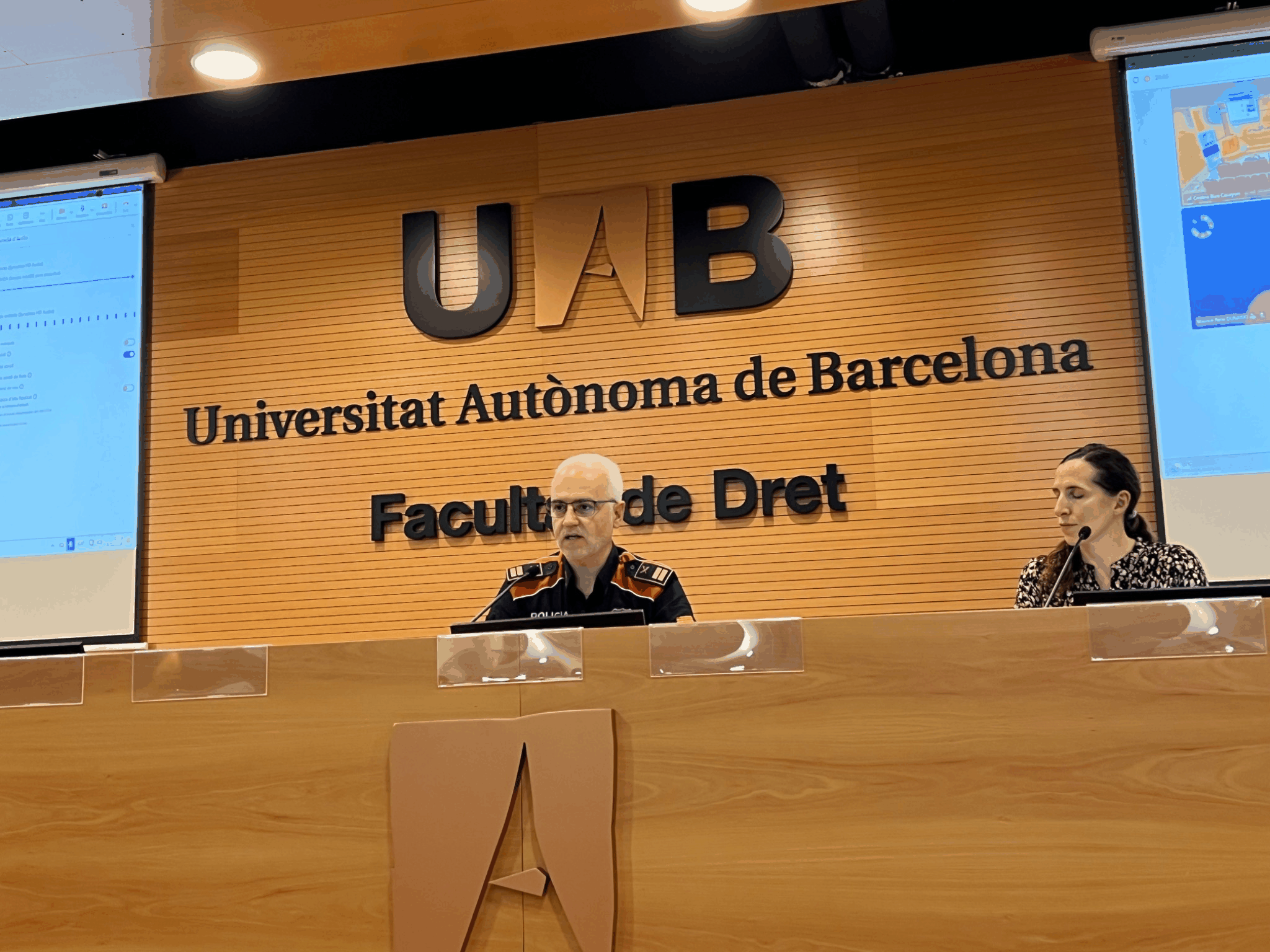
On Monday, 2 November, the Sala de Graus of the UAB Faculty of Law hosted the event "AI and transnational crime: technology, trafficking and Criminal Cooperation in Europe", the first seminar of the REEL-WIDE project (European Legal Responses to the Trafficking of Women in Digital Environments). The event also served as the official launch of the Master's Degree in Artificial Intelligence and Digital Law (MIADD).
The seminar featured three speakers:
- Dr Maurice Dunaiski, from the Data, Analytics and Statistics Section of the United Nations Office on Drugs and Crime (UNODC)in Vienna.
- Ramsés Gallego, Chief Technologist.
- Commissioner Miquel Àngel Garcia Alvira, of the Mossos d'Esquadra.
The presentations provided context for understanding how human trafficking has evolved within digital environments. From the UNODC perspective, it was highlighted that criminal networks are increasingly using digital tools to recruit, control and exploit victims; that administrative records reveal only "the tip of the iceberg"; and that there is still no systematic global data collection capable of measuring the extent to which trafficking is facilitated by technology. For example, administrative data from Germany presented during the seminar showed that the proportion of victims recruited online increased from less than 15% in 2021 to 26% in 2024.
For the REEL-WIDE project, this seminar marks the starting point of the research. The documentation and information-gathering process will enable to obtain results and analyse the phenomenon from different perspectives with the participation of specialists in both data analysis and human trafficking to develop and complete the research.
REEL-WIDE is an RDI project led by the UAB in collaboration with the University of Girona and CIDOB. The research team would like to thank all three speakers for their contributions.
RDI Project "European Legal Responses to the Trafficking of Women in Digital Environments" (REEL-WIDE), reference PID2025-174401NA-I00, funded by MICIU/AEI/10.13039/501100011033.