
New article: “Super‐Selectivity versus Affinity‐Driven Targeting in Oncological Nanomedicine”
Research group: Nanobiotechnology
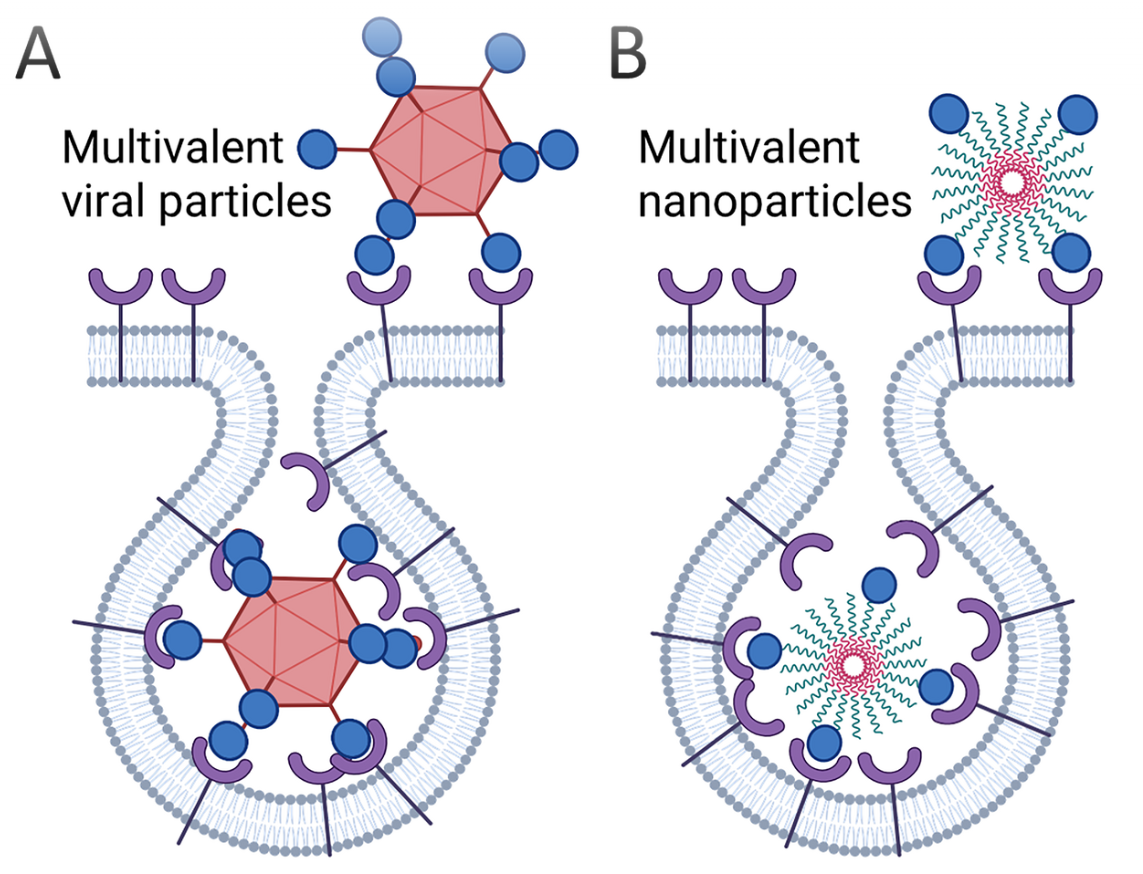
Summary:
Developing functional nanomaterials for targeted drug delivery remains a major goal of nanomedicine, particularly in oncology, where cytotoxic drugs often cause severe systemic toxicity. Most nanoparticle-based strategies rely on surface ligands that bind receptors overexpressed on diseased cells. However, these receptors are rarely exclusive to tumors but frequently present in healthy tissues. As a result, decades of efforts to improve targeting by increasing ligand affinity have produced only limited clinical benefits.
Affinity-driven targeting generally leads to gradual, receptor density-dependent binding, resulting in suboptimal biodistribution, off-target accumulation, and dose-limiting toxicity. Recent advances in nanomaterial engineering suggest an alternative paradigm inspired by viral infection. Rather than relying on high-affinity interactions, viruses often exploit multivalent arrays of weak ligands to achieve highly selective cell recognition.
Mimicking this strategy, synthetic nanoparticles can display spatially organized low-affinity ligands whose cooperative interactions produce super-selective binding, only above a critical receptor density. By tuning ligand valency, nanoscale geometry, and linker flexibility, these virus-inspired nanostructures convert small differences in receptor abundance into sharp threshold-like binding responses. Integrating multivalent recognition with rational nanomaterial design therefore offers a promising strategy to improve tissue discrimination and to achieve super-selective, rather than merely targeted, drug delivery.
Article data:
U. Unzueta, E. Parladé, R. Mangues, E. Vazquez, and A. Villaverde, “ Super-Selectivity versus Affinity-Driven Targeting in Oncological Nanomedicine.” Small (2026): e75777.
The UAB, with the Sustainable Development Goals
-
 Good health and well-being