
New article: "AGGRESCAN and its evolution: A two-decade perspective on protein aggregation prediction"
Research Group: Protein Folding and Conformational Diseases
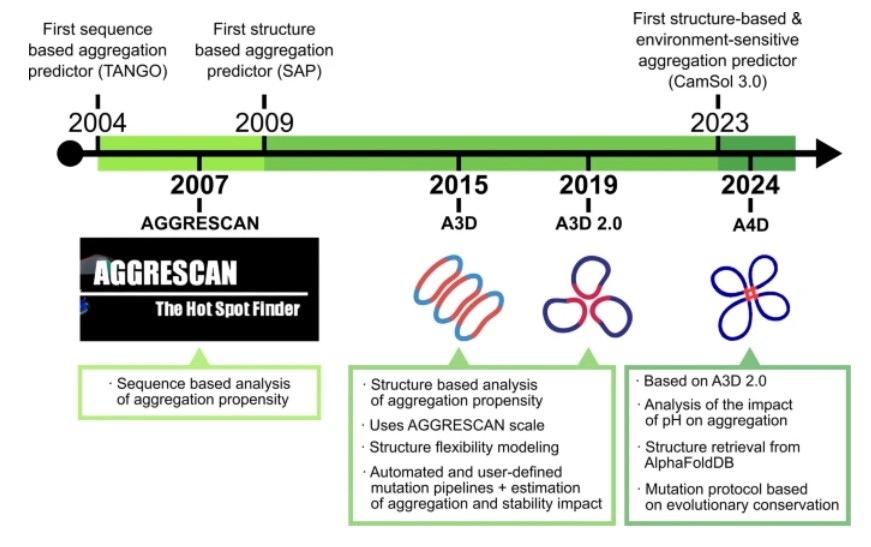
Abstract:
Protein aggregation is a widespread phenomenon with profound biological, biomedical, and biotechnological implications. In human disease, aberrant protein self-assembly is a hallmark of numerous neurodegenerative disorders, whereas in the biopharmaceutical industry, aggregation complicates the production, stability, and formulation of therapeutic proteins. The Aggrescan platform was one of the first empirically based tools designed to predict aggregation-prone regions (APRs) within protein sequences. It has since expanded to incorporate three-dimensional structural contexts and environmental conditions. This review provides a comprehensive overview of the development, application, and impact of the Aggrescan family of tools, which includes AGGRESCAN, Aggrescan3D, and the recent Aggrescan4D. We examine the algorithmic foundations, empirical validation, and key use cases spanning fields from biotechnology to biomedical research. Additionally, we describe how the recent integration of AlphaFold models has enabled proteome-scale exploration of aggregation determinants. This review highlights how Aggrescan has evolved alongside with advances in the field, becoming a reliable and accessible tool for studying and redesigning protein aggregation.
Article data:
Giulia Pesce, Oriol Solé, Oriol Bárcenas, Salvador Ventura. AGGRESCAN and its evolution: A two-decade perspective on protein aggregation prediction. Biophys Rev (2026). https://doi.org/10.1007/s12551-025-01404-9
The UAB, with the Sustainable Development Goals
-
 Good health and well-being