
New article: "Synaptic proteome diversity is shaped by the levels of glutamate receptors and their regulatory proteins"
Work led by researcher Àlex Bayés, from the IR Sant Pau, who has had the collaboration of Nerea Roher and Oriana Zerpa-Rios (Research Group: Evolutionary Immunology)
Abstract:
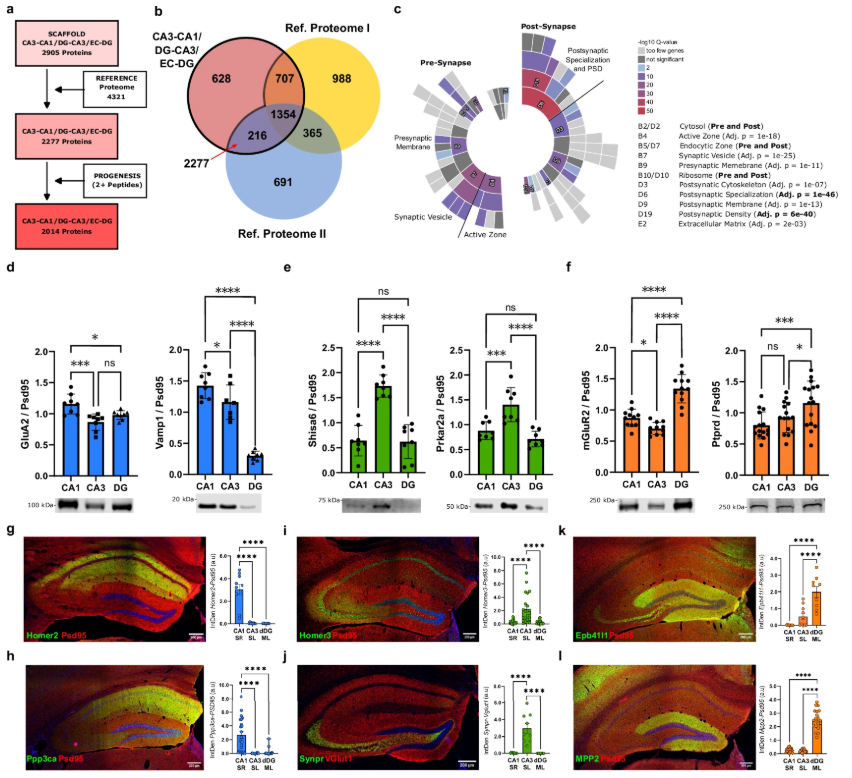
Synapses formed by equivalent pairs of pre- and postsynaptic neurons have similar electrophysiological characteristics, belonging to the same type. However, these are generally confined to microscopic brain regions, precluding their proteomic analysis. This fact has greatly limited our ability to investigate the molecular basis of synaptic physiology. We introduce a procedure to characterise the synaptic proteome of microscopic brain regions and explore the molecular diversity among the synapses forming the trisynaptic circuit in the mouse hippocampus. While we observe a remarkable proteomic diversity among these synapses, we also report that proteins involved in the regulation of the function of glutamate receptors are differentially expressed in all of them. Moreover, neuron-specific gene expression programs would contribute to their regulation. Here, we introduce a combined proteomics and transcriptomics analysis uncovering a previously unrecognized neuron-specific control of synaptic proteome diversity, directed towards the regulation of glutamate receptors and their regulatory proteins.
Article data:
Reig-Viader, R., del Castillo-Berges, D., Burgas-Pau, A. et al. Synaptic proteome diversity is shaped by the levels of glutamate receptors and their regulatory proteins. Nat Commun 16, 10487 (2025). https://doi.org/10.1038/s41467-025-65490-9
DOI: 10.1038/s41467-025-65490-9
The work has been led by the researcher Àlex Bayés, head of the Molecular Physiology of the Synapse research group at the Institut de Recerca Sant Pau (IR Sant Pau), with the collaboration of Nerea Roher and Oriana Zerpa-Rios. You can read the full news by clicking here.
The UAB, with the Sustainable Development Goals
-
 Good health and well-being