Energy consumption
Evolution of energy consumption
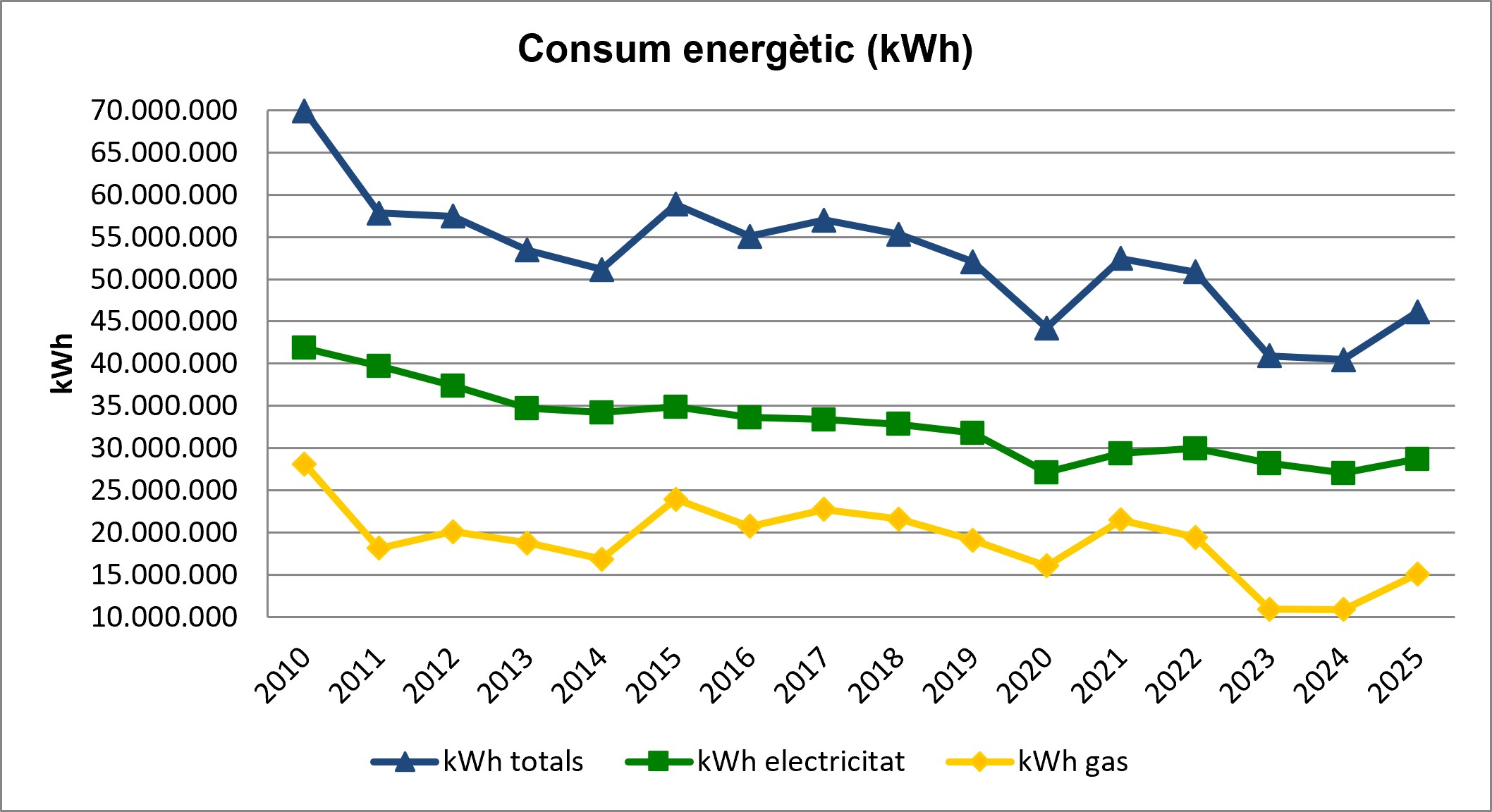
In 2025, there was a 13% increase in overall energy consumption, mainly due to less favourable weather conditions compared with the previous year. As for electricity, the increase was 6.2% (1,664,517 kWh), and for gas it was 38.8% (4,179,746 kWh) compared to the previous year in both cases. Energy expenditure has increased by 11% compared to 2025.
Emissions associated with this consumption (emissions attributable to gas, diesel and biomass, but not from the electricity consumed at the UAB, as this comes from certified renewable energy sources with a guarantee of origin) have increased by 38.5% compared to last year.
Renewable energy production in 2025 stood at 1,676,919 kWh, representing 3.7% of the UAB’s total energy consumption (electricity and gas).
Summary of total UAB consumption for the year 2025
Summary of total UAB consumption for the year 2025.
In 2025, renewable energy production at the UAB totalled 1,676,919 kWh. This represents 3.7 per cent of the UAB’s total energy consumption (electricity and gas).
In 2025, the technology that provided the highest level of renewable energy production was the biomass boiler, accounting for 52 per cent, followed by biomass, solar photovoltaic energy at 36 per cent of the total, geothermal energy at 9 per cent and solar thermal energy at 3 per cent.
It is worth noting that there has been a significant reduction in renewable energy generation from biomass at the Physical Activity Service (SAF), due to a fault in the installation. This incident has led to greater reliance on conventional sources, particularly natural gas, to meet energy demand.
Meanwhile, photovoltaic solar energy output is increasing as new photovoltaic solar plants come on stream. In particular, in 2025, the photovoltaic installations corresponding to Phase 2 of the Medicine Faculty and the SAF Sports Centre became operational.