
New article: “The hidden consequences of marine heatwaves: rising Vibrio risk in European coastal waters”
Research group: EDGE Lab
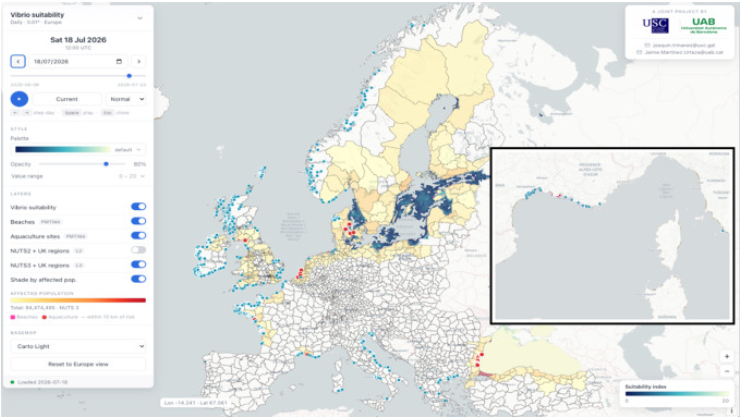
Summary:
Climate change is causing ocean temperatures to rise, creating more favorable conditions for the growth of Vibrio bacteria. These bacteria can cause serious infections, especially in older and vulnerable people. Marine heatwaves are increasing this risk, including in some coastal areas of southern Europe and the Mediterranean, although the overall risk of infection in the Mediterranean remains low and is concentrated in specific coastal areas.
To monitor this situation, researchers have developed a European tool that uses sea temperature and salinity data to identify areas where conditions are favorable for Vibrio growth. The tool provides five-day forecasts that can help public health authorities and the public take preventive measures. Finally, the article emphasizes that although these tools can help reduce the risk, the long-term solution is to reduce greenhouse gas emissions and slow down climate change.
Article data:
Jan C. Semenza, Joaquin A. Trinanes, Jaime Martinez-Urtaza. The hidden consequences of marine heatwaves: rising Vibrio risk in European coastal waters. The Lancet Regional Health - Europe, 2026, 101838, ISSN 2666-7762. https://doi.org/10.1016/j.lanepe.2026.101838.
The UAB, with the Sustainable Development Goals
-
 Good health and well-being