
New article: “GFP-like protein scaffolds for antigen grafting: Soluble and stable neoantigen display in mammalian-compatible platforms”
Research Group: Nanobiotechnology
Abstract:
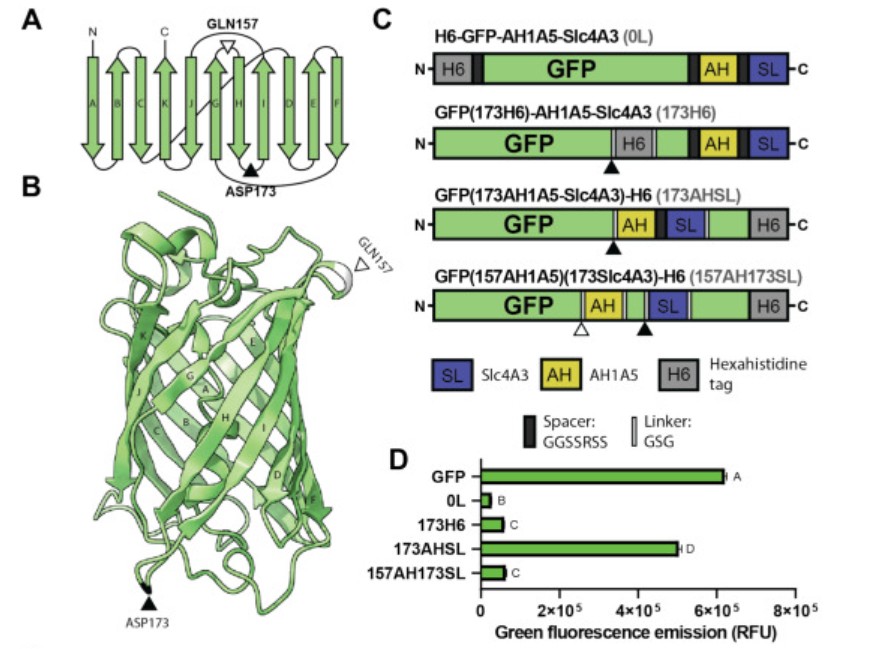
Subunit vaccines are often limited by poor solubility and structural instability, affecting their ability to induce strong immune responses. Scaffold-based antigen display offers a promising solution, but translating designs into stable, scalable proteins remains challenging. Here, we present a pipeline for selecting and inserting tumor-derived peptide sequences into β-barrel protein frameworks, using both GFP and the structurally similar G2 domain of the mouse nidogen. We validate the ASP173 loop in GFP as an effective insertion site, accommodating a double-peptide construct, as well as two distinct single peptides, without compromising folding or fluorescence. We further show that this design logic extends to the mouse nidogen G2 domain, which we employ as a host-native scaffold to carry the inserted epitope. The resulting constructs retain structural integrity and thermal stability, supporting their use in preclinical models and facilitating future applications in human health. This work establishes a modular, mammalian-compatible platform for stable tumor-associated peptide presentation, thereby advancing the development of next-generation cancer vaccines.
Article data:
Eloi Parladé, Marianna T.P. Favaro, Sara Chellou-Bakkali, Eric Voltà-Durán, Hèctor López-Laguna, Antonio Villaverde, Esther Vázquez. GFP-like protein scaffolds for antigen grafting: Soluble and stable neoantigen display in mammalian-compatible platforms. Biomaterials Advances (2026). 214839, ISSN 2772-9508. https://doi.org/10.1016/j.bioadv.2026.214839
The UAB, with the Sustainable Development Goals
-
 Good health and well-being