
New article: “HLA-DRB1 Allelic Combinations Differentially Shape Dendritic Cell Antigen Presentation Enhanced by Tumour Cell Line Lysate-Pulsing”
Research groups: Biosensing and Bioanalysis, Cellular Immunology
Abstract:
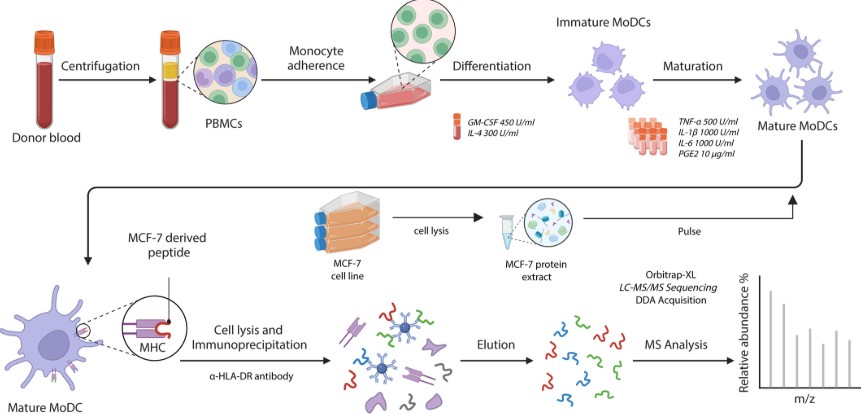
The anti-tumour immune response plays a pivotal role in eliminating tumour cells, with the presence of tumour-infiltrating lymphocytes (TILs) often correlated with improved patient outcomes. Among these, CD4+ T lymphocytes act as key orchestrators of the immune response, functioning as effector and regulatory cells, and are essential for establishing immunological memory.To better understand the role of CD4+ T cells in anti-tumour immunity, we analysed the HLA-II immunopeptidome of dendritic cells (DCs) from HLA-heterozygous donors pulsed with a protein extract from the MCF-7 tumour cell line. Our objective was to identify differences in the arrays of peptides binding distinct HLA-DRB1 allele combinations and the effect of DC pulsing on peptide presentation. We found that presented peptide repertoires are strongly influenced by HLA-DR heterozygosity in an allelespecific manner. Alleles with high binding strength (e.g., DRB1*01:01, DRB1*03:01 and DRB1*04:04) tended to dominate peptide presentation; however, this dominance is significantly modulated by the allelic combination, suggesting that antigen presentation is shaped not only by individual allele properties but also by their combinations. Pulsing DCs with MCF-7 extracts increased peptide overlap between donors and enabled the identification of 58 proteins putatively derived from the tumour cell line lysates.Interestingly, peptide presentation from these proteins reinforced allele-specific features of dominance and weakness previously observed across the entire immunopeptidome. Gaining insights into the peptide repertoire presented by distinct HLA-DR combinations could inform the design of personalised immunotherapies based on peptide-pulsed DCs, ultimately enhancing CD4+ TIL responses across diverse patient populations.
Article data:
Gonzalo Lázaro, Juan A. Cedano, Maitane Faus, Carme Roura-Mir, Laia Garrigós, José Pérez-García, Javier Román-García, Javier Cortés, Andrea Aran, Mercè Martí. HLA-DRB1 Allelic Combinations Differentially Shape Dendritic Cell Antigen Presentation Enhanced by Tumour Cell Line Lysate-Pulsing. HLA 107, no. 2 (2026): e70563.
DOI: 10.1111/tan.70563
The UAB, with the Sustainable Development Goals
-
 Good health and well-being