Introduction
The water cycle and management on the UAB campus.
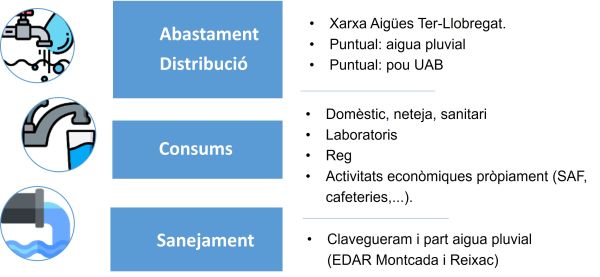
Water is an essential but limited resource. Although it covers much of the planet, only a small fraction is available as fresh water, and in the Mediterranean its availability is particularly irregular. It is therefore important to understand both the natural water cycle — evaporation, precipitation, infiltration and return to rivers and aquifers — and the artificial cycle that occurs in urban and university environments.
At the UAB, the water used by the Bellaterra campus centres comes mainly from the Ter–Llobregat system, through the Aigües de Barcelona network, with occasional contributions from well water, recycled water from cleaning the swimming pool filters and rainwater recovered on the campus itself. Wastewater is channelled through the Eje Central collector and other branches, which ultimately carry the water to the Montcada i Reixac treatment plant, where the urban cycle is completed. As for the streams on campus, their flow comes mainly from surface runoff during rainfall.
Understanding how water arrives on campus and how it is managed helps to better understand annual consumption and the measures that have been implemented to reduce it. All of this is part of the Water Use Rationalisation Plan, which sets out the campus's lines of work and savings targets.
See the Water Plan (in Catalan): Water use rationalisation plan at the UAB