Actuacions
Measures for sustainable water management
Since 2023, the UAB has been rolling out a growing range of initiatives to optimise water use, reduce drinking water consumption, modernise infrastructure and move towards a more resilient water management model that is in harmony with the natural environment. These measures form part of the Water Use Rationalisation Plan and respond both to episodes of drought and to a long-term sustainability strategy.
Water management on campus is not just a matter of saving water: it is also a key factor for biodiversity and ecological quality. Reducing consumption, creating retention ponds and adapting green spaces contribute to a more resilient campus that is better prepared for new climate scenarios.
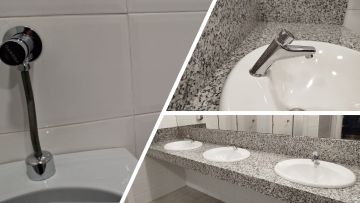
- Refurbishment of fixtures in campus buildings
The UAB has progressively replaced 1,010 flush valves, 480 urinal flush buttons and 1,230 washbasins tap with high-efficiency units. This change significantly reduces water consumption in toilets, one of the main areas of demand. The estimated saving is 35 million litres per year.
- Network improvements and smart monitoring
Sections of the distribution network are being renovated when leaks are detected. The implementation of smart monitoring systems provides real-time consumption data and detects anomalies.
- Use of alternative water sources
The assessment of non-potable water sources for compatible uses on campus, such as rainwater or other alternative sources, is continuing. Although there is no active drought in 2025, the UAB remains committed to reducing its consumption of drinking water and adapting to new climate scenarios.
- Consumption and results
In 2024, the UAB consumed 129 million litres of water, a reduction of 10.5% compared to 2023. This consumption is equivalent to that of a town of 2,200 inhabitants with a consumption rate of 160 litres per person per day. Emissions associated with water consumption stand at around 50 tonnes of CO₂ equivalent.
- Infrastructure and monitoring improvements
A tender was prepared to replace taps, showers and aerators, and new meters were installed to improve understanding of the network’s operation and detect leaks.
- Management of vegetation and outdoor spaces
During the emergency phase of Catalonia’s Drought Plan:
-Irrigation using mains water was suspended
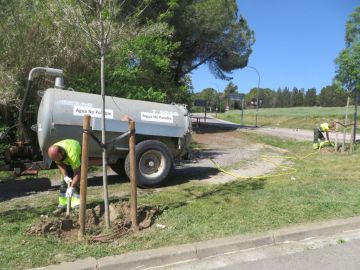
- Only essential irrigation for trees was maintained, using water from the cleaning of the SAF swimming pool filters or well water.
- Other measures:
The flow rate for washbasins and showers was further reduced; the planting of 200 trees was temporarily halted to reduce water demand; and new remote-reading meters were installed.

- Reduction in consumption
The UAB consumed 146 million litres, a reduction of 50,000 m³ (25.1%) compared to 2022. These savings offset the cost of investments in infrastructure improvements and monitoring.
- Measures under the Drought Plan Reduction
-Elimination of sprinkler irrigation across 7 hectares (78% of the irrigated area).
-Reduction Irrigation limited to drip irrigation and tree survival zones.
-Reduction Closure of the SAF’s hot tub and suspension of irrigation of the football pitch.
-Reduction Elimination of outdoor cleaning using drinking water.
- Infrastructure improvements
-Reduction Adjustment of handbasin taps to 3 l/min.
-Installation of aerators in the SAF’s showers (from 8 l/min to 4 l/min).
-Repair of various leaks, notably the 7 m³/h leak at the School of Translation and Interpreting.
- Laboratories:
-Reduction in water use Reduced Installation of four closed-loop cooling systems, with an expected saving of 293,000 litres per year.
-A closed-circuit vacuum system was installed, preventing the continuous consumption of tap water.
- Data and planning
Installation of new remote-reading meters and initiation of discussions to obtain reclaimed water from the Sabadell Riu Sec treatment plant.
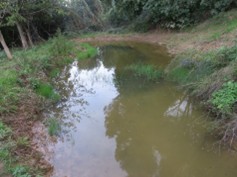
Water-saving and rationalisation measures have a direct impact on the campus’s biodiversity. Reducing drinking water consumption and opting for alternative resources eases the pressure on ecosystems and enables progress towards a more naturalised campus that is better adapted to climate change.
Some of the most notable initiatives include:
- Creating a natural pond on campus, which uses rainwater and provides a refuge for amphibians, insects and birds.
- Adapting green spaces with species more resilient to drought, reducing irrigation and increasing biodiversity.
- Reducing water-intensive areas and expanding areas of vegetation with low water requirements.
- Promoting alternative water sources for survival irrigation.