
The "Catalunya Barreja" knowledge-transfer conference highlights immigration, diversity and mixedness as constitutive facts of Catalan society
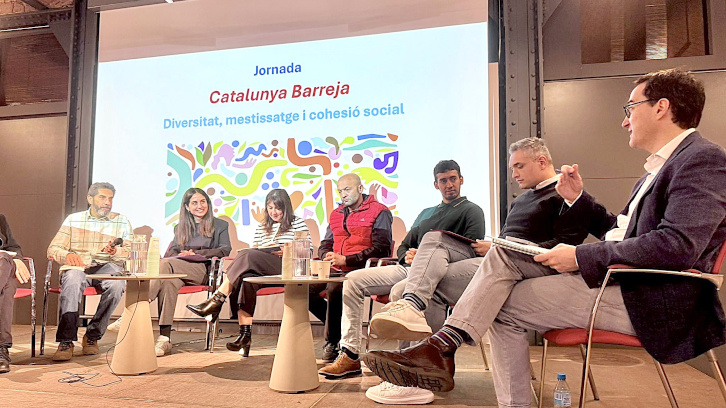
In a European context marked by the questioning of immigration, research into diversity and social cohesion becomes more necessary than ever. Last December, the INMIX research group of the UAB organized a conference to transfer to society the results of years of study on immigration, miscegenation and coexistence in Catalonia, and to open a wide debate between academics, administrations and civic organizations.
On December 17, 2025, the knowledge-transfer conference “Catalonia Mixes. Diversity, Mixedness and Social Cohesion” took place, organized by the Consolidated Research Group INMIX – Immigration, Mixedness and Social Cohesion of the Department of Social and Cultural Anthropology at the UAB, and directed by Professor Dan Rodríguez-García.
This important event was held at the emblematic Museum of the History of Catalonia and brought together academics and representatives from various public administration bodies and civil society organizations to discuss the realities of immigration, minorities, diversity, and cultural mixing as an intrinsic feature of Catalonia. Special emphasis was placed on the Roma community, in the context of the commemoration of the 600th anniversary of the arrival of the Roma people in Spain. The conference was funded by the R&D Challenges project of the Ministry of Science, Innovation and Universities, “Dynamics of Mixedness among the Roma Population of Catalonia: Interethnic Relations, Acculturation and Processes of Social Inclusion and Exclusion – GITMIX” (PID2020-116966RB-I00), led by Professor Rodríguez-García.
The aim of the conference was to promote a positive and proactive narrative capable of countering the reactionary, xenophobic, and racist discourse of the far right, which is dangerously growing across Europe. The conference also included the screening of the documentary Mixed Voices, produced by the INMIX-UAB group, and an open roundtable discussion in which several participants shared their personal life experiences. In this way, the conference created an increasingly necessary space for dialogue and collective reflection.
The event began with an institutional welcome delivered by Mr. Jordi Principal, Director of the MHC, followed by the participation of the following representatives from the administration and civic entities: Ms. Noa Monràs González (Director General for the Defense and Promotion of Human Rights, Department of Equality and Feminism, Government of Catalonia), Mr. Ramon Sanahuja Vélez (Department of Interculturality and Religious Pluralism, Barcelona City Council), Mr. Hatim Azahri (President of the Youth United Association of Poble-Sec), Mr. Aaron Giménez Cortés (Plan for the Roma People, Government of Catalonia), Mr. Pedro Casermeiro Cortés (Coordinator of the Virtual Museum of the Roma People), Mr. Ricard Valentí Gutiérrez (President of the Rromanipe’s Association), and Ms. Enérida Isuf (Coordinator of the Rromanipe’s Association, First Vice-President of the Municipal Council of the Roma People, and member of the Anti-Racist Advisory Council of Barcelona).
Participants shared reflections and personal perspectives that highlighted both the complexity and richness of contemporary Catalan society, fostering mutual understanding and pointing toward shared future paths. Overall, the event served as a platform to exchange experiences and ideas on how to build a more diverse, inclusive, and cohesive society.
Ten key ideas emerged from the conference:
- Catalonia has always been a society shaped by immigration, diversity, and cultural mixing. The majority (75%) of people living in Catalonia (8 million) are, directly or indirectly, the result of migratory processes and miscegenation. Far from weakening society, this reality has been essential to its demographic, economic, social, and cultural development.
- Despite the positive reality of immigration, diversity, and cultural mixing, racism, xenophobia, and discrimination remain persistent and structural in Catalan society, affecting daily life, educational trajectories, labor market integration, and sense of belonging—especially for immigrants from the Global South, Afro-descendant, Muslim, and Roma populations. Paradoxically, despite being born and socialized in Catalonia, many Catalans are not recognized as such.
- It is necessary to firmly combat discrimination and prejudice based on origin, ensuring that “social mobility” works for everyone; otherwise, it would lead to an ethnically segmented society, as seen in other countries.
- Anti-immigration, anti-diversity, and divisive sentiments (the “us” vs. “them” dichotomy) are always latent and emerge strongly in times of political and economic upheaval. This ideology is driven by fear—and in turn, promotes it.
- Diversity is not incompatible with social cohesion; on the contrary, equality depends on recognizing and including diversity within society. Building a cohesive society requires combating discrimination and racism at all levels, ensuring equal opportunities, and recognizing diversity as a collective strength rather than a threat.
- A key factor behind successful models of managing immigration and diversity is a positive and proactive vision—seeing immigration and diversity not as a problem, but as a challenge and an opportunity. At the same time, investment is essential to implement the necessary policies and actions.
- Human rights must be at the center of all policies aimed at combating discrimination, racism, and social inequality.
- Class is a fundamental dimension in managing interculturality. Most coexistence issues often attributed to cultural differences (origin, religion, etc.) are largely explained by economic factors (poverty, marginalization, and social exclusion). Therefore, promoting socioeconomic inclusion is a core axis of any intercultural policy.
- A comprehensive and cross-cutting approach is needed to combat xenophobia, racism, and discrimination in all their forms—from public administration (national, regional, provincial, municipal, and neighborhood levels); from educational institutions, research, and the media; and from civic organizations and associations.
- Awareness-raising actions are necessary, but also affirmative policies to promote the inclusion of members of minority groups across different sectors (media, public administration, education, healthcare, etc.), thus compensating for their underrepresentation due to historical structural barriers. In this regard, the lack of data collection on ethnic and cultural diversity in official statistical records represents a significant obstacle to making racism and discrimination visible and combating them.
In conclusion, these ten ideas all point in the same direction: diversity is not an obstacle to social cohesion, but a condition for achieving it. To make this possible, however, requires concrete policies, investment and the will to combat the structural inequalities that persist.
The program and the opening lecture of the conference can be accessed here:
https://doi.org/10.13140/RG.2.2.25733.82402/1.
And a short video summary of the conference is available here:
https://m.youtube.com/shorts/vazP30vfNso?si=13NMaVyM8ee7uWRj.
Information of the Director of the Conference:
Dan Rodríguez García
Serra Húnter Full Professor
Department of Social and Cultural Anthropology
Research Group on Immigration, Mixedness, and Social Cohesion - INMIX
Universitat Autònoma de Barcelona