1st International Digital Audiences Conference: Debates on Algorithmic Mediations and Political Socialization
Nearly 70 experts from universities and research centres across Europe and Latin America gathered in Barcelona for the 1st International Digital Audiences Conference to discuss the impact of algorithmic mediations on news consumption, political socialization, and the challenges digital platforms pose to democracy and citizenship.
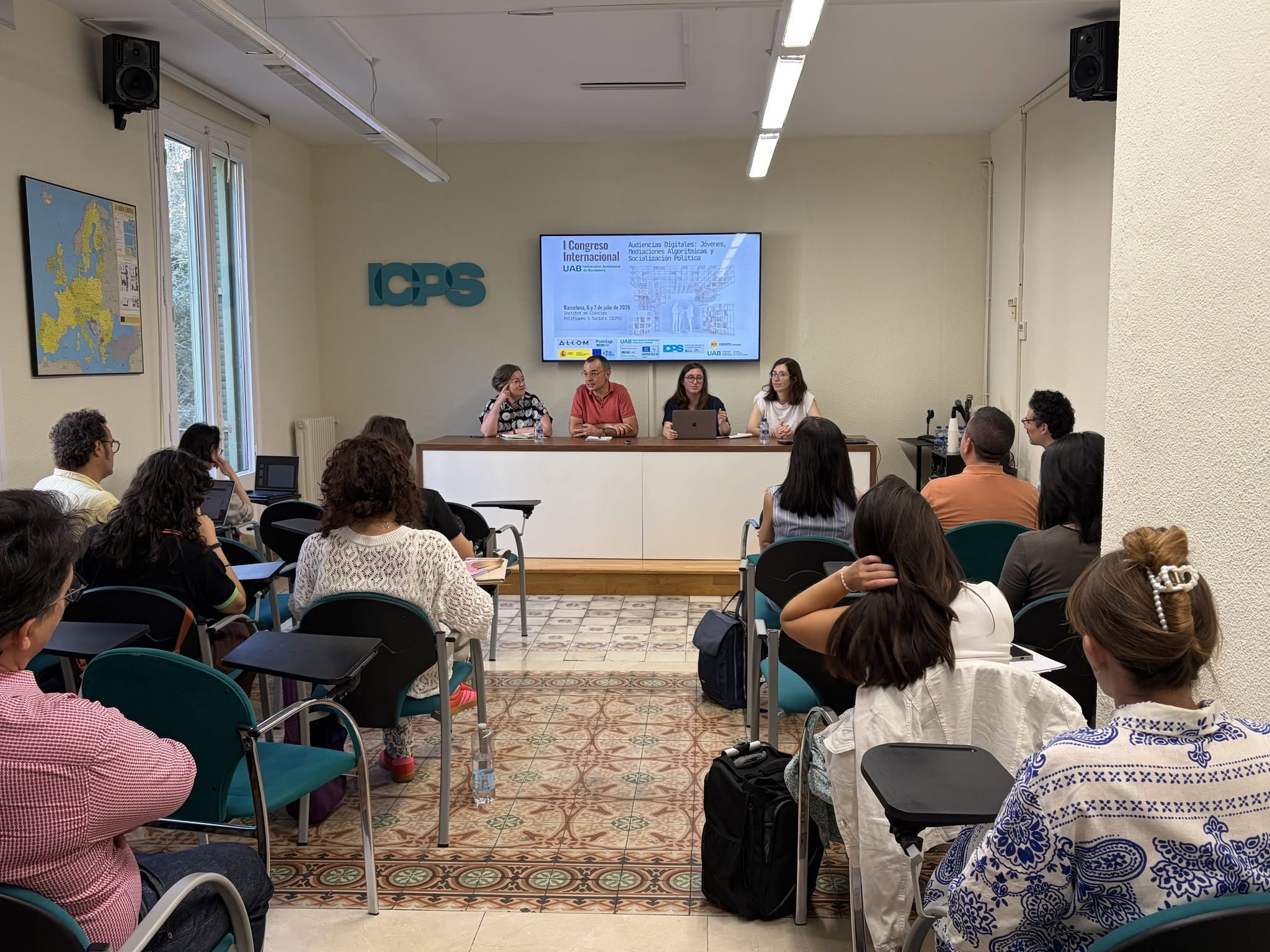
The 1st International Digital Audiences Conference, held on 6 and 7 July under the theme "Youth, Algorithmic Mediations and Political Socialization", brought together nearly 70 experts at the Institute of Political and Social Sciences (ICPS), located in the centre of Barcelona. Organised by the Universitat Autònoma de Barcelona (UAB), the event forms part of the 2026 programme of the UNESCO Chair in Communication, based at the Institute of Communication (InCom) and coordinated by researchers Amparo Huertas and Celina Navarro.
Arturo Arriagada, from the School of Communications and Journalism at Universidad Adolfo Ibáñez (Chile), opened the conference as the keynote speaker. In an engaging and accessible presentation, Arriagada highlighted key issues through thought-provoking reflections. One of the questions he posed to the audience was: "How are markets and culture produced through the work of audiences?" He reflected on visibility and authenticity, social imaginaries and cultural intermediations. Ultimately, he focused on what it means to have to "pass through the algorithm's filter in order to be visible."
The conference revolved around seven thematic areas: digital consumption, habits and practices; algorithmic experiences and mediations; political socialization; circulating content; gender and diversity; public debate and citizenship; and, finally, online radicalization. Discussion flowed across all sessions in an interconnected way. Regarding content, participants expressed concern about the quality of information and the ease with which false content continues to circulate thanks to artificial intelligence. From the perspective of audiences, discussions also addressed the self-deception involved in believing that users control the system when, in reality, algorithmic logic determines the content they receive through personalised recommendations. In the political sphere, the rise of the far right emerged as one of the main topics of discussion, particularly concerns about how its narratives are eroding the welfare state.
The 1st International Digital Audiences Conference was organised through two research projects at the Universitat Autònoma de Barcelona funded by the Spanish Ministry of Science, Innovation and Universities. These projects are Pointap (Social Polarization and Interculturality: Monitoring Political Current Affairs among Migrant and Native Youth from an Intersectional Perspective), led by Amparo Huertas (PID2021-125032OB-I00), and ALCOM (Perception and Knowledge Generation on Personalisation Algorithms in Digital Communication Platforms), led by Fernanda Pires and Celina Navarro (PID2023-1-48682OA-I00). While the former is affiliated with InCom, the latter is conducted within the Department of Audiovisual Communication and Advertising.
In total, the conference featured 32 presentations and brought together representatives from 21 institutions, most of them universities. In addition to research teams from UAB, participants also came from Universitat Pompeu Fabra, the University of Girona, the University of Barcelona, Blanquerna–Universitat Ramon Llull, ESIC Business & Marketing School Barcelona, Universitat Politècnica de València, the University of Valencia, the University of the Basque Country (EHU), the University of Vigo and the University of A Coruña. Latin American institutions included the Benemérita Universidad Autónoma de Puebla (Mexico), Escola Superior de Propaganda e Marketing (São Paulo, Brazil), Centro Universitario Adventista de São Paulo (Brazil), and the Federal University of Rio de Janeiro (Brazil). European institutions presenting research included Jagiellonian University (Poland), the University of Silesia (Poland), the London School of Economics and Political Science (United Kingdom), Universidade Católica Portuguesa (Portugal), and the Centre for Research in Information Sciences, Technologies and Architecture (Portugal).
Within UAB, in addition to the ICPS, the Faculty of Communication Sciences and the Department of Audiovisual Communication and Advertising also collaborated in organising the conference. This first edition of the International Digital Audiences Conference received the support of the Spanish Association for Communication Research (AE-IC).